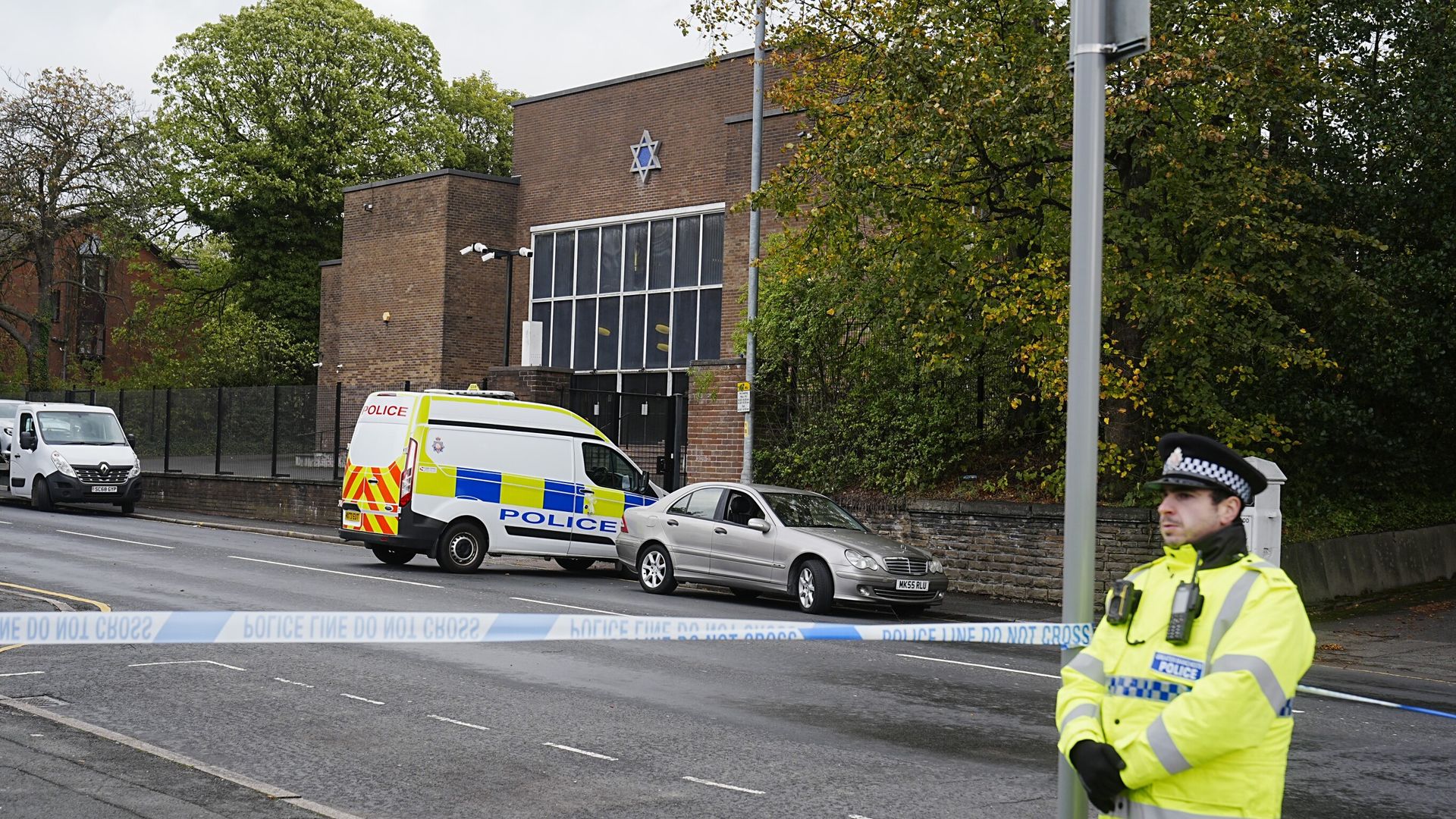
When Jihad Al-Shamie drove his car into the gates of the Heaton Park Hebrew Congregation Synagogue in Manchester and began a knife rampage on Yom Kippur, he did not operate in a vacuum. The October 2025 attack left two men dead—Melvin Cravitz and Adrian Daulby—and shattered the fragile security assumptions of Britain's Jewish community on their most solemn holy day. Months later, as courts hand down lengthy sentences to co-conspirators and prosecutors bring charges against accomplices for failing to disclose terrorist plots, a darker institutional reality emerges. This was a tragedy enabled by missed digital warnings, systemic institutional blind spots, and a counter-terrorism apparatus that often reacts only after blood has been spilled.
Security services and local police forces face severe scrutiny regarding what was known before Al-Shamie launched his assault. Greater Manchester Police later acknowledged a critical failure: investigators had failed to properly examine data seized from electronic devices belonging to Al-Shamie prior to the attack. Those devices contained significant, explicit evidence pointing directly to his radicalized mindset. Sitting in a police backlog while a radicalized actor mapped out mass murder, crucial intelligence went unread. Bureaucratic inertia proved lethal.
The conspiracy extended far beyond a lone actor radicalized in isolation. Court proceedings revealed deep networks of complicity that active intelligence gathering should have intercepted much earlier. Mohammad Bashir, a 31-year-old associate of the attacker, was sentenced to life imprisonment with a minimum term of 17 years after admitting to preparing acts of terrorism. Months before the synagogue attack, Bashir and Al-Shamie traveled across the country to conduct hostile reconnaissance on the UK Defence Academy in Oxfordshire, treating military installations as dry runs for synchronized jihadist violence. They traded more than 2,000 extremist messages on encrypted group chats over a six-month window, detailing plans for physical violence and murder. Yet, despite this high volume of extremist communication, the plot matured unchecked until an international flight landing at Manchester Airport intercepted Bashir returning from Pakistan.
Subsequent legal actions underline the sprawling nature of the conspiracy. Authorities charged Hekmat Omar Ali Hakim, a 49-year-old resident of Salford, with failing to disclose information regarding terrorist activity under anti-terrorism legislation. Hakim's arrest marked the first formal charge directly connected to the execution of the October 2 attack, pointing to a wider circle of acquaintances who watched radicalization unfold next door without alerting authorities. In communities across northern England, the unarticulated code of silence or sheer apathy among associates created an environment where violent extremists could plot openly.
The mechanics of the attack itself exposed the terrifying speed at which modern lone-wolf operations unfold. Armed with a knife and wearing a crude, non-viable fake explosive vest to maximize psychological terror and draw fire, Al-Shamie converted a vehicle into a battering ram. Worshippers inside the Heaton Park synagogue showed immense physical courage, holding heavy doors closed to prevent the assailant from breaching the main sanctuary where hundreds were gathered. In the chaotic seconds that followed, a tragedy compounded itself. Pathologists and law enforcement later confirmed that Adrian Daulby, one of the men heroically securing the doors, was fatally struck by a bullet discharged by armed police officers attempting to neutralize the terrorist. While police acted under extreme duress to stop an active mass casualty event, the admission highlights the grim calculus of urban counter-terrorism response, where split-second interventions carry horrific collateral risks.
Public officials offered the customary statements of solidarity following the bloodshed. Prime Minister Keir Starmer vowed increased police visibility and promised a national embrace of the traumatized community. Community security organizations, such as the Community Security Trust, noted that the massacre occurred against the backdrop of record-high antisemitic incidents across the United Kingdom following regional conflicts in the Middle East. Rhetoric from political leaders, however, rings hollow for families burying their dead when institutional reviews consistently reveal that digital evidence sat un-analyzed on police servers while a killer prepared his assault.
Preventing future atrocities requires confronting structural incompetence within intelligence pipelines. When digital forensic units are overwhelmed by data backlogs, encrypted extremist chatter becomes invisible noise rather than actionable threat intelligence. Until law enforcement agencies secure the staffing, technical capabilities, and analytical speed required to process seized electronics in real time, extremist networks will continue to exploit the gaps between digital footprints and boots on the ground.