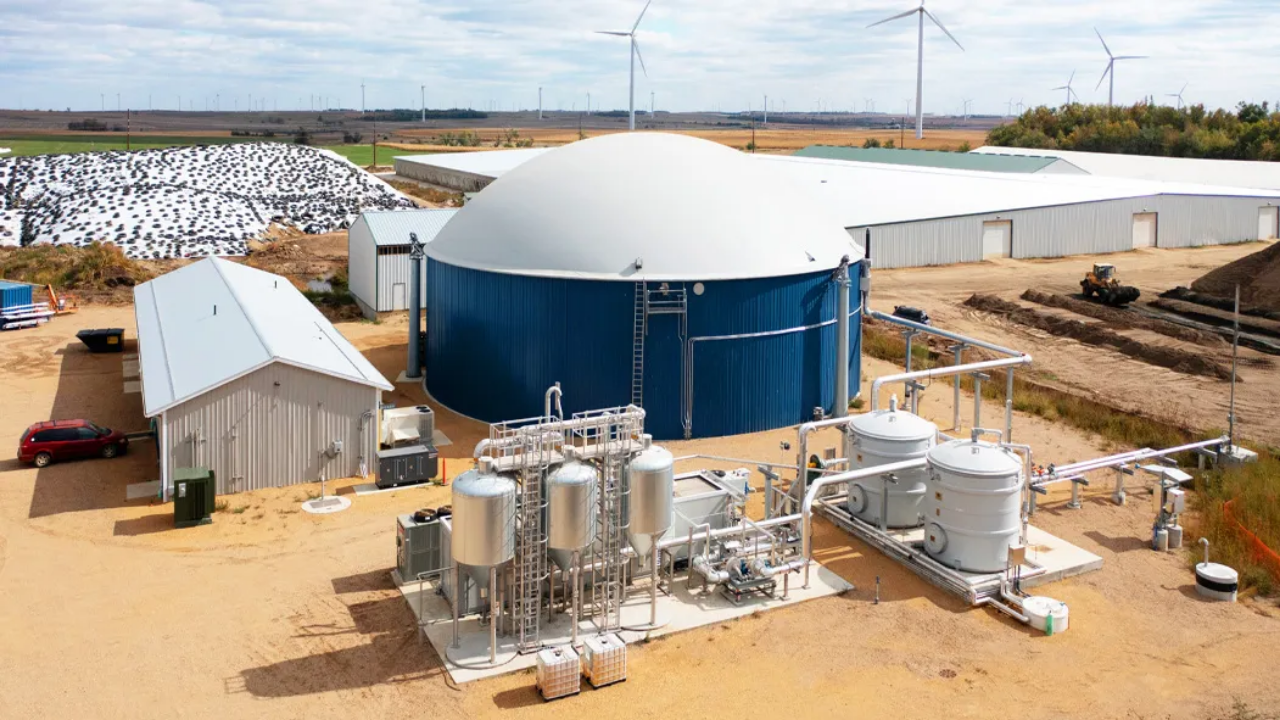
On a fifty-five-acre footprint in rural Lincoln County, Minnesota, a quiet industrial transformation is rewriting the economics of modern agriculture. Ash Grove Dairy houses more than two thousand milking cows, an operation that generates up to sixty thousand gallons of raw waste every single day. Instead of pooling that material into conventional open lagoons to off-gas unmitigated methane into the atmosphere, the farm funnels its slurry into sealed anaerobic digesters. This multi-million-dollar facility, built by Dynamic Renewables and backed by Clean Energy Fuels, captures raw biogas, strips out impurities like hydrogen sulfide and carbon dioxide, and injects pipeline-ready biomethane straight into interstate commercial grids.
The headline numbers look pristine. At peak output, the plant yields roughly 480,000 gasoline-gallon equivalents of negative carbon-intensity fuel annually. Commercial transit networks and long-haul freight lines snap up this fuel to satisfy strict low-carbon mandates. Yet behind the corporate press releases and environmental accolades lies a far more complex industrial reality. Turning livestock excrement into compressed vehicle fuel is not a simple green fairy tale. It is an expensive, heavily subsidized high-stakes engineering gamble with operational vulnerabilities that most public reports gloss over.
The Mechanical Reality Beneath the Slurry
To understand why projects like the Ash Grove installation draw massive capital, you have to look at the chemistry of decay. Raw manure sitting in open air naturally decomposes through methanogenesis. Methane packs a warming punch far more potent than carbon dioxide over a twenty-year horizon. By intercepting this waste stream inside oxygen-free concrete and steel tanks, operators trap the gas before it can escape.
Thermophilic and mesophilic bacteria do the heavy lifting inside these massive vessels, breaking down volatile solids at controlled temperatures. But biology is fickle. If a dairy feed ration changes unexpectedly, or if antibiotic use alters the gut microbiome of the herd, the microbial colonies inside the digester can experience sudden shock. Gas production plummets.
Once the raw biogas is liberated from the digester, it undergoes a punishing cleanup cycle. Scrubbers remove moisture, siloxanes, and sulfur compounds. Compressors squeeze the remaining biomethane to match interstate pipeline pressures. Every stage of this conditioning process demands continuous electricity and mechanical upkeep. A single valve failure or compressor seal blowout can halt operations, venting millions of cubic feet of intermediate gas or forcing a costly flare-off.
Following the Subsidies and Regulatory Tailwinds
Commercial energy entities do not invest tens of millions of dollars into rural livestock operations out of pure ecological altruism. The financial architecture supporting these projects rests on a intricate scaffolding of regulatory credits. Chief among them is California's Low Carbon Fuel Standard alongside federal Renewable Identification Numbers (RINs).
Because capturing methane prevents a potent greenhouse gas from reaching the atmosphere, the resulting fuel achieves a negative carbon intensity rating. Regulators assign credits to this negative score. Fleet operators who must offset their heavy diesel emissions buy these credits at premium rates.
For the dairy owner, this arrangement offers a predictable secondary revenue stream detached from the notoriously volatile wholesale milk market. For the energy corporation, it secures a steady supply of low-carbon volume to satisfy regulatory compliance portfolios. Yet this entire financial model remains vulnerable to policy shifts. If a state regulatory board alters its credit valuation formulas or tightens verification rules, the profit margins on these multi-million-dollar conversion plants can contract overnight.
The Long-Term Burden of Digestate Management
Public discussions surrounding agricultural biogas generation frequently ignore what happens after the gas is extracted. The physical volume of the manure does not disappear. Operators are left with an immense quantity of processed byproduct known as digestate.
This material separates into solid and liquid fractions. The solids find secondary life as dried animal bedding or low-grade soil amendments, while the liquid fraction is stored and eventually applied to surrounding farm fields as fertilizer. Proponents point out that digestate has a more stable nitrogen profile and reduced odor compared to raw manure.
Critics and local hydrologists raise valid concerns regarding field saturation. Applying massive volumes of liquid digestate across regional watersheds requires rigorous nutrient management plans to prevent phosphorus runoff and groundwater contamination. When thousands of gallons of liquid fertilizer are continuously injected into local soils year after year, the risk of sub-surface leaching into municipal water tables remains an ongoing operational hazard that demands vigilant monitoring.
The Industrial Future of Ag-Waste Energy
Scaling this infrastructure across the American heartland requires capital depth that independent family farms simply cannot muster on their own. Joint ventures with specialized energy conglomerates represent the primary pathway for construction. As more dairy operations evaluate these systems, the industry faces a clear bottleneck. Interconnection queues for interstate natural gas pipelines are notoriously long, and the civil engineering required to tie a rural livestock facility into a high-pressure commercial transmission line can add millions to upfront capital expenditures.
The transformation happening in rural Minnesota demonstrates that agricultural waste can effectively power municipal transit and long-haul freight. At the same time, treating these installations as silver bullets obscures the rigorous mechanical oversight, regulatory dependence, and environmental management required to keep them running smoothly.
Pumps hum day and night across the Lincoln County flatlands, converting millions of pounds of bovine waste into commercial fuel. The engineering works, but the margins are tight, the infrastructure is unforgiving, and the long-term ecological ledger remains open.