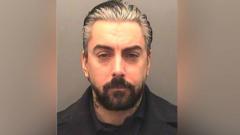
The internal ecosystem of HMP Wakefield, the high-security facility colloquially known as "Monster Mansion," has long operated under a grim social contract. For years, the facility managed to house the UK’s most depraved criminals—serial killers, rapists, and child abusers—with a level of control that prioritized containment over reform. But that contract has been shredded. On October 11, 2025, Ian Watkins, the former Lostprophets frontman serving 29 years for a litany of child sex offenses, was killed in a knife attack that many saw coming. The stabbing followed a 2023 hostage situation where Watkins had been held for six hours, yet despite these blinking red lights, the state failed to maintain the one thing it owes every prisoner: basic safety.
The 48-year-old was found with his jugular slashed, a definitive and calculated end for a man whose crimes were so heinous they made him a permanent target in the prison hierarchy. This was not a spontaneous outburst of violence. It was the culmination of a security collapse at Wakefield, where violent incidents have surged by 62% in the last three years. The "why" is not just about the victim's notoriety; it is about a prison system that has lost its grip on its most dangerous wards. Don't forget to check out our previous coverage on this related article.
The Warning Signs Ignored
To understand the October 2025 fatality, one must look at the botched intervention of August 2023. Watkins was taken hostage by three inmates, an ordeal that lasted long enough for him to sustain multiple non-lethal stab wounds. In any other high-stakes environment, a targeted assassination attempt would trigger an immediate and permanent transfer or a total overhaul of the prisoner's security detail.
Instead, Watkins was returned to the same general population dynamics that had already tried to kill him. Reports from the 2025 court proceedings involving his alleged killers—men aged 25 and 43—suggest that threats against Watkins were common currency in the months leading up to his death. He was a marked man, and everyone from the cell block to the governor’s office knew it. The state’s inability to protect even its most reviled inmates is a damning indictment of current staffing levels and the "younger cohort" of violent offenders now filling category A wings. If you want more about the history here, The Guardian provides an excellent summary.
A Systemic Rupture at Wakefield
Wakefield is no longer the controlled environment it once was. A July 2025 inspection report revealed a "marked increase" in violence, driven by a 72% rise in serious assaults. The prison, which has a capacity for 750 but often operates under heavy strain, is seeing a demographic shift. Older, more "settled" lifers are being replaced by younger, more volatile inmates who view attacking high-profile sex offenders as a way to gain social capital and "clout" within the walls.
- Violent Incidents: Increased by 62% since 2022.
- Serious Assaults: Surged by 72% in the same period.
- Security Classification: 148 of the 630 inmates are Category A (highest risk).
The failure to sequester Watkins after the 2023 incident suggests a catastrophic lapse in risk assessment. In the legal aftermath, defense arguments have already begun to pivot toward the environment of the prison itself, suggesting that the "Monster Mansion" has become an unmanageable pressure cooker. When the state takes away a person's liberty, it assumes total responsibility for their life. In the case of Watkins, the state allowed a slow-motion execution to take place over the course of two years.
The Shadow of the 2023 Hostage Crisis
During the 2023 attack, Watkins was reportedly used as a pawn in a larger negotiation between inmates and staff. It was a terrifying preview of the finality to come. Sources close to the investigation indicate that the 2025 murder was far more clinical. There was no hostage negotiation this time. The attackers moved with the precision of those who knew exactly when and where the surveillance gaps existed.
The court has heard that Watkins had reportedly expressed fear for his life just days before the stabbing. These warnings were apparently filtered through a system that had become desensitized to the threats surrounding him. The irony of Watkins’ death is that it occurred in a facility designed specifically to prevent such outcomes for the nation’s most "vulnerable" (in the carceral sense) high-profile prisoners.
The Fallout and the Unanswered Questions
The death of Ian Watkins is not a tragedy in the traditional sense; the depravity of his crimes—including the attempted rape of an infant—removed any public sympathy long ago. However, his death is a massive investigative failure. If a high-profile prisoner who has already survived one assassination attempt can be murdered in a maximum-security facility, no one is safe. Not the staff, not the other inmates, and certainly not the public's trust in the justice system's ability to carry out a sentence to its conclusion.
Just weeks after Watkins was killed, another high-profile inmate, Kyle Bevan, was found dead in his cell. The pattern is clear: Wakefield is hemorrhaging control. The investigation into Watkins’ murder is now pulling back the curtain on a facility where "lockdown" has become a daily reality rather than an emergency measure.
The focus must now shift to the Ministry of Justice. They must explain how a man who was already a victim of a documented hostage plot was allowed to be reached again. This wasn't a failure of intelligence; it was a failure of action. The threats were logged, the previous wounds were healed, and yet the killers were given the window they needed to finish the job.
The state’s duty of care does not pause for the despicable. By failing to protect Watkins, the prison service has effectively allowed the inmates to take over the role of judge, jury, and executioner. That is a precedent that should terrify any civilized society, regardless of who is at the end of the blade.