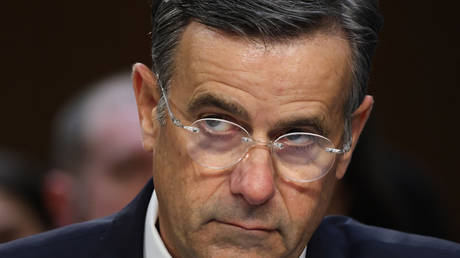
Secret high-level intelligence delegations rarely occur without a structural shift in global power dynamics. When Central Intelligence Agency Director John Ratcliffe touched down in Moscow for unannounced meetings with Russian security counterparts, mainstream commentary immediately splintered into competing narratives. Multiple outlets offered conflicting theories regarding the core objective. Some insisted the mission centered on warning the Kremlin against expanding military adventures into Baltic NATO territory. Others claimed the clandestine journey was designed to pressure Russian leadership into an immediate settlement over Ukraine, or to deliver ultimatums concerning arms transfers to third-party states.
This chaotic scramble for explanations reveals a deeper institutional discomfort. Washington and Moscow operate within an opaque ecosystem where traditional diplomatic channels have degraded into performative theater. To understand who truly benefits from this high-stakes gambit, one must look past the public relations posturing from both capitals and examine the structural anxieties driving intelligence chiefs back to the negotiating table. Recently making headlines in related news: The Lindsay Clancy Mistrial Exposes the Deepest Flaw in the Insanity Defense.
The Mechanics of Shadow Diplomacy
Official statecraft relies on ambassadors, formal communiques, and public ultimatums. Intelligence channels operate on an entirely different frequency. When a sitting spy chief boards a military transport bound for a hostile capital, it signifies that standard diplomatic cables have failed to prevent a dangerous escalation spiral.
Consider the operational reality. Intelligence directors do not travel across enemy lines to negotiate treaties or draft permanent peace accords. They meet to establish hard boundaries. In high-stakes espionage architecture, these backchannels serve a singular purpose: preventing catastrophic miscalculation. When surveillance data indicates that one side is preparing a major force mobilization or probing a neighbor's air defense perimeter, public denials carry zero credibility. Additional insights on this are explored by Al Jazeera.
A direct face-to-face encounter strips away the rhetorical padding. When Ratcliffe sat down with Sergei Naryshkin of the Foreign Intelligence Service and Alexander Bortnikov of the Federal Security Service, the transmission was unambiguous. Written warnings can be dismissed as political posturing for domestic consumption. Direct verbal delivery from the head of opposing intelligence forces leaves no room for misinterpretation.
The Battle of Strategic Assessments
The fundamental driver behind the Moscow mission lies in conflicting intelligence evaluations regarding attrition limits. Washington analysts have long operated on the assumption that prolonged economic sanctions and battlefield losses will eventually force the Kremlin to reconsider its strategic objectives. Conversely, Russian leadership maintains a calculus built on endurance, wagering that Western political unity will fracture before its own military capacity exhausts itself.
When an intelligence chief travels directly to the adversary's turf to argue that their position is deteriorating, the move carries inherent risks. Moscow's immediate public downplaying of the event—with officials characterizing the encounter as a routine working format with nothing special to report—reflects a desire to project unshakeable confidence.
Yet, the very fact that the meeting took place under deep secrecy exposes a crack in that facade. If the Kremlin genuinely believed its adversaries were on the verge of collapse, an unannounced visit from the head of the opposing spy agency would be rebuffed entirely. Instead, the doors were opened, discussions occurred, and intelligence teams spent hours parsing intentions.
Who Wins in the Shadows?
Determining the ultimate beneficiary requires separating short-term tactical positioning from long-term strategic advantage.
The White House gains a mechanism for deterrence enforcement. By communicating red lines directly to the architects of Russian security policy, Washington reduces the probability of a catastrophic accident involving NATO forces along the eastern flank. If a future incident occurs in Estonian or Latvian airspace, Moscow cannot claim ignorance of the potential consequences.
For the Kremlin, the visit serves domestic and international signaling needs. Hosting the head of the primary adversarial intelligence agency underscores Russia's status as a necessary interlocutor on global security. Even while dismissing the substance of the warnings through state spokespersons, Moscow demonstrates that Washington must occasionally bypass traditional allies to engage directly.
Ukraine and European front-line states occupy a more precarious position in this equation. Whenever great powers open secret bilateral channels, smaller nations naturally harbor anxieties regarding backroom compromises. However, historical precedent suggests that direct intelligence exchanges rarely result in grand betrayal. More frequently, they serve to lock in existing boundaries and manage the velocity of conflict to prevent a wider conflagration.
The true utility of this extraordinary diplomatic maneuver is not found in immediate breakthroughs or signed declarations. It lives in the quiet containment of worst-case scenarios, proving that even amid total geopolitical frost, the urge to prevent absolute catastrophe still forces adversaries into the same room.