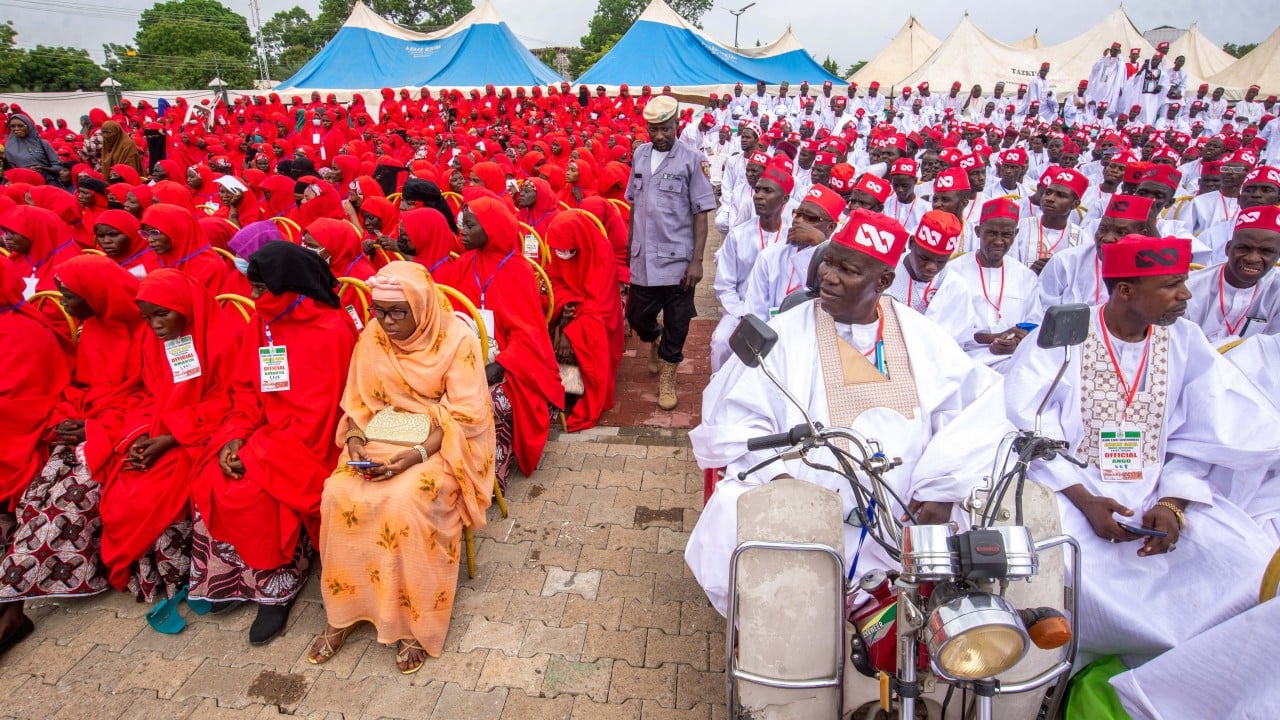
When 1,500 couples line up to exchange vows simultaneously in a single afternoon, the casual observer sees romance on an industrial scale. Fifteen hundred pairs of matching ankara fabric. Three thousand rings glinting under West African sunlight. Choirs singing in polyphonic harmony over banks of public address speakers.
Look closer. Strip away the festive pageantry, the rows of matching plastic chairs, and the sea of white lace. What remains is not just a cultural spectacle. It is a massive, highly calculated economic intervention designed to bypass a financial barrier that has locked millions of young West Africans out of traditional family formation.
Inflation in Nigeria has battered household budgets. The cost of living has skyrocketed following the removal of fuel subsidies and the floating of the local currency, the naira. Organizing a conventional wedding in urban centers like Lagos or Abuja has become an exercise in elite financial endurance. Venue rentals, catering for hundreds of guests, mandatory traditional engagement gifts, and professional photography routinely run into millions of naira. For the average working-class citizen earning minimum wage, hosting a modest independent ceremony is an impossible mathematical equation.
Mass weddings subsidized by religious institutions, state governments, or philanthropic foundations change the equation entirely. They remove the overhead. They absorb the crushing financial shock of hospitality, administrative fees, and ceremonial attire, transforming marriage from a luxury commodity into an accessible public utility.
The Financial Mechanics Behind Mass Nuptials
How do you feed, clothe, and legally register three thousand people at once without collapsing the balance sheet?
The logistics require the precision of a military deployment. Organizers secure corporate sponsorships from telecommunications giants, fast-moving consumer goods manufacturers, and financial institutions eager for positive brand visibility among large consumer blocks. In exchange for underwriting the cost of bulk-purchased fabrics, mass catering, and mass registry documentation, corporate partners gain direct access to a captive demographic.
Religious bodies approach the phenomenon from a different angle. For organizations like the Nasrul-lahi-l-Fatih Society or various Pentecostal mega-churches, facilitating mass unions is an extension of moral governance. Unmarried cohabitation carries severe social and religious stigmas in conservative Nigerian communities. By removing the financial hurdles that delay weddings, religious institutions exert a stabilizing influence on their congregations, ensuring that family structures conform strictly to doctrine while offering financial relief to struggling members.
State governments also step into the arena for political utility. Sponsored mass weddings serve as visible proof of populist welfare delivery. Governors and local government chairmen routinely fund these ceremonies to demonstrate direct engagement with the working poor. The optics are undeniable: a smiling politician handing out marriage certificates and gift packages of rice, cooking oil, and small home appliances to hundreds of grateful couples makes for powerful evening news.
Yet, beneath the surface efficiency lies a complex web of social negotiations, vetting procedures, and status anxieties.
Vetting Love on an Assembly Line
You cannot simply walk off the street and join a mass wedding brigade. The administrative vetting process is rigorous, invasive, and intensely bureaucratic.
Organizers must verify that participants are legally free to marry. This involves background checks, medical screenings for genotype and sexually transmitted infections, and religious counseling sessions. In a society where family lineage and health compatibility carry immense weight, these checks protect organizers from legal liability and protect partners from future domestic friction.
Couples must submit to mandatory pre-marital counseling. These sessions address conflict resolution, financial management, and domestic responsibilities. While critics argue that mass counseling cannot possibly address individual psychological nuances, proponents insist it provides a vital baseline of education for couples who might otherwise enter marriage entirely unprepared for economic pressures.
The emotional texture of the day itself is surreal. Imagine standing shoulder-to-shoulder with hundreds of strangers, waiting for an official to shout a collective declaration of vows. Intimacy is outsourced to the crowd. Private glances and whispered promises are traded against a backdrop of blaring megaphones and television cameras.
For many participants, the lack of privacy is a fair trade for legitimacy. A legally recognized marriage certificate unlocks banking privileges, inheritance rights, and social standing that cohabitation simply cannot provide.
The Cultural Pushback and Class Divide
Not everyone views the industrialization of matrimony with enthusiasm.
Traditionalists argue that mass weddings strip away the deeply personal, familial significance of marriage rites. In Igbo, Yoruba, and Hausa cultures, the wedding process is traditionally a deliberate negotiation between extended families. It is an alliance of clans, marked by elaborate rites of passage, symbolic gift exchanges, and ancestral blessings.
When a state government or a religious charity bundles 1,500 couples into a three-hour stadium ceremony, those nuanced cultural traditions vanish. They are replaced by an assembly-line model that flattens regional specificities into a uniform, homogenized event.
Furthermore, a distinct class divide underpins the phenomenon. Mass weddings are explicitly designed for the economically disenfranchised. The elite continue to host multi-day destination weddings in Dubai, London, or exclusive resorts in Lekki, complete with designer attire and celebrity performers. Mass weddings serve as a stark reminder of economic stratification, highlighting a two-tier society where the wealthy buy bespoke romance while the working class relies on wholesale charity to formalize their relationships.
Despite these criticisms, the demand for mass weddings continues to surge. Waiting lists are often oversubscribed. The economic reality on the ground overrides cultural purism. When survival requires every available financial shortcut, young couples care less about whether their wedding looks like a movie and more about whether they can legally sign a lease together without facing moral condemnation or administrative hurdles.
The Ripple Effects on Domestic Stability
What happens after the confetti is swept away and the borrowed plastic chairs are stacked in a truck?
Long-term data on mass wedding stability is sparse, but sociologists note that removing initial debt prevents a major source of early marital strain. Couples who start their journey without crippling wedding loans avoid the immediate default on debts that plagues many young families. They do not begin married life paying off caterers and event planners at exorbitant interest rates.
However, financial relief at the starting line does not insulate couples from the broader macroeconomic storms battering Nigeria. Inflation does not pause for newlyweds. Unemployment remains stubbornly high. The structural pressures that made mass weddings necessary in the first place—stagnant wages, housing deficits, and the high cost of raising children—continue to exert immense pressure on these newly formalized households long after the cameras have gone home.
The mass wedding phenomenon is ultimately a symptom of economic distress disguised as a celebration of love. It is a pragmatic adaptation to an unforgiving financial landscape, proving that even the most sacred social institutions will bend, reshape, and industrialize when survival demands it.
The thousands who queue up for these ceremonies are not victims of romance; they are strategic operators navigating a broken economic system with whatever tools remain at their disposal.


