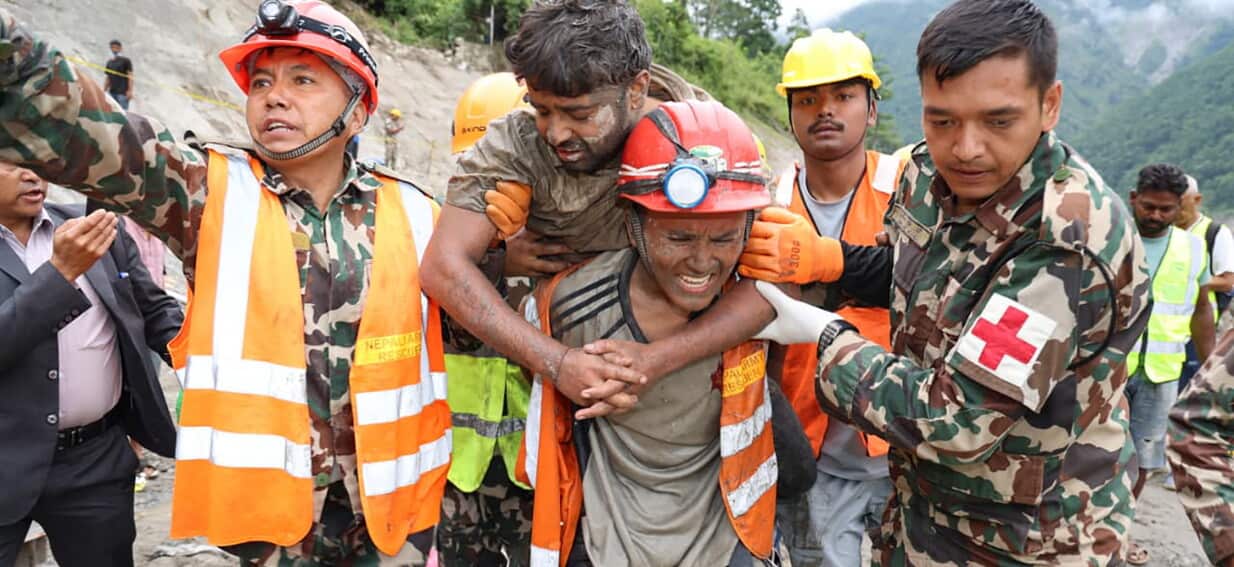
Nine days after a catastrophic glacial flood sealed the underground chambers of Nepal's Trishuli 3A hydropower plant, two men emerged from the dark into the blinding Himalayan daylight. Mechanical foreman Sanjay Shah, 30, and mechanical supervisor Kabir Maharjan, 45, were pulled from a depth of 170 meters through a labyrinth of hardened silt and debris. Their survival shattered statistical probabilities in a disaster that left more than 1,200 people dead and thousands missing across the Nepal-Tibet border following an upstream wall of water. While mainstream reports frame the extraction as a momentary stroke of divine intervention, the operational reality on the ground reveals a grueling engineering battle against geography, physics, and institutional vulnerability.
The August 26 disaster was not a routine seasonal flood. Triggered by a massive mountain and glacial collapse near the border, a slurry of rock, ice, and mud descended upon the Bhotekoshi and Trishuli river corridors. Twelve separate hydropower projects took the direct brunt of the surge. Infrastructure meant to harness clean energy instead transformed into subterranean traps. Mountain engineering projects are designed to withstand tremendous internal hydraulic pressure from water flowing through rock, but they possess zero structural defense against catastrophic alluvial choking from the outside.
When the wall of debris slammed into the portals, it did not simply block the entrances. It compressed air chambers, sheared internal access routes, and packed the main conduits with dense aggregate. For six days, heavy excavators and specialized teams from the Nepal Army fought just to uncover the buried portals of facilities like Upper Trishuli 3A. They were not reopening a tunnel; they were mining through a newly forged geological barrier.
The Anatomy of Underground Survival
Human physiology rebels against prolonged darkness, dehydration, and foul air. Yet Shah and Maharjan endured 216 hours trapped roughly 170 meters inside the main infrastructure conduit. How did they cheat the statistics?
Subterranean survivability during major floods depends entirely on localized micro-environments. When water cascades into a sloped tunnel, it compresses trapped air ahead of it, creating pockets of high-pressure oxygen if the geometry of the chamber prevents complete displacement. Shah, who was stationed in the facility control room when the alarms sounded, recognized the immediate danger and attempted to shepherd coworkers toward safety before the intake valves and access shafts were overwhelmed.
Trapped alongside a small handful of colleagues in an isolated pocket, Shah relied on psychological fortitude. Voice propagation through wet rock and concrete allowed brief acoustic contact with three or four other trapped workers early in the ordeal. As days bled into a week, those voices faded, leaving silence. Shah spent the duration reciting the Hare Krishna Mahamantra to anchor his cognitive focus against the encroaching panic of total blackness.
Physical endurance under these conditions requires minimizing metabolic output. Without fresh water, human cellular function deteriorates rapidly, typically leading to multi-organ failure within three to five days. The presence of residual moisture seeping through the rock walls or condensation within the high-humidity tunnel environment likely provided just enough hydration to stave off acute renal collapse, marking the razor-thin margin between life and a silent death.
Digital Logistics and Guerrilla Engineering
Physical muscle alone cannot crack a blocked mountain core. The successful extraction of Shah and Maharjan highlights an unconventional shift in modern disaster response: the weaponization of civilian communication networks for technical logistics.
As heavy machinery stalled against impenetrable walls of boulders, engineering coordinators turned to a pre-existing professional WhatsApp group that quickly ballooned to over 500 members. When rescue units reached points where blueprints were missing or structural modifications made historical maps obsolete, they broadcast requests into the chat. Within minutes, former plant designers and remote consultants swapped digital schematics of powerhouse access tunnels and turbine chambers.
This decentralized data sharing allowed specialized teams from the Nepal Army and supporting international experts to bypass bureaucratic delays. They cross-referenced the mobile phone locations of missing personnel with telecom ping data, mapping probable human clusters inside the mountain while clearing the debris. It is a stark reminder that modern disaster management relies as much on cloud connectivity as it does on hydraulic cranes.
The Looming Crisis Downstream
The extraction of two men from the Trishuli 3A project provides a psychological lift, but it masks a grim systemic reality. Independent power producers estimate that hundreds of workers remain unaccounted for across the nation's battered energy grid. Roughly 500 individuals are still believed to be sealed inside various underground chambers along the river systems.
Time is rapidly expiring for anyone else surviving on compressed air pockets. The structural integrity of the tunnels remains severely compromised by ongoing tremors and shifting surface debris. Rescuers operating deep underground face the constant threat of secondary collapses. Families who spent the past week preparing symbolic funerals now wait beside muddy cordons, caught between the agonizing spectrum of grief and improbable hope.
The rush to develop Himalayan hydropower has long prioritized rapid kilowatt expansion over extreme-weather redundancy. As climate volatility accelerates glacial melting across the roof of the world, subterranean engineering in the region faces a brutal audit. The survival of two men in the muck of Trishuli is a testament to human endurance, but the hundreds still missing demand a complete rewrite of how vulnerable infrastructure is planned, monitored, and defended against the mountains themselves


