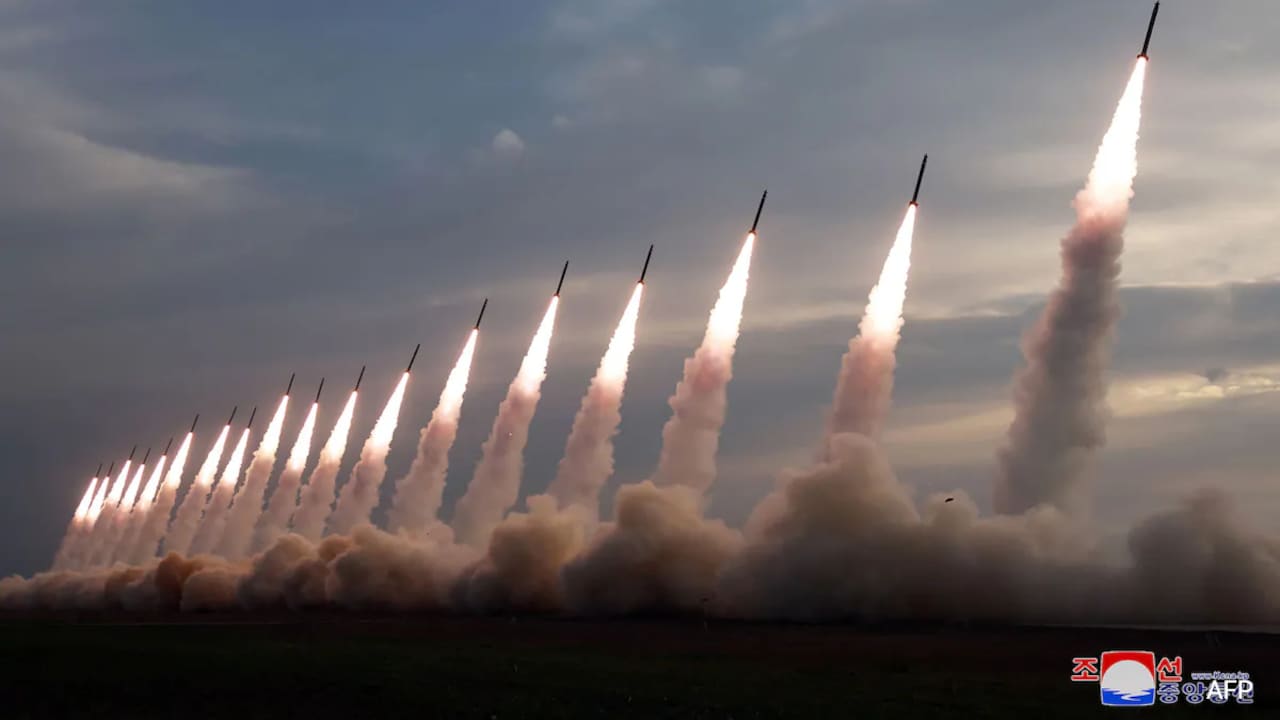
A specialized North Korean ballistic missile unit is arriving in western Russia to back Moscow's ongoing military campaign against Ukraine. According to intelligence disclosures from Kyiv, this operational shift brings roughly ninety foreign personnel, six mobile launchers, and a fresh inventory of KN-23 and KN-24 tactical missiles into the Voronezh region. The arrangement transitions bilateral military assistance from static munitions trading into direct, boots-on-the-ground operational integration.
Years of watching proxy conflicts teach one harsh truth. Hardware shipments eventually require human handlers when precision, maintenance, and technical execution break down. For a long time, Moscow relied on its own domestic stockpiles of Iskander tactical systems alongside imported hardware. When those inventories strained under the sheer volume of a protracted war of attrition, foreign supply lines stepped into the void.
Yet shipping crates of artillery shells across rail networks is vastly different from embedding foreign missile crews into active western military brigades. The integration of North Korean specialists directly into Russia's 112th Missile Brigade exposes a deeper logistical adaptation. It reveals a transactional desperation on one side and a calculated geopolitical gamble on the other.
The Anatomy of the KN-23 and KN-24 Arsenal
To understand why this deployment matters, one must examine the specific mechanics of the weapons involved. The KN-23 and KN-24 are solid-fuel tactical ballistic systems designed for rapid deployment and short preparation times. Liquid-fueled rockets demand lengthy pre-launch fueling procedures that leave them vulnerable to counter-battery fire and reconnaissance drones. Solid-fuel systems skip this agonizing countdown. They roll out, elevate, fire, and displace before enemy artillery can pinpoint their coordinates.
Military analysts tracking debris fields inside Ukraine note distinct metallurgical and guidance differences between these imports and standard Russian models. While the external architecture mimics certain features of the Iskander family, internal components highlight a separate manufacturing pedigree.
Consider a hypothetical comparison. If a standard domestic system relies on microelectronics sourced through complex grey-market semiconductor channels, a parallel indigenous manufacturing base handles its own closed-loop component production under severe economic sanctions. This isolation creates unique performance profiles.
The payload capacity of these North Korean models often runs heavier than equivalent Russian stock, carrying explosive yields designed to maximize structural destruction. However, that destructive power comes with a critical drawback. Dispersion rates are notably wider. Precision targeting suffers when guidance systems lack high-end micro-processors or advanced satellite-navigation corrections. The result is a weapon system capable of devastating wide-area infrastructure, but prone to catastrophic misses that frequently end up tearing through civilian neighborhoods rather than hardened military outposts.
Logistics and the Voronezh Calculus
Geography dictates military strategy. The positioning of this newly arrived unit within Russia's Voronezh Oblast places the launch assets within striking distance of key eastern and southern Ukrainian logistical hubs. Voronezh provides a sheltered rear echelon while keeping launch vectors uncomfortably close to the border.
Intelligence assessments indicate that the current transfer involves an initial batch of forty missiles, with total allocations expected to scale up toward one hundred twenty units following high-level bilateral talks. Managing these assets requires specialized maintenance infrastructure. Mobile transporter-erector-launchers require heavy hydraulic upkeep, specialized telemetry calibration tools, and secure communications arrays.
Bringing in ninety North Korean personnel means Pyongyang is not merely handing over the keys and wishing Moscow luck. These technicians, drivers, and targeting officers are there to ensure the hardware actually functions under combat conditions. Operating foreign ballistic systems within a host nation's command structure introduces immense friction. Language barriers, divergent doctrine, and mismatched secure radio frequencies create operational chaos.
Armies do not merge overnight. To bridge this divide, liaison officers fluent in Russian or English must act as continuous interpreters between Korean battery commanders and Russian regional artillery chiefs. Every fire mission requires coordination through layered command posts, meaning tactical delays are inevitable.
Air Defense Realities and Interceptor Depletion
Ukraine faces a brutal numbers game. High-end air defense interceptors, such as Western-supplied Patriot batteries, remain chronically scarce. Intercepting a supersonic ballistic missile requires sophisticated radar tracking and scarce, expensive interceptor missiles.
When Moscow combines indigenous production with imported North Korean stockpiles, the math shifts heavily in favor of the attacker. Firing multiple ballistic vectors simultaneously overwhelms regional air defense umbrellas. Even if a battery successfully tracks incoming threats, prioritizing targets forces painful choices. Defending a power substation means leaving a regional transit junction exposed.
The human toll of this mathematical imbalance is stark. When less-accurate foreign ballistic systems miss their intended military coordinates by hundreds of meters, residential blocks bear the brunt. The winter heating season compounds these vulnerabilities. Historical precedent shows that sustained ballistic barrages targeting electrical grids and water treatment plants aim to break civilian endurance rather than just tactical frontlines.
Geopolitical Barter Behind the Lines
Nothing in international relations happens for free, least of all military hardware of this magnitude. Pyongyang is not shipping hundreds of thousands of artillery shells and ballistic missiles out of pure ideological solidarity.
The quid pro quo involves technology transfers that North Korea has coveted for decades. Satellite technology, nuclear submarine blueprints, advanced aviation avionics, and refined material sciences sit high on Pyongyang's wish list. By trading conventional munitions and specialized manpower for strategic military technology, Kim Jong Un's regime accelerates its own strategic modernization programs at an alarming rate.
Sanctions enforcement mechanisms have proven largely porous when two heavily isolated states establish direct overland and maritime supply corridors. Cargo ships make regular runs between North Korean ports and Russian Far East facilities under darkened transponders, shielding shipments from routine maritime interdiction.
This deepening cooperation binds the security architecture of East Asia directly to the battlefields of Eastern Europe. Security developments in the Korean Peninsula now possess direct feedback loops into European security dynamics.
The integration of foreign missile crews on European soil shoves open a dangerous door. It establishes a practical precedent for multinational force pooling outside formal multilateral alliances like NATO. If one coalition can legally and operationally blend foreign artillery brigades into active regional commands, the operational rules governing modern industrial warfare shift permanently.
The hardware is rolling into position. The personnel are settling into their barracks in Voronezh. The skies above eastern Europe prepare for another wave of incoming vectors.
The trajectory is set.