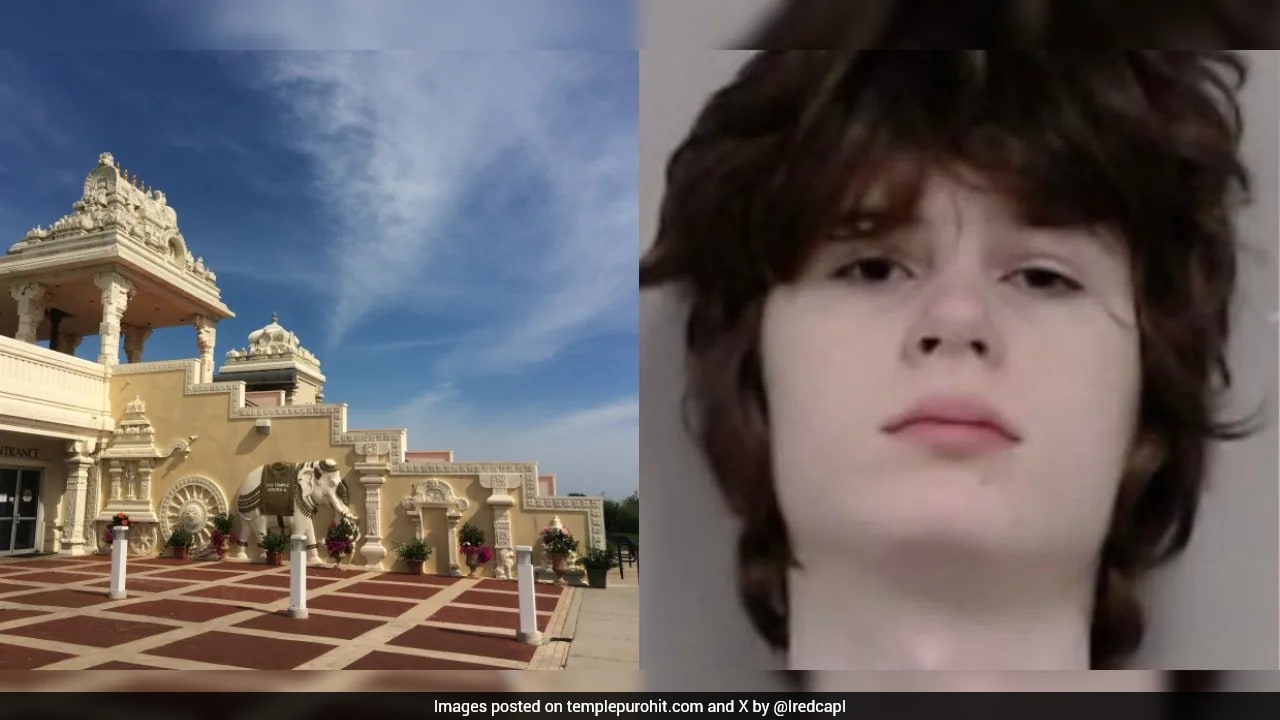
An Illinois teenager accused of planning an armed attack on a suburban Chicago Hindu temple entered a plea of not guilty in federal court, setting the stage for a trial that centers on the rapid radicalization of minors through encrypted channels. Federal agents arrested the minor after an undercover operation exposed detailed operational plans to execute a mass shooting at the religious site. While defense attorneys contest the extent of the suspect's intent, law enforcement officials frame the plot as part of a sharp rise in domestic extremism targeting religious minority institutions across North America.
The legal proceedings in Chicago illuminate a reality that security agencies have struggled to contain for years. Violent extremism is no longer confined to physical cells or long-standing political organizations. It thrives in fragmented digital spaces where radical ideology mixes with youth isolation, turning vulnerable adolescents into operatives faster than traditional counterterrorism frameworks can track. For another look, check out: this related article.
The Anatomy of an Intercepted Plot
Court documents reveal that the suspect spent months communicating within extremist forums, consuming materials produced by international hate groups and white supremacist networks. The target was not chosen at random. The Hindu temple in the Chicago metropolitan area represented both a high-profile gathering place for a growing diaspora and a soft target with standard commercial security measures.
Federal investigators infiltrated the suspect's communication channels after automated monitoring flagged specific threats regarding firearm acquisitions and tactical reconnaissance. Undercover agents engaged the minor directly, validating that the individual had mapped out entry and exit points, tracked gathering times, and sought to procure semi-automatic rifles. Related analysis on this trend has been published by TIME.
When federal marshals and FBI agents executed the arrest, they seized electronic devices containing operational schematics and manifestos intended for online publication post-attack. The defense argues that the youth was engaged in online posture rather than executable intent, characterizing the communications as juvenile fantasy weaponized by overzealous law enforcement. Prosecutors maintain that the threshold from talk to action had already been crossed when physical surveillance of the temple grounds began.
The Escalating Threat to Diaspora Communities
Suburban places of worship have historically operated on open-door principles. That openness now presents a complex security vulnerability. Over the past decade, temples, mosques, gurdwaras, and synagogues have been forced to reallocate significant operational budgets toward perimeter defense, armed guards, and surveillance infrastructure.
The targeting of a Hindu temple highlights a shifting dynamic in domestic hate crimes. While historically antisemitic and anti-Muslim incidents have dominated religious bias statistics, South Asian institutions face an increasingly complex threat matrix. Ideological hatred imported from international geopolitics mixes with domestic white supremacist rhetoric that views any non-Christian or non-white gathering space as a primary target.
Security consultants who specialize in religious infrastructure note that many facilities lack the capital to install blast-resistant glass, automated lock-down mechanisms, or continuous professional security details. Smaller congregations rely heavily on local municipal police departments, which are often reactive rather than predictive in handling targeted intelligence.
Operational Blindspots in Faith Security
Most houses of worship make critical errors when designing their defensive posture.
- Over-reliance on visual deterrence. Visible cameras without active monitoring provide documentation after an incident occurs but fail to stop an initial breach.
- Ignoring digital footprint exposure. Schedules, high-profile donor visits, and festival crowd estimates are frequently published online without access restrictions, granting potential attackers free operational intelligence.
- Lack of physical access controls. Main sanctuaries often feature multiple unmonitored entry points during peak service hours, allowing an intruder immediate access to assembled crowds.
The Digital Pipeline and the Architecture of Adolescent Radicalization
Understanding how a minor transitions from routine internet usage to planning mass casualty events requires examining the algorithms of modern social platforms. Radicalization rarely begins on dark web forums. It starts on mainstream video-sharing platforms and gaming servers through seemingly benign memes and subcultural humor.
Extremist recruiters employ a technique known as irony-poisoning. By disguising hate speech as dark humor, recruiters desensitize young users to violent imagery and radical concepts. Once a user demonstrates susceptibility, they are funneled into smaller, encrypted channels where explicit propaganda and tactical guides are shared.
The speed of this process leaves parents and educators largely unaware until law enforcement intervenes. The Chicago suspect lived in a standard suburban environment, attending school and maintaining normal household routines while managing a parallel digital existence dedicated to violent planning.
The Legal Strategy and Federal Precedent
The plea of not guilty triggers a complex legal battle over juvenile jurisdiction, mental competency, and the boundaries of federal entrapment. Federal prosecutors increasingly favor charging minors as adults in terrorism cases, arguing that the public safety risk outweighs the rehabilitative focus of the juvenile justice system.
Defense counsel will likely focus on three core arguments.
First, they will challenge the role of federal undercover operatives, raising questions about whether the suspect possessed the capability to carry out the attack without external encouragement or logistics assistance. Second, the defense will emphasize the suspect's age and brain development, arguing that adolescents are uniquely susceptible to online manipulation and lack the cognitive maturity to fully form criminal intent in complex conspiracy charges. Third, they will seek to suppress evidence gathered from encrypted applications, challenging the breadth of federal search warrants applied to digital data.
Federal judges have historically set a high bar for entrapment defenses in terrorism trials. If the government can demonstrate predisposition—evidenced by prior searches, manifestos, or independent attempts to acquire weapons—the prosecution's position remains strong.
Protecting Vulnerable Sites Without Sacrificing Openness
The Chicago case serves as a warning for religious leaders across the nation. Reliance on passive security measures is no longer viable in an environment where extremist material is universally accessible.
Institutions must adopt a multi-tiered security model that balances community access with rigorous threat mitigation. This includes establishing direct liaison channels with federal threat-tracking units, conducting regular security audits of physical premises, and training staff to recognize pre-operational surveillance behavior.
Law enforcement agencies face an equally daunting challenge. Detecting isolated individuals radicalized in private digital spaces requires sophisticated intelligence tools, yet those tools must operate within constitutional boundaries governing speech and privacy. Until regulators, tech platforms, and law enforcement align on proactive intervention strategies, houses of worship remain on the front lines of a decentralized war.