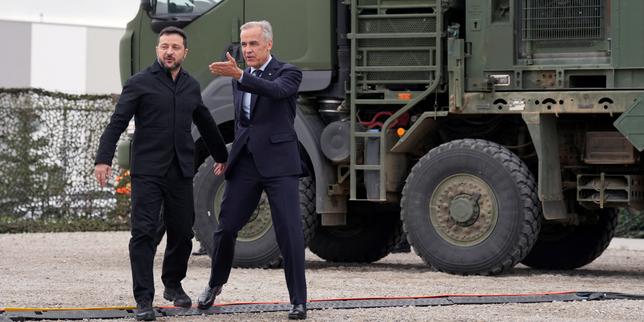
When Canadian Prime Minister Mark Carney and Ukrainian President Volodymyr Zelenskyy signed a sweeping declaration in Calgary to forge a 100-year security and economic partnership, diplomatic circles mostly focused on the sheer novelty of a century-long horizon. Diplomatic pacts rarely look past the next election cycle, let alone a hundred years. But look past the political theatre and you find an industrial mobilization blueprint born out of brutal necessity. Ottawa and Kyiv are not just shaking hands on future trade; they are fusing Canada's vast natural resource base with Ukraine's hard-learned, blood-soaked lessons in modern attritional warfare.
For decades, Western defense procurement has moved at the speed of a glacier. Multi-year reviews, bureaucratic bloat, and gold-plated weapon systems designed for showroom floors rather than muddy trenches have defined the military-industrial output of North America. The war in Ukraine shattered that illusion. Modern conflict demands scale, speed, and continuous iteration. By tying Canada’s military rearmament directly to Ukraine’s battle-tested drone and electronic warfare ecosystem, Carney has initiated an extraordinary shift in how middle powers prepare for an increasingly hostile century.
The central pillar of this agreement is not diplomatic platitudes about shared values. It is industrial manufacturing. Under the new framework, Canada and Ukraine are setting up joint production lines aimed at churning out millions of uncrewed aerial systems, counter-drone mechanisms, and electronic jamming suites. Carney noted bluntly that while the Canadian Armed Forces currently maintain roughly two thousand drones in inventory, future defense requirements demand millions. That is not an incremental adjustment. That is a complete reconception of military stockpiles.
To achieve this, Ottawa is launching a domestic drone marketplace designed to connect military units directly with hundreds of private suppliers. Instead of waiting five years for a legacy defense contractor to design a high-priced airframe, the strategy mimics the Ukrainian model of agile, decentralized manufacturing where hardware iterations happen on a weekly basis. Ukrainian engineers bring the software updates forged under Russian fire. Canadian firms bring the capital, raw materials, and fabrication capacity.
Critics will rightly point out that signing a hundred-year declaration is easy; surviving the next ten years of geopolitical turbulence is the real test. Governments change. Budgets fluctuate. Public attention spans wane. Yet the geographic and economic logic binding these two nations runs deeper than transient political whims. Canada hosts the largest Ukrainian diaspora outside of Eurasia, heavily concentrated in the prairie provinces where the partnership was formally cemented. Cultural ties create political staying power, ensuring that domestic constituencies will hold future administrations accountable to the commitments made today.
Beyond unmanned systems, the partnership dives deep into critical minerals, energy security, and artificial intelligence governance. Ukraine sits on significant deposits of critical resources necessary for the clean tech and defense economies, while Canada possesses the extraction infrastructure and financial weight to scale production independent of hostile supply chains. Furthermore, the agreement addresses immediate survival, incorporating hundreds of millions in air defense packages and loan guarantees to help Ukraine secure natural gas and protect civilian energy grids before winter.
We are watching the old rules of international security dissolve in real time. Alliances are no longer mere mutual defense pacts where passive partners hide behind a nuclear umbrella. They are active, industrial joint ventures. Canada has recognized that its own geographic isolation is an illusion in an age of cyber warfare, shadow fleets, and long-range aerial threats. By binding its industrial future to the most experienced combat laboratory on earth, Ottawa is buying survival insurance for the next hundred years. The machinery is already moving. The only question left is whether domestic bureaucracy can keep pace with the brutal tempo of the future.