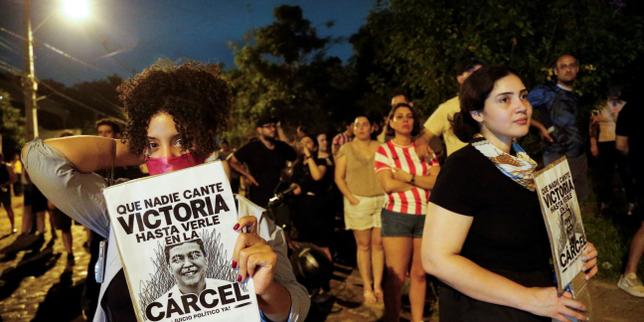
The ouster of a sitting president rarely happens over a single speech or a lone scandal. In Paraguay, political turmoil surrounding Santiago Peña exposes how deeply banking interests, campaign financing, and state power have intertwined over decades. When lawmakers move to remove a president or force a political reckoning, the formal charges on paper often mask a sharper struggle over credit lines, regulatory capture, and who controls the machinery of public spending. Anyone watching Asunción knows that formal constitutional mechanisms are only half the story. The other half sits in boardrooms, brokerage accounts, and backroom negotiations where political loyalty has a market price.
How Finance and State Power Converge in Asunción
To understand why a political crisis in Paraguay draws immediate attention from bankers and economists, you have to look at the scale of the state relative to the domestic financial system. Public procurement, sovereign debt issuance, agricultural subsidies, and infrastructure contracts move massive sums through a relatively concentrated set of institutions. Access to those flows shapes fortunes far faster than ordinary commercial competition. Discover more on a related topic: this related article.
In many small, open economies, the line between public office and private capital is thin. Politicians need campaign war chests, media access, and organizational muscle to win votes and hold coalitions together. Financiers, agribusiness leaders, and major contractors need predictable tax rules, favorable regulatory enforcement, and access to state-backed projects or liquidity. When those two sides depend on each other, policy decisions stop looking like neutral public administration and start looking like balance-sheet management for connected insiders.
Observers who have covered Latin American politics for years recognize this pattern immediately. A president arrives with promises of modernization, institutional reform, or fiscal discipline. Yet governing requires votes in Congress, support from regional bosses, and calm nerves among major economic players. Keeping everyone aligned often means trading regulatory teeth or budget influence for political survival. Additional analysis by Al Jazeera explores comparable perspectives on this issue.
The Revolving Door of Influence
Influence in Asunción rarely relies on crude, clumsy transactions alone. It operates through overlapping networks of family ties, party machinery, corporate boards, and advisory roles. A figure who holds sway over a ministry or regulatory agency today may sit across from commercial lenders or major exporters tomorrow, or share long-standing political patronage within the same governing party.
Consider a hypothetical example to see how such pressure builds without a single smoking-gun wire transfer. Suppose a regulatory body proposes stricter oversight on certain financial transactions or tax compliance among large commercial groups. Within days, lobbying intensifies, legislative committees suddenly prioritize unrelated political grievances, and allies question the executive branch's competence or loyalty to party priorities. Even when the formal conflict is framed around governance or accountability, the underlying friction often stems from whose economic interests are being protected or threatened.
This dynamic creates a structural vulnerability for any president. If the executive branch leans too hard on entrenched financial or political actors, coalitions fracture and impeachment or removal talk gains oxygen. If the executive branch accommodates them too readily, public frustration rises over corruption, inequality, and captured institutions.
Constitutional Mechanisms Versus Realpolitik
Paraguay's political history shows that constitutional procedures and raw political math do not always move in lockstep. Impeachment and political removal mechanisms exist on paper as tools of accountability and checks and balances. In practice, legislative majorities can turn constitutional language into a blunt instrument when factions inside the ruling bloc or opposition decide a leader has become a liability.
Past political crises in the country offer sobering context. Executives have faced intense legislative pushback, street protests, and institutional standoffs where legal arguments were inseparable from party power struggles. When a president loses control of legislative arithmetic or alienates key backers within their own political apparatus, legal or ethical accusations quickly become weapons in a broader power realignment.
That does not mean every allegation raised in political battles is fabricated. Weak transparency, opaque campaign funding, and cozy ties between politicians and wealthy patrons are long-standing complaints in Paraguayan public life. The hard part for an investigator is separating genuine institutional rot from opportunistic power plays by rivals who may be just as entangled in the same financial web.
Why Institutional Reforms Stall
If citizens and international observers repeatedly spot conflicts of interest between politics and finance, why do deep reforms so often stall? Because the people with the votes to pass meaningful laws are frequently the same people who benefit from the status quo.
Campaign finance rules, conflict-of-interest disclosures, public procurement audits, and central bank or supervisory independence look straightforward on paper. In reality, enforcing them requires prosecutors, judges, and regulators with real autonomy and political cover. Without insulated institutions, oversight can become selective—used aggressively against political opponents while looking the other way when powerful allies are involved.
There is also a practical economic argument that defenders of the current order often invoke. They warn that sudden institutional shake-ups, aggressive investigations, or abrupt policy shifts can spook investors, tighten credit, or slow growth. Stability is a real public good. Yet treating entrenched patronage as a synonym for stability is a dangerous mistake that simply delays a harsher reckoning.
What Overlooked Factors Shape the Fallout
Most surface-level coverage focuses on dramatic headlines—who voted which way, who gave an angry press conference, or which rival faction gained ground. Those details matter, yet they often miss quieter forces that determine what happens next.
- Credit and liquidity conditions: Commercial banks and major borrowers watch political instability closely because uncertainty raises risk premiums and can make financing more expensive or selective.
- Agribusiness and export leverage: Paraguay's economy relies heavily on commodities and cross-border trade, meaning major producers and traders wield substantial economic weight whenever policy stability is questioned.
- Party discipline and factional survival: Lawmakers often calculate their own re-election prospects and local patronage networks first, treating loyalty to a president as conditional rather than permanent.
- Public trust and street pressure: Unresolved perceptions of favoritism and impunity erode legitimacy over time, turning what starts as an elite dispute into a broader test of democratic patience.
Another overlooked angle is how external partners react. Neighboring countries, regional blocs, and international financial institutions prefer constitutional predictability and clear rules of the game. When political removals or maneuvers look driven by narrow factional bargains rather than transparent rule of law, external confidence takes a hit even if markets stay calm for a few weeks.
Separating Scandal From Structural Reality
A sharp analysis resists easy moralism on one side and cynical fatalism on the other. Not every businessperson or banker is a shadowy manipulator, and not every politician is beyond redemption. Plenty of legitimate enterprise, honest civil servants, and sincere reformers operate inside imperfect systems every day.
At the same time, ignoring structural collusions between political power and financial muscle leaves the public blind to why policies repeatedly favor well-connected players. When state contracts, regulatory leniency, or financial privileges cluster around the same small circle, ordinary citizens and smaller businesses pay the price through higher costs, weaker public services, and uneven rules.
For readers trying to make sense of any political upheaval in Paraguay, the most revealing question is rarely just who holds the title at the end of the week. Look instead at who gets appointed to key economic and oversight posts, which investigations move forward or quietly stall, and whose balance sheets look stronger once the dust settles.