Mass arrests and violent street clashes in France rarely stem from a single isolated grievance. While breaking news reports routinely tally broken shopfronts, tear gas canisters, and detention numbers in the hundreds, the underlying engine driving these recurring eruptions is a structural breakdown between aggressive French public-order doctrine, executive bypasses of parliamentary debate, and deep economic frustration among working-class citizens. When the French state deploys tens of thousands of riot officers to contain civil unrest, the resulting street battles are less a sudden breakdown of order and more the predictable outcome of how modern French governance manages dissent.
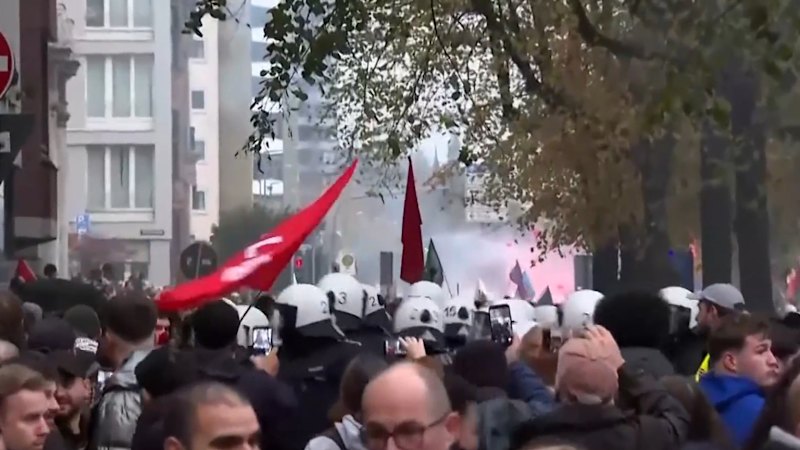
The immediate images are familiar to anyone who has watched European news over the last decade. Black-clad demonstrators hurl paving stones near the Place de la République in Paris or along the boulevards of Lyon and Nantes. Moments later, lines of heavily armored officers advance behind polycarbonate shields, launching dispersion grenades and executing rapid snatch-and-grab arrest maneuvers.
To understand why these confrontations escalate so quickly, you have to look past the evening tally of detainees. You have to examine the machinery of French street politics and the specific policing doctrines that turn tense standoffs into pitched battles.
The Anatomy of a Modern French Street Clash
A standard wire report treats a protest in France like a weather event. Pressure builds, a storm hits, arrests are made, and the streets are cleared by midnight. That framing misses the mechanics on the ground.
Modern French demonstrations rarely operate as a single cohesive march anymore. Historically, major trade unions like the Confédération Générale du Travail (CGT) organized strictly marshaled processions. Union stewards wore armbands, linked arms, and kept tens of thousands of workers moving along a pre-approved route negotiated with the local police prefecture. The police stayed on the periphery, intervening only when someone breached the perimeter.
That era is largely over. Today, a major mobilization in Paris, Rennes, or Marseille is an uneasy coalition of distinct groups occupying the same geographic space at the same time.
At the front or along the flanks, you often find the black bloc—a decentralized tactic rather than a formal organization, where participants wear identical black clothing and masks to prevent individual identification while targeting symbols of state and corporate power. Behind them walk traditional union members, retirees, students, and unorganized citizens furious about purchasing power, pension rules, or public service cuts.
When tactical units move in to neutralize a few dozen individuals smashing a bank window at the head of a march, their crowd-control munitions do not discriminate. Tear gas drifts backward into crowds of families and union stewards. Flash-ball launchers and sting-ball grenades create panic among people who came out simply to hold a cardboard sign. Within minutes, a peaceful march transforms into a chaotic game of cat and mouse across side streets.
The Doctrine of Contact and the BRAV-M Factor
If the crowd has changed, French policing has mutated even faster. For decades, France was studied abroad for its model of maintien de l'ordre—a doctrine built on keeping physical distance between police lines and demonstrators to prevent panic and casualties. The Compagnies Républicaines de Sécurité (CRS) and the Gendarmerie Mobile were trained to hold static lines, absorb tension, and let crowds exhaust themselves.
Over the past several years, that philosophy has been steadily replaced by a doctrine of proactive contact and mobile intervention.
The clearest symbol of this shift is the BRAV-M (Brigades de Répression de l'Action Violente Motorisées). Operating in pairs on heavy motorcycles, one officer drives while the passenger carries a baton, tear gas canisters, and a launcher. Designed for speed, these units bypass static barricades, roar into side streets, and break up groups before they can coalesce.
Police commanders argue that mobile units are essential to stop hyper-mobile rioters who use encrypted messaging apps to coordinate hit-and-run property damage. Without fast-response teams, they contend, small groups can loot commercial districts faster than traditional riot squads in heavy boots can march.
Critics, including legal observers from the Human Rights League and international bodies like the Council of Europe, see a different reality. Mobile units arriving at high speed into dense urban crowds escalate adrenaline on both sides. Because motorcycle squads cannot safely hold a static perimeter, their primary tool is shock and rapid dispersal. That dynamic frequently leads to indiscriminate baton charges, bruised bystanders, and mass preventative detentions.
The Preventive Arrest Pipeline
When headlines announce hundreds of arrests during a single afternoon of unrest in France, those numbers require closer inspection. In French legal practice, a large percentage of protest arrests do not result in criminal trials.
Police routinely use contrôles d'identité (identity checks) and preventative detentions under broad statutes governing "participation in a group with a view to committing violence." Officers can detain individuals simply for carrying swimming goggles, saline solution, or a scarf—items protesters bring to protect themselves from tear gas, which authorities frequently classify as evidence of intent to participate in a riot.
Detainees are held in garde à vue (police custody) for 24 to 48 hours, effectively removing them from the streets for the duration of the mobilization, only to be released later without charge due to insufficient evidence. For the Ministry of the Interior, this serves a dual purpose. It clears the streets immediately and projects an image of decisive state authority on the evening news. For civil liberties lawyers, it represents an administrative neutralization of the right to protest, using the criminal justice system as a temporary holding pen.
Why Institutional Pressure Boils Into the Streets
Street clashes do not happen in a political vacuum. France possesses a uniquely centralized presidential system under the Fifth Republic, established by Charles de Gaulle in 1958 to prevent the parliamentary gridlock that paralyzed postwar governments.
That constitutional architecture gives the French executive extraordinary power to push legislation through without a traditional parliamentary majority. The most notorious mechanism is Article 49.3 of the constitution, which allows the government to pass a bill without a vote unless the National Assembly successfully passes a motion of no confidence within 24 hours.
When successive administrations rely on executive decrees or Article 49.3 to pass deeply unpopular reforms—whether raising the retirement age, overhauling unemployment insurance, or altering labor codes—the institutional pressure valve snaps shut.
Consider a hypothetical example to see how this plays out for an ordinary worker. Imagine a 54-year-old logistics technician in a mid-sized town outside Rouen. Their wages have barely kept pace with inflation, local bus routes have been cut, and they now face working two additional years before qualifying for a full pension. They see a massive majority of the public opposing the reform in opinion polls, and they watch parliamentary debate get cut short by an executive constitutional maneuver.
At that point, voting feels distant and parliamentary opposition feels powerless. Taking to the streets becomes the only visible lever left to pull.
This structural bottleneck explains why French protests carry an existential intensity rarely seen in neighboring countries like Germany or the Netherlands, where proportional representation forces coalition-building and compromise behind closed doors before laws are ever passed. In France, compromise rarely happens in parliament; it happens in the streets, or not at all.
The Geography of Anger Beyond Paris
International television crews almost always set up their cameras in central Paris, framing the story around iconic landmarks shrouded in smoke. Focusing exclusively on the capital distorts the reality of modern French unrest.
Some of the fiercest clashes and highest per-capita arrest rates occur in regional cities with long histories of militant labor and student organizing. Cities like Nantes, Rennes, Toulouse, and Bordeaux regularly see intense confrontations between demonstrators and riot police.
In smaller industrial towns and outer-ring suburbs—the banlieues and the peri-urban zones that birthed the Gilets Jaunes (Yellow Vests) movement—the grievances are rooted in a deep sense of abandonment. Over two decades, the rationalization of public spending led to the closure of local tax offices, maternity wards, post offices, and regional train lines.
For residents living thirty miles outside major urban centers, rising fuel taxes or stagnating wages hit immediately and hard. When these communities mobilize, they lack the institutional buffers of big-city unions. Their protests are spontaneous, leaderless, and fiercely skeptical of both politicians and media commentators in Paris.
When police meet these decentralized protests with the same heavy-handed tactics refined in the capital, resentment hardens into long-term alienation. A teenager arrested in a suburban housing project or a factory worker tear-gassed at a roundabout does not simply go home and forget the encounter. The state ceases to be an abstract provider of public services and becomes a physical adversary in riot gear.
The Economic Toll and the Political Stalemate
Every major wave of street clashes leaves a measurable financial footprint, though the exact numbers are frequently weaponized by competing political camps.
Business associations routinely highlight smashed storefronts, canceled hotel bookings, and disrupted supply chains in city centers. Insurance federations tally tens of millions of euros in property damage following major weekends of unrest. Small shopkeepers along major protest boulevards bear the brunt of the immediate losses, forced to board up their windows and close their doors on peak Saturday shopping days while still paying rent and staff wages.
At the same time, the state incurs massive operational costs. Keeping tens of thousands of CRS officers, mobile gendarmes, helicopters, and water cannon trucks deployed across dozens of cities drains public budgets through overtime pay, equipment replacement, and logistical support.
Yet neither the economic damage nor the mass arrests break the underlying cycle. Instead, France remains locked in a predictable political stalemate:
- The Executive View: The government insists that democratically elected leaders have a mandate to modernize the economy and balance public finances, arguing that yielding to street pressure undermines representative democracy and rewards violence.
- The Street View: Unions, opposition parties, and grassroots movements argue that governing by constitutional decree against overwhelming public opposition violates the spirit of democracy, leaving mass disruption as the sole legitimate counter-power.
- The Policing Trap: Caught between an uncompromising executive and an angry public, the police become the sole point of physical contact between the state and its citizens, absorbing public fury while facing growing scrutiny over excessive force.
Until France reforms either the constitutional mechanisms that concentrate power in the Elysée Palace or the confrontational policing doctrines deployed on its boulevards, the cycle will repeat. Another unpopular bill will be forced through parliament, another call to strike will echo across social media, and another round of headlines will count the hundreds of arrests in the morning smoke.