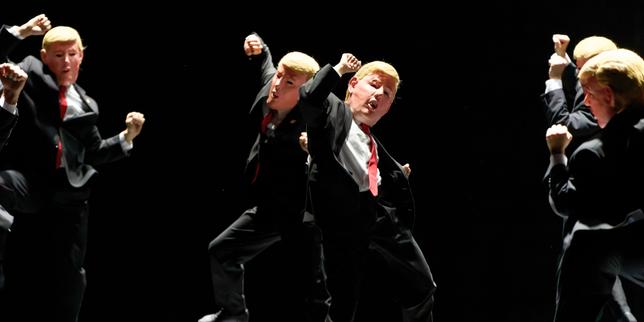
Political theater rarely survives the transition to classical dance, yet a wave of contemporary choreography has placed Donald Trump squarely at the center of the stage as a disruptive anti-hero. Productions titled America—most notably Belgian-Colombian choreographer Annabelle Lopez Ochoa’s bold ensemble piece—strip away campaign speeches and cable news punditry to examine American populism through physical tension, rigid formations, and satirical excess. Rather than offering a literal biographical impersonation, these works translate the mechanics of modern political polarization into sharp, kinetic movement, turning the forty-fifth and forty-seventh president into a symbol of institutional friction.
Dance is an inherently abstract medium. That makes it an unlikely weapon for partisan critique. Yet over the past decade, European and American stages have increasingly treated contemporary ballet not as an escapist museum piece, but as an immediate editorial cartoon written in muscle and sweat.
When a choreographer names a work America and casts a polarizing political figure as its gravitational center, the objective goes beyond easy mockery. Audiences paying upwards of eighty dollars a ticket do not show up merely to watch a dancer mimic a familiar hand gesture or adjust an oversized red tie. They come to see how an art form built on aristocratic symmetry processes an era defined by democratic upheaval.
The Mechanics of Turning Politics Into Choreography
Translating a real-world politician into a ballet anti-hero requires a deliberate rejection of literalism. If a choreographer relies too heavily on direct caricature, the piece collapses into a Saturday Night Live sketch set to strings. Instead, veteran dance makers use spatial dynamics and rhythmic disruption to represent political power.
Consider how traditional ballet operates. The corps de ballet moves in unified, predictable patterns, reflecting an idealized social order where every individual submits to a central authority—usually a monarch or a classical conductor. Introducing a Trump-inspired anti-hero into that ecosystem means breaking the geometry.
In productions exploring this theme, the central figure rarely conforms to the established tempo. While the ensemble executes tight, synchronized phrases evoking constitutional order or bureaucratic routine, the anti-hero cuts across the stage diagonally, interrupting the phrasing and forcing the group to scatter or realign. The critique is embedded in the floor pattern. You do not need a single word of dialogue to understand the tension between a solitary disruptor and a collective system.
Costuming and score do the rest of the heavy lifting. Red, white, and blue motifs appear not as pristine flags, but as fragmented, restrictive garments—suits that constrict movement, or gilded props that weigh down the performers carrying them. Musical selections frequently splice lush, nostalgic Americana with jarring electronic static or brass fanfares that cut off mid-note.
Why European Stages Lead the Charge
A striking pattern emerges when tracking politically charged ballets about the United States. The sharpest, most unvarnished productions frequently originate in Europe rather than New York or San Francisco.
Funding models explain much of this divide.
American ballet companies rely overwhelmingly on private philanthropy, corporate sponsorships, and wealthy board members. Programming a fiercely political piece that paints a sitting or former American president as a reckless anti-hero carries an immediate financial risk for a domestic artistic director. Donors walk. Subscribers cancel.
European state-subsidized houses operate under a completely different mandate. Institutions in Brussels, Amsterdam, Paris, and Berlin receive substantial public funding designed specifically to insulate artists from commercial censorship. A choreographer working within the European subsidy system is actively expected to interrogate global power structures. To an international audience, the American presidency is not a domestic family dispute; it is a global weather system that affects trade, defense, and cultural norms across the Atlantic.
This distance also alters the artistic perspective. European creators tend to view the Trump phenomenon less through the granular lens of American culture wars and more through the historical memory of twentieth-century populism. On a European stage, the anti-hero archetype carries heavy historical baggage, invoking questions about charisma, spectacle, and how quickly democratic norms can bend under the weight of a single personality.
The Trap of Preaching to the Choir
For all its visual sophistication, political ballet suffers from a persistent structural flaw. It almost always preaches to the converted.
The demographic sitting in the orchestra seats of a major contemporary dance house skews heavily urban, progressive, and cosmopolitan. When a choreographer stages a biting critique of right-wing populism, the applause at curtain call is guaranteed—not necessarily because the choreography broke new artistic ground, but because the audience feels its own worldview validated.
This creates a dangerous complacency for artists.
True theatrical tension requires genuine ambiguity. In classical tragedies, the anti-hero captivates the room precisely because the audience understands their allure, even while recoiling from their methods. Think of Shakespeare’s Richard III or Prokofiev’s tyrannical monarchs. When a modern ballet reduces a complex political movement to a collection of buffoonish tics, it sacrifices dramatic depth for cheap catharsis.
The most effective works in this genre avoid that trap by turning the mirror back onto the ensemble. Instead of portraying the public as helpless victims of a manipulative leader, sharper choreographers show the corps de ballet actively enabling, applauding, and propeling the anti-hero forward. They choreograph the complicity of the crowd, illustrating how spectacle requires both a performer and an eager audience to sustain itself.
Historical Precedents for Stage Satire
Using dance to skewer political authority is hardly a twenty-first-century invention. In fact, ballet began as an explicit instrument of state propaganda before evolving into a vehicle for subversion.
During the reign of Louis XIV, court ballets were meticulously engineered to project absolute royal power, with the king himself dancing the role of Apollo to reinforce his divine right to rule. It took centuries for choreographers to flip that script and use the same vocabulary to mock the powerful.
In the 1930s, German choreographer Kurt Jooss created The Green Table, a devastating anti-war ballet that depicted diplomats in tailored suits dancing around a negotiating table while soldiers marched to their deaths. Jooss used grotesque, exaggerated gestures to expose the hollow pageantry of political leadership on the brink of World War II. Decades later, during the height of the Cold War, choreographers on both sides of the Iron Curtain embedded subtle ideological critiques into neoclassical works, knowing that censors struggled to police pure movement.
Contemporary pieces centered on Trump sit squarely in this lineage. They recognize that politics, at its core, is already a form of choreography—a carefully managed sequence of rallies, camera angles, handshakes, and staged confrontations designed to project strength.
The Risk of Expiration Dates
Art tied directly to the news cycle faces a brutal enemy: time.
Journalism is written to capture the urgency of the immediate moment, whereas repertoire dance is built to endure across seasons. When a choreographer anchors an entire evening-length work to the specific mannerisms and controversies of a contemporary politician, the piece risks aging like milk.
Specific references lose their sting. A gesture that draws a knowing laugh in 2026 might require a program note in 2036. For a ballet titled America to survive beyond the current political era, its underlying movement vocabulary must speak to universal themes—ambition, tribalism, the fragility of institutions, and the intoxicating pull of nationalism.
Audiences ultimately remember how a piece made them feel in their gut, not how accurately a dancer mimicked a cable news clip. If the choreography relies on surface-level parody, it vanishes the moment the news cycle moves on. Only when the movement exposes the raw, timeless machinery of power does political dance earn its place on the stage.