When the Kremlin announced a planned meeting between Vladimir Putin and Donald Trump following the Asia-Pacific Economic Cooperation (APEC) summit plenary in Shenzhen, China, most wire services treated it as routine diplomatic scheduling. That was a mistake. The November 19, 2026, bilateral sit-down—which immediately morphed into an unprecedented three-way summit alongside Chinese President Xi Jinping—was never about trade policy or Pacific Rim cooperation. It was a calculated geopolitical theater designed by Moscow and Beijing to fracture Western alliances, neutralize international war crimes warrants, and legitimize a sphere-of-influence world order without giving Washington a single binding concession in return.
To understand what actually happened in southern China, you have to strip away the official communiqués and look at the incentives driving each leader into that room. State media in Moscow framed the post-plenary meeting as a natural convergence of great powers. In reality, three leaders facing severe domestic and strategic pressures used an economic forum as cover for a high-stakes optics play.
The Mechanics of a Diplomatic Trap
Diplomatic summits at multilateral forums like APEC rarely happen by accident. Every minute of an American president’s overseas schedule is fought over by competing factions inside the White House, the State Department, and the National Security Council. When the Kremlin publicly confirms a pull-aside or post-plenary meeting before the planes even touch down, Moscow is already shaping the narrative.
The mechanics of the Shenzhen encounter reveal a classic asymmetry in diplomatic preparation. For weeks leading up to the November 2026 gathering, Russian and Chinese officials coordinated protocol details down to the centimeter. Xi Jinping personally greeted Trump at the airport in Shenzhen, deploying massive displays of pageantry, military honor guards, and choreographed crowds. That flattery served a specific operational purpose. By elevating Trump’s sense of personal rapport with both Xi and Putin, Beijing and Moscow steered the agenda away from technical verification mechanisms and toward broad, unenforceable statements of goodwill.
Look at the sequence of events on November 19:
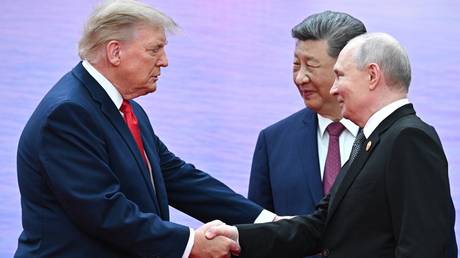
- The Bilateral Warm-Up: Trump and Putin met one-on-one prior to joining Xi, with Trump telling cameras that "a lot of wonderful things can come out of this" and referencing the relationship he had built with the Russian leader over the years.
- The Trilateral Pivot: The bilateral talks transitioned directly into a 90-minute trilateral session—the first formal three-way summit between sitting leaders of the United States, Russia, and China.
- The Communiqué: Instead of concrete timelines on troop withdrawals or arms caps, the leaders emerged with a thin "peace declaration" that targeted the International Criminal Court (ICC) and called for vague United Nations reforms.
Trump arrived in Shenzhen politically bruised. His party had just suffered heavy losses in the November midterm elections, domestic tech outages were dominating American news cycles, and escalating military strikes involving Iran were threatening global energy chokepoints like the Strait of Hormuz. He needed a headline-grabbing foreign policy triumph. Putin and Xi understood that desperation and priced their participation accordingly.
What Moscow Actually Won in Shenzhen
If you measure diplomatic success by tangible policy shifts, the post-plenary meeting looks empty. No ceasefire was signed. No borders were redrawn. Yet inside the Kremlin, the Shenzhen meetings were celebrated as a decisive victory because Putin achieved three structural objectives without moving a single battalion in Ukraine.
Neutralizing the War Crimes Stigma
Since March 2023, Vladimir Putin has operated under an active arrest warrant from the International Criminal Court for the unlawful deportation of Ukrainian children. That warrant severely restricted his travel and turned him into a diplomatic pariah across Europe and much of the Western world. Standing shoulder-to-shoulder with the President of the United States—and taking turns standing in the position of highest protocol honor to Xi Jinping’s right during group photographs—instantly shattered that isolation.
Worse still for international legal norms, Trump publicly attacked the ICC during the summit, calling the court "out of control". The resulting joint declaration explicitly rebuked the court for abusing its jurisdiction and demanded "respect for the immunities of State officials". Moscow effectively got an American president to co-sign an attack on the very institution prosecuting Russian war crimes.
Sidelining Europe and Kyiv
For nearly five years of full-scale war in Ukraine, Western strategy relied on a simple rule: nothing about Ukraine without Ukraine. By agreeing to discuss the conflict directly with Putin and Xi in Shenzhen while Ukrainian President Volodymyr Zelenskyy and more than 40 European leaders were huddled separately in Berlin with U.S. envoys Steve Witkoff and Jared Kushner, Washington validated Moscow’s preferred worldview.
Putin has long argued that European nations are mere vassals of Washington and that the war should be settled over their heads by "great powers." The optics in Shenzhen handed Russian state television endless footage proving that exact thesis. When Trump later posted a photo shaking Putin’s hand with the caption "My friend," the shockwaves hit London and Brussels immediately. Even traditional Trump allies in the United Kingdom, including Reform UK deputy leader Richard Tice and Conservative leader Kemi Badenoch, were forced to publicly distance themselves from the White House, calling the display a grave mistake.
Buying Time on Nuclear Arms Control
The Shenzhen talks took place in the shadow of the New START treaty’s expiration in February 2026. For the first time in decades, the world’s two largest nuclear arsenals are operating without legally binding verification limits or warhead caps. Trump has insisted that any replacement treaty must include China’s rapidly expanding nuclear stockpile. Beijing flatly refuses to accept parity caps while its arsenal remains smaller than those of Washington and Moscow.
By folding nuclear risk reduction into a broad, non-binding trilateral dialogue in Shenzhen, Putin and Xi successfully stalled any real verification regime. Moscow retains total freedom to modernize its strategic forces while sounding reasonable on the world stage by endorsing general statements about preventing nuclear war.
The Counter-Argument Why Washington Took the Gamble
Dismissing the Shenzhen meeting as pure incompetence misses the cold calculus operating inside the White House. Administration defenders argue that traditional containment had reached a dead end by late 2026, and that direct leader-to-leader engagement was the only remaining lever to break multiple simultaneous crises.
From Washington’s perspective, the United States was facing an unsustainable two-front strain. In Eastern Europe, the war in Ukraine was grinding through its fifth year with mounting casualties and severe budget fatigue among European allies. In the Middle East, direct conflict with Iran was driving up global oil prices and threatening maritime shipping through the Strait of Hormuz.
Both Moscow and Beijing hold immense economic and military sway over Tehran. China buys the vast majority of sanctioned Iranian crude, while Russia relies on Iranian defense industrial cooperation. Trump’s team calculated that personal engagement with Xi and Putin might persuade them to lean on Tehran to reopen the Strait of Hormuz and halt nuclear enrichment, while simultaneously opening a backchannel to freeze the front lines in Ukraine.
There is a historical logic to triangular diplomacy. Richard Nixon and Henry Kissinger famously exploited the Sino-Soviet split in 1972 to gain leverage over both Moscow and Beijing. The fatal flaw in 2026 is that the geopolitical polarity has reversed. Russia and China are not bitter ideological enemies looking to Washington for protection against each other; they are deeply integrated strategic partners united by a shared desire to dismantle American hegemony. Trying to play Beijing against Moscow when Xi is hosting Putin as a guest of honor in Shenzhen misunderstands the basic architecture of the relationship.
The Missing Pieces in Mainstream Coverage
Most initial reports on the Kremlin’s APEC announcement focused narrowly on whether Trump and Putin would shake hands or mention Ukraine. That framing ignores two underlying economic and institutional shifts that make the Shenzhen summit far more dangerous for Western stability than a simple photo op.
First, look at supply chain coercion. China’s ability to convene this summit on equal footing with the United States rests heavily on its chokehold over critical minerals, battery manufacturing, and industrial processing. European leaders watching from Brussels were not just worried about Ukraine; they were terrified that a bilateral economic truce between Trump and Xi would redirect massive waves of subsidized Chinese industrial overcapacity straight into European markets. By pairing economic discussions at APEC with security theater alongside Putin, Beijing subtly linked trade stability to geopolitical compliance.
Second, examine the hollowing out of multilateral institutions. APEC was founded in 1989 to promote free trade, open regionalism, and rules-based economic integration across the Pacific. Turning the margins of an economic summit into a forum where three nuclear-armed powers attack international courts and propose rewriting United Nations governance turns multilateralism on its head. Smaller Indo-Pacific nations—from Japan and South Korea to Australia and Vietnam—watched the proceedings with quiet alarm. If Washington is willing to sideline its closest European allies to cut side deals with Moscow and Beijing, Asian partners have every reason to question the durability of American security guarantees in the Taiwan Strait or the South China Sea.
What Happens When Optics Replace Strategy
A week after the cameras packed up in Shenzhen, the reality on the ground had not moved an inch. Russian missiles continued to strike Ukrainian infrastructure. Fighting in the Middle East continued to rattle energy markets. Trump later told reporters that he had asked Putin to pull back military aggression across Europe, framing the talks as the start of a process. Yet in Brussels, European Union leaders were locked in fractious emergency meetings, scrambling to shore up independent defense financing amid growing doubts about Washington’s reliability.
Personal chemistry between leaders is not a substitute for leverage. Authoritarian rulers like Vladimir Putin and Xi Jinping treat summits as tactical milestones in multi-decade campaigns, not as finish lines. When an American president enters a room seeking validation and quick headlines without concrete preconditions, the outcome is predetermined before the interpreters even sit down. Moscow got legitimacy, Beijing got the spotlight, and Washington walked away holding nothing more than a handshake and a promise to keep talking.