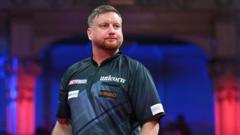
A Sudden Silence at Winter Gardens
The noise inside the Winter Gardens in Blackpool is usually loud enough to vibrate the floorboards. On Wednesday night, July 22, 2026, the roar died in an instant.
Cameron Menzies stood at the oche against Ross Smith in the second round of the Betfred World Matchplay. He was leading 2-1. Just forty-eight hours earlier, the 37-year-old Scot had produced the performance of his life, upsetting world number two Luke Humphries 10-7 with a stunning 170 checkout. He was throwing with the swagger of a man who had finally unlocked his vast potential. For a different perspective, consider: this related article.
Then, midway through the fourth leg, everything changed.
Menzies reached for his left ear. He stumbled backward, his eyes unfocused, swaying under the blistering television lighting. He bent double, hands clutched around his knees as he struggled for air. Ross Smith stopped mid-flight, stepping away from the board to offer aid. The referee moved in. Within seconds, Sky Sports cut its broadcast away from the stage, switching to anxious commentary as St John Ambulance medics rushed into the wings. Related analysis on this matter has been published by CBS Sports.
The match was abandoned. The Professional Darts Corporation later confirmed Menzies had suffered a severe spike in blood pressure, causing acute dizziness before he fainted off-camera. Smith was awarded a default passage into the quarter-finals. Menzies was treated on-site and stabilized.
To the casual viewer, it was a frightening, freak health episode. To those who have tracked the brutal reality of professional darts over the last decade, it was something far more alarming. It was an inevitable reckoning.
The Illusion of a Low-Impact Sport
Darts looks easy from a couch. Men and women in collared shirts stand fifteen feet away from a board, tossing tiny bits of tungsten into double-inch segments. There is no tackling. There are no sprint intervals. There is no heavy lifting.
That perception is complete nonsense.
Professional darts is an endurance nightmare masquerading as a pub game. A top-tier player spends up to ten hours a day on their feet, holding a rigid posture that wreaks havoc on the lower back, hips, and shoulders. They work inside crowded, airless arenas where stage temperatures routinely breach ninety degrees Fahrenheit under heat-emitting broadcast rigs.
The physiological strain is deceptive. When a player steps up to hit a match-winning double, their heart rate does not gently elevate. It spikes to rates rivaling marathon runners. Medical studies on elite precision athletes show that acute mental stress under extreme focus triggers intense vasoconstriction—a sudden narrowing of blood vessels that drives blood pressure through the roof.
When you compound that physical environment with constant travel across Europe, irregular sleep patterns, and high-calorie catering, you create a biological pressure cooker. Menzies did not simply feel unwell on Wednesday. His body hit a wall built by months of relentless conditioning fatigue and acute fight-or-flight over-arousal.
The Raw Human Cost of Competing on the Edge
To understand what happened in Blackpool, you have to look at the man behind the darts. Cameron Menzies does not possess the icy, detached demeanor of a mechanical scoring machine. He plays with his nerves permanently exposed to the air.
He wears his heart on his sleeve, a trait that makes him a fan favorite but leaves him utterly defenseless against the psychological weight of the sport. His career has been defined by extreme emotional volatility.
Just months before his collapse at the World Matchplay, Menzies hit rock bottom at the PDC World Championship at Alexandra Palace. Following a agonizing first-round defeat to Charlie Manby, he lost control of his temper backstage and repeatedly smashed his bare fist into a solid wooden table. He left the venue dripping blood, needing emergency surgery to repair structural damage to his hand. For six weeks afterward, he had no feeling in his fingers. He openly admitted he considered walking away from the sport forever, burdened by shame and physical impairment.
He fought his way back. He underwent hand therapy, reshaped his mental approach, and arrived in Blackpool playing the best darts of his life. The victory over Luke Humphries was meant to be his redemption arc.
Yet high emotional stakes cut both ways. The adrenaline rush of a career-defining triumph can collapse into profound nervous exhaustion forty-eight hours later. For a player with a history of anxiety and emotional hyper-reactivity, the intense sensation of standing under the spotlight with victory in sight proved too much for his circulatory system to bear.
When Rules Clash with Medical Realities
The abandonment of the match raises uncomfortable questions about how professional sports governing bodies handle medical emergencies mid-contest.
Under current PDC rules, if a player cannot continue a match due to illness or injury, the match is forfeited. Ross Smith progressed to the quarter-finals automatically. While Smith handled the distressing situation with complete grace and concern for his friend, the structural outcome feels harsh.
Darts regulations are built on a binary framework designed to prevent gamesmanship. If a match could simply be postponed overnight due to an illness, officials fear unethical players might simulate panic attacks or physiological distress to break an opponent's momentum when losing.
However, treating an acute medical emergency—like a dangerous spike in blood pressure verified by St John Ambulance medics—the exact same way as a tactical withdrawal creates a perverse incentive. Players facing extreme bodily distress are motivated to push past safe medical limits to avoid immediate elimination from tournaments worth hundreds of thousands of pounds.
Menzies knew what was at stake. Winning that match would have propelled him into the top tier of the global rankings, guaranteeing lucrative exhibition contracts and major tournament berths. He tried to stay on his feet while his cardiovascular system was actively failing him because the system offers no pause button for human fragility.
The Modern Tour Machine Needs a Reset
The PDC circuit has expanded at a dizzying rate over the past five years. Prize money is at an all-time high, driven by massive television contracts, global streaming deals, and arena tours that sell out in minutes.
The calendar is relentless. Players bounce from European Tour events over the weekend to ProTour floor tournaments on Monday and Tuesday, only to jump on flights for major televised events by Thursday. There is virtually no off-season.
This breakneck schedule takes a heavy toll. While sports like tennis and golf have integrated sophisticated sports medicine teams, biometric tracking, and mandatory recovery periods into their tour infrastructure, darts remains culturally rooted in an older era. Players are largely left to manage their own physical conditioning, mental health, and nutritional strategies in isolation.
The incident in Blackpool must serve as a wake-up call for tournament organizers. Expecting elite athletes to perform under suffocating heat, relentless public scrutiny, and immense financial pressure without comprehensive, mandatory medical support protocols is no longer sustainable.
A Sport Forced to Face Its Own Reality
Cameron Menzies returned to his hotel room on Wednesday night conscious and surrounded by loved ones, but his sudden collapse left an indelible mark on the 2026 World Matchplay.
The sport can no longer pretend that throwing darts is merely a test of hand-eye coordination. It is a severe test of psychological resilience and physical stamina, conducted inside a pressure cooker that breaks even the most talented competitors.
Menzies will recover from his hypertensive episode, but the broader questions surrounding player welfare, tour scheduling, and mid-match medical policies remain unanswered. Until the governing bodies treat these athletes with the same duty of care demanded in high-impact physical sports, the stage at Winter Gardens will remain a volatile, dangerous place to work.


