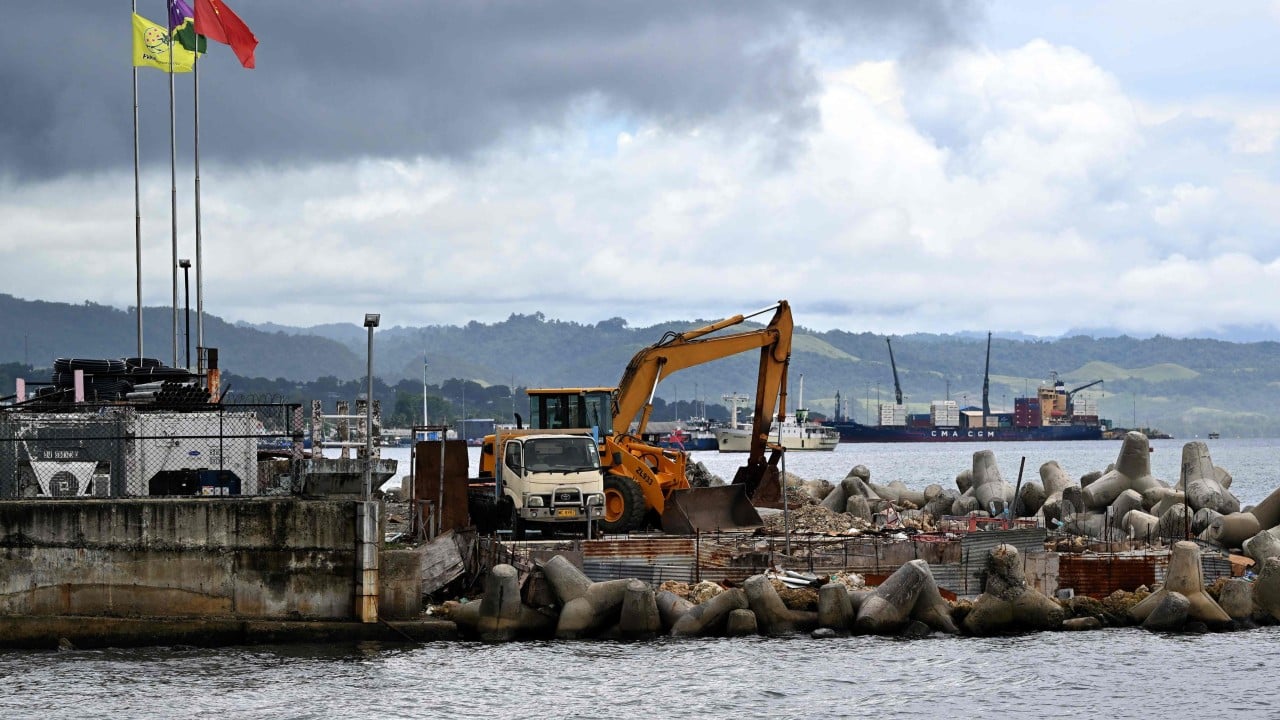
The United States is locked in advanced financial negotiations with the Solomon Islands to fund the development of Bina Harbour, marking a desperate attempt to catch up after years of diplomatic neglect in the South Pacific. For decades, Washington treated its regional obligations as an afterthought, leaving a vacuum that Beijing readily filled with infrastructure financing, police training programs, and strategic security pacts. Now, the White House and Canberra are scrambling to rewrite the rules of maritime dominance by backing deep-water commercial projects. This sudden burst of economic statecraft is less about altruistic development and more about pure geopolitical triage.
Look past the diplomatic communiqués coming out of Washington and Honiara. The reality on the ground reveals a small island nation expertly playing major global powers against one another to secure maximum national infrastructure funding. When a sovereign government faces crushing economic hurdles and limited domestic capital, whoever shows up with open checkbooks wins the day. Beijing understood this calculus years ago, systematically securing commercial ports, logging concessions, and a contentious security agreement that sent shockwaves through the Pentagon. American strategists suddenly woke up to the realization that commercial wharves can easily double as forward logistics nodes for foreign navies. You might also find this connected article interesting: The Normalization Trap Behind Global Apathy to Presidential Threats.
The proposed funding for Bina Harbour involves critical infrastructure upgrades, including wharves, local power generation grids, fuel storage depots, and heavy-duty access roads. These are assets the local economy has desperately required for generations to support its commercial tuna industry and regional shipping lanes. Yet, every ton of concrete poured and every dollar spent carries heavy strategic weight. Washington is utilizing the International Development Finance Corporation to bypass traditional bureaucratic stagnation, deploying capital directly into regions where Chinese state-owned enterprises previously held a near-monopoly on large-scale civil engineering contracts.
Critics of this sudden American pivot point out a fundamental flaw in the strategy. Writing checks for concrete does not automatically translate into long-term diplomatic loyalty. Pacific nations have made it abundantly clear that they reject forced binary choices between Western democracies and Beijing. The recent signing of maritime enforcement frameworks, such as local shiprider agreements with the United States, runs parallel to existing arrangements with other international partners. Sovereignty in the contemporary Pacific means keeping options open. When external actors demand exclusivity, local leaders often push back, leveraging their strategic geography to extract concessions from multiple directions simultaneously. As extensively documented in latest coverage by NBC News, the implications are worth noting.
The broader geopolitical struggle relies heavily on maritime domain awareness. Whoever controls the ports controls the surrounding sealanes, fisheries, and underwater communication corridors. For years, the U.S. Coast Guard and regional navies struggled to maintain a consistent physical presence across millions of square miles of open ocean. By financing civilian port infrastructure that can support dual-use logistics, Western allies hope to secure logistical footholds without repeating the heavy-handed colonial mistakes of the past. Yet, building infrastructure is only half the battle. Maintaining economic relevance requires sustained commercial trade, fair market access, and reliable partnerships that outlast changing political administrations in Washington and Canberra.
The race for influence in Oceania remains volatile. Financial commitments made today must survive bureaucratic bottlenecks, environmental hurdles, and local political shifts. As construction blueprints for Bina Harbour move closer to reality, the true test will not be whether Western capital can outbid rival offers. The real challenge is whether foreign powers can offer a partnership model that respects local autonomy while delivering genuine, lasting economic growth to communities caught in the crosshairs of a new global cold war.

.png?itok=1mb05mKJ)

