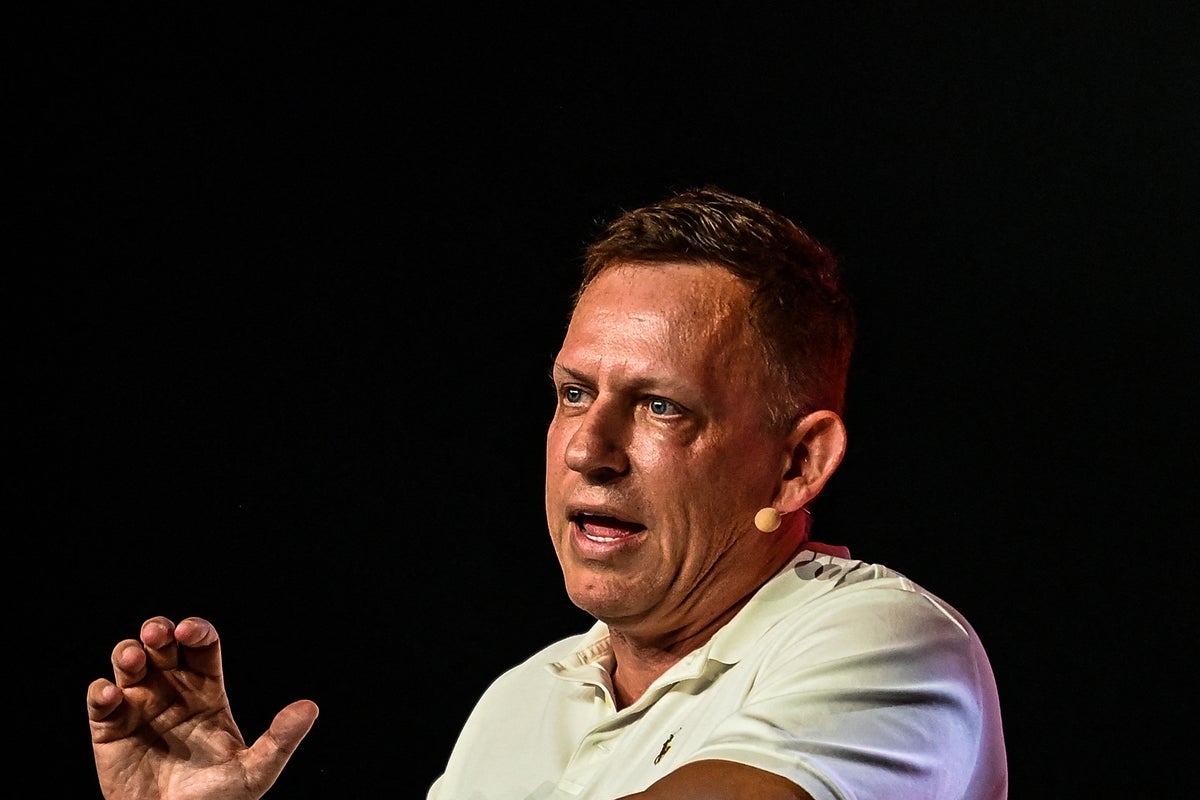
Tech billionaire Peter Thiel has reportedly bought a $12 million mansion in Buenos Aires and temporarily relocated his family to Argentina to escape a looming California wealth tax, highlighting a growing tension between global tech elites and the nation-states that fund them. This shift occurs even as Thiel's core enterprises continue to draw massive financial support from the American government. Palantir, the data-analytics giant he chairs, brought in $687 million in U.S. government revenue during the first quarter of 2026 alone. Meanwhile, Anduril Industries, a defense technology firm heavily backed by his Founders Fund, recently locked in a U.S. Army contract worth up to $20 billion. The stark contrast between a personal exit plan and deep dependence on federal contracts exposes a fundamental vulnerability in modern governance.
Silicon Valley has long operated under the philosophy of the Sovereign Individual, an ideology dictating that capital and talent owe no permanent allegiance to any single geography. Thiel, who previously secured New Zealand citizenship and explored options in Malta, has consistently put this theory into practice. His sudden affinity for Argentina is not merely a lifestyle choice; it is a calculated response to California’s proposed initiative, which aims to levy a 5% annual tax on residents with a net worth exceeding $1 billion. To avoid the January 1, 2026 residency deadline attached to the measure, Thiel moved his capital and his family. Also making waves recently: Why Wildfires Are Actually Saving France’s Oyster Capital From Itself.
The Subsidized Escape Hatch
The primary contradiction of the billionaire exit strategy lies in the origins of the wealth being protected. Unlike internet entrepreneurs who scale consumer software applications globally with minimal state interaction, the modern defense-tech boom relies entirely on the state as its primary customer.
Palantir and Anduril do not survive on consumer subscriptions. They build the intelligence architecture and autonomous systems utilized by the Pentagon, immigration enforcement, and domestic law enforcement agencies. The capital used to purchase real estate in the exclusive Barrio Parque neighborhood of Buenos Aires was generated through contracts paid for by the American taxpayer. Further information into this topic are explored by Harvard Business Review.
This creates a structural imbalance where the financial upside of national defense procurement is entirely privatized and expatriated, while the fiscal burden of maintaining the nation’s infrastructure remains with the domestic public. When prominent industrialists systematically hedge against the stability of the state providing their revenue, it signals a deeper institutional breakdown.
The Ideological Alliance with Anarcho-Capitalism
Argentina currently presents a unique laboratory for ultra-high-net-worth individuals seeking a regulatory vacuum. President Javier Milei has aggressively pursued a program of radical deregulation, public spending cuts, and a philosophical stance that positions taxation as a form of state-sanctioned theft. For a billionaire who once wrote that democracy and freedom are no longer compatible, Milei's administration offers an ideal testing ground.
During his recent stay in Buenos Aires, Thiel engaged in high-level discussions with Milei and various local economists. These meetings were not focused on establishing manufacturing hubs or building local engineering infrastructure. Instead, the dialogue centered on how libertarian principles could outlast a single political presidency and, curiously, explored esoteric theories regarding global governance and existential risk.
For the host nation, the benefit of these interactions remains heavily lopsided. While local administrations often court foreign tech titans in the hope of securing high-tech employment or capital injection, the reality is frequently far more transactional. Wealthy expatriates utilize these regions as a Plan B, bringing inflation to local real estate markets while keeping their primary corporate holdings anchored in traditional Western legal frameworks for maximum protection.
The Mirage of Geopolitical Insulation
A recurring theme among modern tech elites is the pursuit of geographic insulation from global catastrophes, such as nuclear escalation or the unchecked advancement of artificial intelligence. The Southern Hemisphere is frequently targeted by survivalist investors who believe that distance from northern hemisphere conflict zones offers safety. Thiel's reported land acquisitions in Uruguay follow a similar logic.
This isolation strategy is fundamentally flawed. A localized real estate footprint does not disconnect an individual from a globally integrated financial system. The value of Thiel's vast portfolio remains bound to the performance of Western stock exchanges, the liquidity of the U.S. dollar, and the operational continuity of Silicon Valley banks. If a catastrophic global event were to destabilize the primary economies of the West, the wealth required to maintain private security, independent energy grids, and isolated estates would evaporate overnight.
Furthermore, the legal protections that allow billionaires to move billions across borders with a keystroke are maintained by the very international state system that these exit strategies seek to bypass. A passport is only as valuable as the diplomatic and military power of the nation that issues it.
The Impending Corporate Confrontation
As national governments face mounting fiscal deficits and increasing public scrutiny over wealth inequality, the tolerance for mobile capital is beginning to wane. The friction between state authorities and hyper-mobile tech executives is likely to intensify, moving beyond state-level initiatives like California's wealth tax to international frameworks.
We are approaching an environment where access to lucrative government procurement contracts may eventually become legally tied to domestic residency and tax compliance. If a corporation's primary revenue stream is derived from national security infrastructure, the state possesses significant leverage to demand that its principal shareholders remain within the domestic tax base.
The strategy of extracting capital from a domestic government while systematically moving personal liabilities offshore is reaching its structural limit. When the state decides to exercise its power as a monopsony buyer, the sovereign individual may find that the ultimate exit plan carries a cost far higher than any wealth tax.