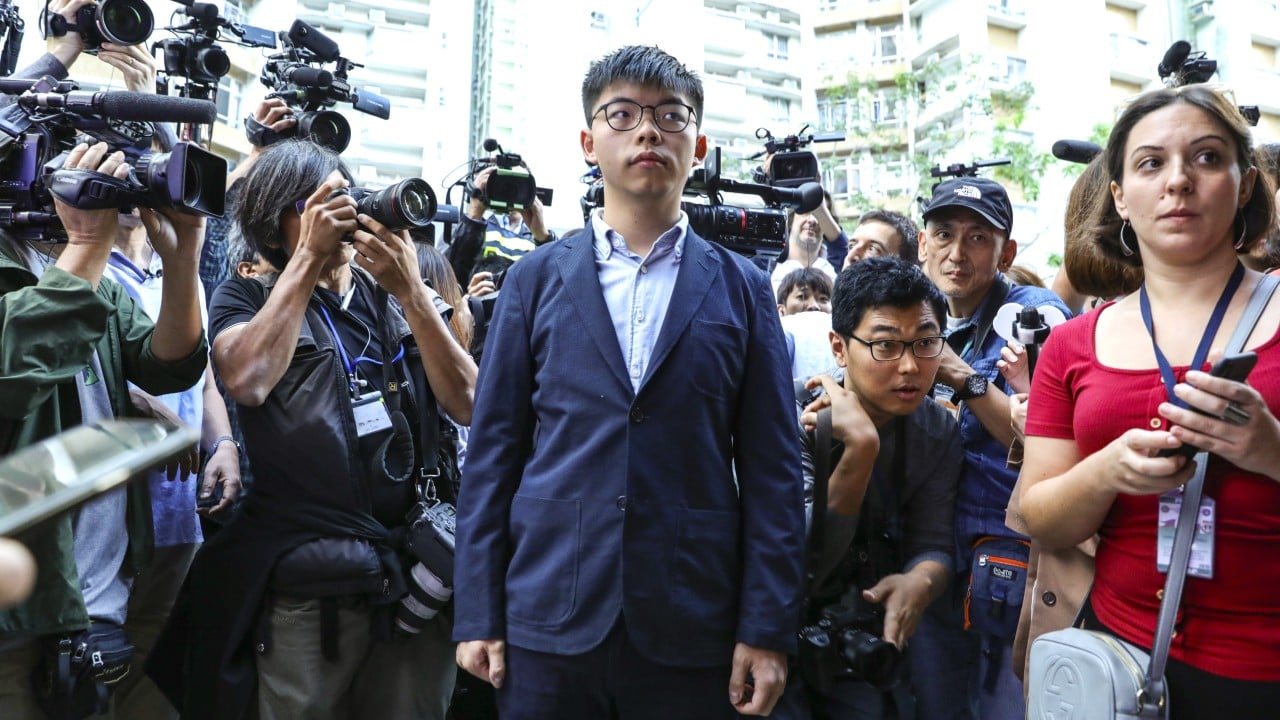
In late 2026, Hong Kong’s High Court handed prominent democracy activist Joshua Wong a ten-year prison sentence after he pleaded guilty to conspiring to collude with foreign forces to impose sanctions on Beijing and the Hong Kong government. The ruling—delivered under the Beijing-imposed National Security Law—marks one of the steepest penalties ever issued to a former student protest leader in the territory. More than an individual punishment, the verdict establishes a permanent legal boundary in Hong Kong, signaling that international lobbying and cross-border political advocacy now carry the exact same judicial weight as domestic subversion.
To understand how a 29-year-old activist who first rose to prominence opposing school curriculum changes ended up facing a decade behind bars, you have to look past the surface headlines of courtroom drama. The mechanics of this case reveal a methodical transformation of Hong Kong’s legal architecture, turning what was once standard international diplomacy for opposition politicians into a severe national security offense.
The Architecture of a National Security Conviction
For decades, Hong Kong operated under a common law system that fiercely protected political speech, even when that speech angered authorities in Beijing. Opposition lawmakers routinely traveled to Washington, London, and Brussels to testify before parliamentary committees, meet with foreign officials, and advocate for international pressure on local governance.
Everything changed on June 30, 2020.
When the Standing Committee of the National People's Congress enacted the Hong Kong National Security Law (NSL), it bypassed the local legislature entirely and introduced four broad categories of crime: secession, subversion, terrorism, and collusion with a foreign country or with external elements to endanger national security.
Under Article 29 of the NSL, requesting a foreign country or institution to impose sanctions, blockades, or engage in other hostile activities against the Hong Kong Special Administrative Region or the People's Republic of China became a major felony. The law did not merely ban future conduct; prosecutors used pre-2020 actions as foundational context to establish ongoing conspiracies that crossed the June 2020 threshold.
In Wong’s case, the prosecution focused on his international advocacy—specifically his engagements with foreign politicians, public statements urging international accountability, and coordination with overseas networks to lobby for targeted sanctions against Chinese and Hong Kong officials. Even though Wong was already serving prison sentences for earlier unauthorized assembly charges and his role in the 2020 unofficial legislative primary (the "Hong Kong 47" subversion trial), the collusion charge represented a fundamentally different tier of legal exposure.
Why the Sentencing Math Matters
Under the NSL, offenses are divided into tiered sentencing brackets based on the court's assessment of severity. For collusion with foreign forces, the law stipulates a baseline sentence of three to ten years. However, if the court deems the offense to be of a "grave nature," the sentencing floor jumps to ten years, extending all the way to life imprisonment.
| Legal Provision | Offense Category | Standard Sentencing Range | "Grave Nature" Sentencing Range |
|---|---|---|---|
| NSL Article 20 | Secession | 3 to 10 years | 10 years to life |
| NSL Article 22 | Subversion | 3 to 10 years | 10 years to life |
| NSL Article 29 | Foreign Collusion | 3 to 10 years | 10 years to life |
By classifying Wong’s involvement in the sanctions push as an offense of a grave nature, the bench locked in the ten-year minimum. A guilty plea typically yields a one-third reduction in prison time under Hong Kong’s long-standing sentencing guidelines. Yet in national security cases, judges have consistently ruled that mandatory minimum sentences under the NSL take precedence over traditional common law discounts, meaning a guilty plea cannot drop a sentence below the statutory floor unless the defendant provides substantial assistance to authorities in prosecuting others.
From Scholarism to the High Court Dock
Joshua Wong’s trajectory mirrors the entire arc of Hong Kong’s post-handover political conflict. He was never a traditional party politician with deep institutional backing. Instead, he emerged as a tactical organizer who understood how to mobilize public sentiment around specific, tangible grievances.
In 2011, at age fourteen, Wong co-founded Scholarism, a student activist group opposing the government’s introduction of "Moral and National Education" in public schools—a curriculum critics argued amounted to state propaganda. Through mass protests and hunger strikes outside government headquarters, the teenager forced the administration to shelve the plan in 2012. It was a rare, complete victory against Beijing-backed policy, and it turned Wong into the face of a new generation of activists who rejected the cautious, incremental approach of older pan-democrat politicians.
Two years later, during the 2014 Umbrella Movement, Wong was one of the student leaders whose arrest sparked a 79-day occupation of major thoroughfares across Hong Kong. The protests demanded genuine universal suffrage for the election of the city's Chief Executive. While the occupations ended without political concessions, they radicalized a segment of the electorate and convinced Wong that street protests alone could not move Beijing.
In 2016, he co-founded Demosistō, a political party advocating for Hong Kong’s "self-determination." The shift in strategy was deliberate. Recognizing that Beijing held absolute structural control over Hong Kong’s political apparatus, Wong and his colleagues pivoted toward internationalizing the Hong Kong issue. Their theory was straightforward: Hong Kong’s value to China rested heavily on its status as a global financial hub with distinct trade privileges, separate customs territory status, and an independent judiciary. If Western democracies threatened to revoke those privileges in response to political crackdowns, Beijing would face real economic costs for eroding the city’s autonomy.
The Mechanics of the Sanctions Strategy
During the height of the 2019 anti-extradition bill protests, Wong’s international lobbying reached its peak. Following his release from a brief prison term in June 2019, he embarked on a high-profile diplomatic tour, speaking in Berlin, Washington, and Taipei.
In September 2019, Wong testified before the U.S. Congressional-Executive Commission on China on Capitol Hill. Dressed in a dark suit rather than the black t-shirts of the street protesters, he urged American lawmakers to pass the Hong Kong Human Rights and Democracy Act. That legislation, signed into law two months later, required the U.S. government to conduct annual reviews of Hong Kong's autonomy to justify its special trade status and authorized targeted sanctions—asset freezes and visa bans—against officials deemed responsible for human rights abuses in the territory.
To Wong and his allies, this was legitimate, non-violent diplomatic advocacy aimed at preserving the "One Country, Two Systems" framework promised in the 1984 Sino-British Joint Declaration.
To Beijing, it was treason.
Chinese state media began labeling Wong a "black hand" and a traitor colluding with Western intelligence agencies to destabilize the nation. From Beijing’s perspective, inviting foreign powers to impose economic or diplomatic penalties on Chinese sovereign territory crossed an existential red line. After a century of foreign intervention in China—a period deeply embedded in the Chinese Communist Party’s historical narrative—any domestic actor partnering with Western governments to pressure Beijing is viewed not as a political dissident, but as an agent of foreign containment.
The Counter-Argument and the Strategic Miscalculation
Evaluating the fallout of Wong’s ten-year sentence requires confronting an uncomfortable reality that many sympathetic observers avoid: the international lobbying strategy failed to achieve its primary objective, and it handed Beijing the exact pretext it needed to dismantle Hong Kong’s opposition movement entirely.
The core premise of the sanctions push rested on deterrence. Activists believed that the threat of U.S. Treasury sanctions and the revocation of special trade privileges would force Beijing to back down and grant democratic concessions. Instead, the opposite happened. Rather than deterring Beijing, foreign sanctions convinced the central government that Hong Kong had become a national security vulnerability—a base of operations for Western powers seeking to undermine China from within.
Beijing calculated that the political risk of losing control over Hong Kong outweighed the economic cost of Western sanctions. Once that calculation was made, the central government moved with overwhelming speed.
- The Political Purge: Within months of the NSL taking effect, Demosistō disbanded, dozens of opposition lawmakers resigned or were disqualified, and the entire leadership of the pro-democracy camp was arrested.
- The Legal Precedent: Prosecutors used the exact speeches, op-eds, and congressional testimonies that activists had celebrated in 2019 as irrefutable evidence of foreign collusion in 2020 and beyond.
- The Economic Adaptation: While targeted officials faced banking restrictions, Hong Kong’s broader financial sector did not collapse. Capital flows shifted, mainland Chinese firms filled the void left by departing Western entities, and the city pivoted aggressively toward deeper integration with the Greater Bay Area.
In hindsight, the activists severely underestimated Beijing’s willingness to absorb economic friction in pursuit of absolute political security. They also overestimated the willingness of Western capitals to impose crippling, broad-based economic penalties on a major global financial center where thousands of American and European corporations maintained regional headquarters.
The Gray Areas of Hong Kong’s Judicial Transformation
Western governments and human rights organizations condemned Wong’s sentencing as politically motivated, arguing that the prosecution criminalized peaceful expression and retroactive political activity. Conversely, the Hong Kong government and Beijing’s Ministry of Foreign Affairs maintained that the trial followed strict legal procedures, noting that no one is above the law and that national security legislation in Western countries carries similarly severe penalties for conspiring with foreign powers.
Both arguments miss the nuanced reality of how Hong Kong’s courts actually operate today.
Hong Kong’s judiciary has not simply been replaced by mainland-style party courts. Judges still write lengthy, meticulously reasoned common law judgments citing precedents from the United Kingdom, Australia, and Canada. Defendants are represented by skilled senior counsel, and rules of evidence remain rigorously enforced in ordinary commercial and criminal cases.
However, in national security trials, the structural rules have been permanently altered:
- Designated Judges: Only a specific pool of judges handpicked by the Chief Executive—who is accountable to Beijing—can preside over NSL cases.
- No Juries: Unlike traditional High Court criminal trials in Hong Kong, where a jury of peers determines guilt or innocence, NSL trials in the High Court are heard by a panel of three designated judges.
- Presumption Against Bail: Under common law, bail is generally granted unless prosecutors prove a flight risk or danger of reoffending. Under the NSL, bail is denied unless the judge has sufficient grounds to believe the accused will not continue to commit acts endangering national security—a nearly impossible threshold for defendants charged with speech-related offenses.
- Binding Interpretations: If a legal ambiguity arises, the Standing Committee of the National People's Congress in Beijing holds the ultimate constitutional authority to issue an interpretation of the law that Hong Kong courts must follow.
This hybrid system creates a profound legal gray area. The courtroom procedures look familiar to any common law practitioner, yet the substantive outcomes are predetermined by statutory frameworks designed to prioritize state security above individual civil liberties.
The Ripple Effect on Civil Society and Corporate Risk
The ten-year sentence handed to Wong serves a dual purpose: incapacitation and deterrence. By keeping one of the movement’s most recognizable figures incarcerated well into the 2030s, authorities ensure he cannot serve as a rallying point during key political anniversaries.
More importantly, the verdict sends an unambiguous warning to what remains of Hong Kong’s civil society, academia, and international business community. The definition of "external elements" under the NSL is deliberately broad. It does not just cover foreign governments and intelligence agencies; it encompasses foreign non-governmental organizations, international think tanks, and overseas advocacy groups.
For journalists, researchers, and corporate risk analysts operating in Hong Kong, the line between routine international engagement and unlawful collusion has blurred. Sharing non-public policy analysis with a foreign consulate, attending an overseas conference funded by a Western foundation, or publishing research critical of state economic policies now requires careful legal vetting. Many international NGOs and media outlets have quietly relocated their regional hubs to Taipei, Seoul, or Singapore, not necessarily because they expect imminent arrest, but because the legal ambiguity makes routine operations untenable.
A Permanent Shift in the Political Landscape
When Joshua Wong walked into the High Court dock, he was already a veteran of Hong Kong’s prison system, having spent years behind bars across multiple convictions stemming from the 2014 and 2019 protests. Unlike several prominent peers—such as Nathan Law, Sunny Cheung, and Ted Hui—who fled into exile in London, Washington, and Adelaide before travel bans could be enforced, Wong chose to remain in Hong Kong, fully aware that arrest was inevitable.
That decision cemented his status among supporters as a symbol of unwavering commitment, even as it guaranteed his removal from public life for over a decade.
The ten-year sentence closes the chapter on an era when Hong Kong’s streets and legislative chambers functioned as an open battleground over the future of Chinese governance. The city remains a vital conduit for global capital, its skyline unchanged, its courts still speaking the language of English common law. Yet beneath that familiar surface, the political boundaries are now carved in stone, enforced not by riot police in the streets, but by decade-long sentences handed down from the bench.