The ambitious promise to bring rapid commercial development and an ironclad ceasefire to the Gaza Strip has run directly into the buzzsaw of Middle Eastern geopolitical reality. When the White House unveiled its sweeping twenty-point plan last October, backed by a corporate-styled Board of Peace, it was sold as a business-forward blueprint that would succeed where decades of traditional diplomacy had failed. Yet, six months after transitioning into its critical second phase, the framework is locked in a dangerous paralysis. The immediate humanitarian relief achieved during the initial phase has given way to structural deadlocks over disarmament, repeated security friction, and the quiet collapse of local administrative cooperation.
To understand why this commercialized peace strategy is stalling, one must look past the glittering press releases issued in Washington and Davos. The core failure is not a lack of funding or managerial willpower. Instead, it is the fundamental error of treating a deeply rooted asymmetric war as a corporate turnaround project.
The Illusion of the Corporate Turnaround
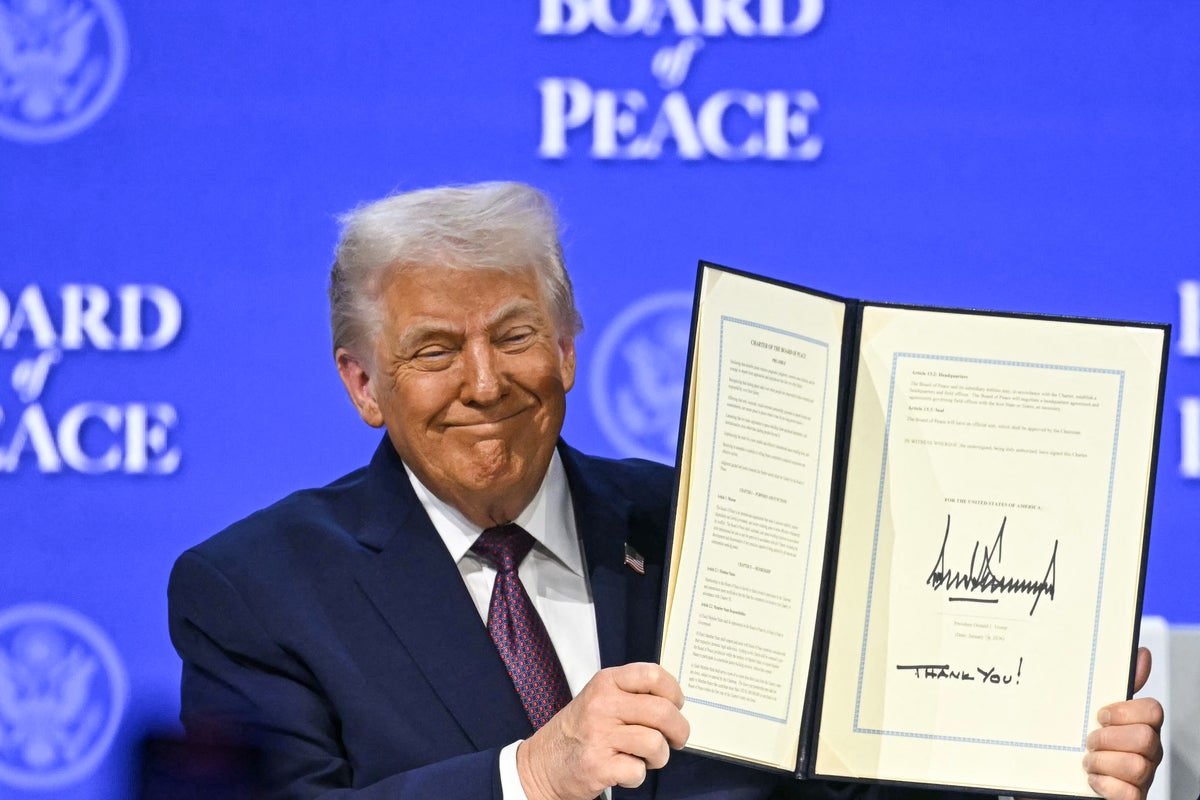
The architecture of the initiative, spearheaded by the administration and key regional partners, treated Gaza's recovery like a distressed asset restructuring. The centerpiece of this strategy was the creation of the Board of Peace, an international body chaired by Donald Trump with an executive lineup featuring real estate envoys, international financiers, and former Western prime ministers. The theory was simple. By dangling billions of dollars in infrastructure investments and offering permanent board seats to wealthy nations for a billion-dollar entry fee, Washington believed it could buy stability.
Money, however, cannot fill a political vacuum. While the United Arab Emirates and Kuwait pledged over a billion dollars to the reconstruction pool, the World Bank noted the actual cost to rebuild the shattered enclave exceeds seventy billion dollars. More critically, the plan assumed that a committee of apolitical Palestinian technocrats could step in and run day-to-day operations under international oversight, completely bypassing local political dynamics.
This technocratic fantasy shattered on July 6, when the local civil administration under the plan resigned. By trying to strip politics out of governance, the framework alienated the very people required to administer electricity, water, and medical care. You cannot run a war zone with a board of directors when the people on the ground do not recognize the board's authority.
The Disarmament Deadlock
Phase two of the agreement required an immediate shift from a temporary cessation of hostilities to the total demilitarization of Gaza. Clause thirteen explicitly dictated that Hamas and other militant factions would have no role in governance, all tunnels would be destroyed, and weapons would be permanently removed.
This remains the structural flaw that broke the momentum. Hamas agreed to the initial October ceasefire and returned the remains of the final Israeli hostages in January, fulfilling its phase-one obligations. But the group has consistently rejected total disarmament without a guaranteed path to an independent Palestinian state.
Phase 1: Immediate Ceasefire & Hostage Return (Completed Jan 2026)
Phase 2: Total Demilitarization & Technocratic Rule (Stalled)
The administration’s negotiators operated on the assumption that economic incentives would force a militant faction to voluntarily dissolve its military wing. It was a severe miscalculation. For an armed faction, weapons are not a bargaining chip to be traded for infrastructure; they are the sole source of their political survival. When Special Envoy Steve Witkoff announced the start of phase two in mid-January, there was no realistic mechanism to enforce disarmament without reigniting open warfare.
The Unenforceable Stabilization Force
Another major crack in the strategy lies in the proposed International Stabilization Force. The plan envisioned twenty thousand international troops and twelve thousand police officers deployed to divide Gaza into five distinct security sectors, beginning in Rafah. This force was intended to manage borders and train a new, vetted Palestinian police force.
Yet, six months into the year, the force exists largely on paper. Western allies, particularly within NATO, flatly declined invitations to participate. They expressed deep reservations over the board's sweeping charter and the decision to include nations whose leaders face international legal sanctions.
Without broad Western backing, the burden fell entirely on regional Arab state partners. But these neighboring states are highly reluctant to act as an occupation force. To police Gaza effectively, these troops would have to hunt down remaining militant cells and enforce an unpopular demilitarization mandate. No regional capital wants its soldiers filmed fighting Palestinians to enforce a framework designed in Washington.
Friction on the Ground
While diplomacy stalls in air-conditioned rooms, the security situation on the ground has quietly deteriorated. Since the January transition, intermittent military strikes and security operations have continuously eroded the fragile trust built during the initial hostage exchanges.
The administration’s insistence that the region can transition directly into a prosperous trade hub ignores the reality of frozen battle lines. Thousands of displaced residents remain stuck in temporary camps, unable to return to destroyed neighborhoods because reconstruction funds are held hostage by the political standoff. The Board of Peace met with great fanfare in Washington this past February, but a committee cannot pour concrete while drones are still humming overhead.
The current deadlock leaves the White House with a stark choice. It can continue to insist on an all-or-nothing corporate restructuring that demands immediate disarmament before any real rebuilding begins. Or it can adapt the framework to recognize that political recognition, rather than just investment capital, is the currency that buys actual security in the Middle East. Until that shift occurs, the promise of rapid prosperity will remain an expensive public relations exercise frozen on the launchpad.