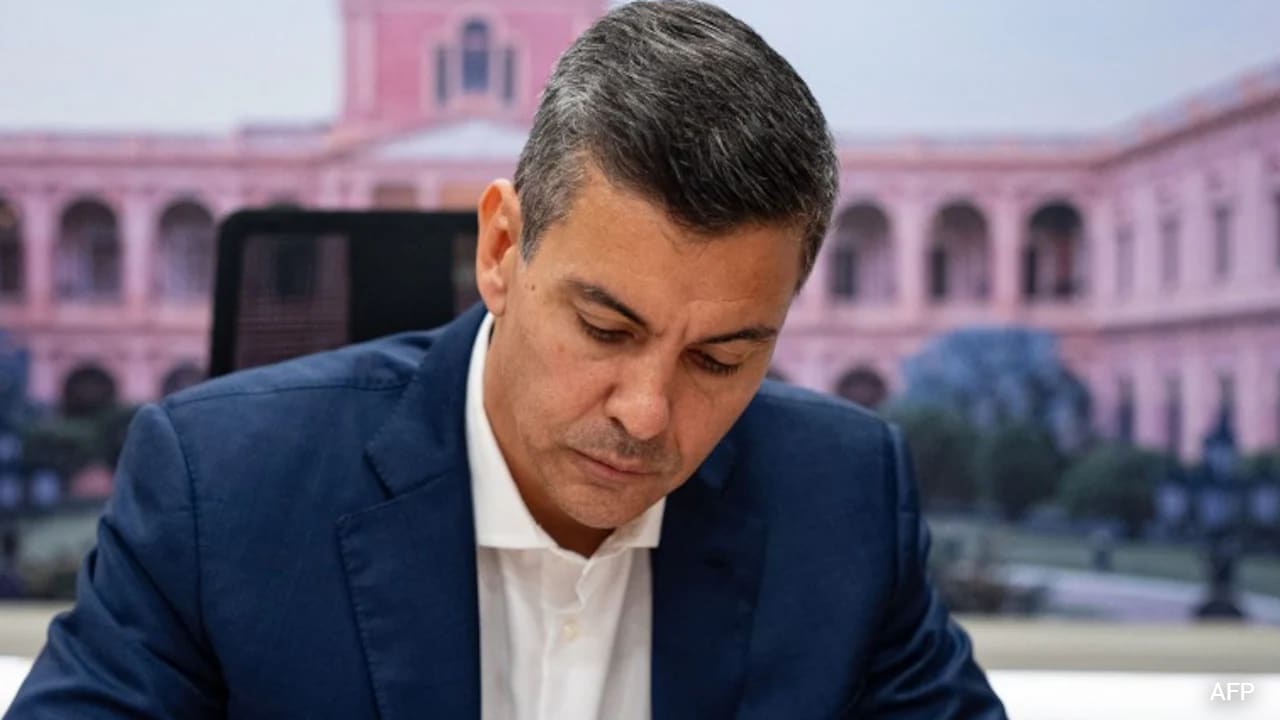
Rumors claiming that Paraguayan President Santiago Peña resigned amid street protests over a collapse at Ueno Bank are false. Neither the Palacio de López nor the Central Bank of Paraguay has issued any statement confirming a presidential step-down, and Ueno Bank continues to operate under standard regulatory oversight. Yet the rapid spread of this specific narrative across social media reveals something far more consequential than a simple internet hoax. It exposes a deep, simmering anxiety in Asunción regarding the concentration of political power, rapid financial consolidation, and the blurred lines between state patronage and private capital.
When false headlines about a head of state stepping down gain traction within hours, experienced observers do not merely dismiss the rumor and move on. They ask why the public was so primed to believe it. In Paraguay, the name Ueno has become shorthand for a broader debate over institutional independence, rapid market capture, and the historical fragility of the domestic banking sector.
Anatomy of a Viral Financial Rumor
Financial panics rarely start with a balance sheet. They start with a whisper that confirms an existing suspicion.
In the modern Latin American media environment, unverified claims about bank runs or sudden political resignations travel along encrypted messaging apps long before traditional newsrooms can verify a single fact. When a headline pairs a sitting president with a fast-growing financial institution and civil unrest, it hits every psychological trigger required for viral distribution. People share it out of fear for their savings, anger at the political establishment, or simple partisan opportunism.
The mechanics of this specific rumor rely on a classic disinformation technique known as contextual grafting. By taking real, publicly documented controversies—such as ongoing political debates over government contracts, banking sector mergers, and public discontent over the cost of living—and attaching a fabricated climax, the narrative feels plausible to the casual reader. If you already distrust the relationship between the executive branch and major financial players, a story claiming the system finally broke feels like an inevitability rather than a fabrication.
Why Ueno Bank Became a Political Lightning Rod
To understand why Ueno sits at the center of this storm, you have to look at the speed of its ascent. Traditional banking in Paraguay has historically been dominated by a handful of conservative, deeply entrenched institutions. Ueno disrupted that quiet equilibrium by expanding aggressively, rebranding itself as a modern digital-first bank, and absorbing established competitors like Visión Banco.
Rapid growth in emerging markets always attracts scrutiny. When a relatively young financial entity scales to become one of the largest banks by customer volume in a matter of years, competitors and regulators alike pay close attention. That scrutiny intensifies exponentially when the institution shares historical business ties with the sitting president.
Before taking office in August 2023, Santiago Peña held roles within Grupo Vázquez, the conglomerate behind Ueno, and previously served on the board of Banco Basa, an institution linked to former President Horacio Cartes. In a country where the Colorado Party has maintained near-unbroken political dominance for decades, the overlap between private business networks and public administration is a constant source of friction. Critics argue that this proximity creates an uneven playing field, especially when state-affiliated funds or public-sector payroll accounts are involved.
Supporters of the administration and the bank tell a very different story. They point out that Paraguay desperately needed financial modernization and greater banking inclusion. Bringing hundreds of thousands of previously unbanked citizens into the formal financial system through streamlined digital onboarding is a measurable economic achievement. From their perspective, the backlash against Ueno is largely driven by legacy competitors losing market share and opposition politicians looking for a convenient target.
Both arguments contain elements of truth, which is precisely why the issue remains so volatile.
The Ghosts of 1995 Still Haunt Asunción
In New York or London, a rumor about a bank crisis might trigger a brief dip in share prices before algorithmic traders correct the anomaly. In Asunción, the same rumor carries generational trauma.
Paraguay suffered a catastrophic systemic banking crisis between 1995 and 1998. Over half of the domestic financial institutions collapsed, wiping out the life savings of thousands of middle-class families, paralyzing credit, and triggering a prolonged economic recession. For years afterward, citizens kept their cash in mattresses or moved their capital across the border into Uruguay and the United States rather than trust a Paraguayan bank.
Because of that history, the Central Bank of Paraguay (BCP) spent the subsequent two decades building some of the strictest liquidity and capital adequacy requirements in South America. The regulatory framework today is vastly more conservative and transparent than it was in the late nineties. Banks are stress-tested regularly, reserve requirements are high, and supervisory reporting is stringent.
Yet institutional memory outlasts regulatory reform. For anyone over the age of forty in Paraguay, the mere suggestion of a banking crisis triggers an immediate defensive reflex. Disinformation campaigns exploit this vulnerability deliberately. They do not need to prove that a bank is insolvent; they only need to plant the seed of doubt and let historical anxiety do the rest of the work.
How Information Vacuums Fuel Street Protests
While there has been no presidential resignation over Ueno, Paraguay is no stranger to sudden, fierce street demonstrations. When public anger spills onto the avenues around the National Congress in Asunción, it usually follows a predictable pattern.
Protests in Paraguay rarely erupt over a single isolated policy. Instead, they build slowly around a perception of impunity. Whether the spark is a controversial legislative bill, an accusation of nepotism within state agencies, or questions surrounding public procurement, the underlying grievance is almost always the same: a belief that the rules apply differently to those connected to power.
When financial institutions become entangled in these political narratives, the risk of real-world spillover increases. A hypothetical example illustrates how quickly this dynamic can escalate. Imagine a scenario where a major state pension fund announces plans to deposit reserves into a private commercial bank. Even if the bank offers the highest interest rate and meets every regulatory standard set by the central bank, opposition lawmakers will immediately frame the move as a bailout or a political favor. Unions will mobilize, social media influencers will amplify claims of impending insolvency, and ordinary depositors may begin withdrawing cash simply as a precaution.
In such an environment, the line between a political protest and a liquidity crunch becomes dangerously thin.
Separating Institutional Reality from Political Noise
Evaluating the actual stability of a financial system requires ignoring the noise on social media and looking strictly at verifiable indicators. When analysts assess whether a bank in an emerging market is genuinely facing a crisis, they look at four concrete metrics:
- Liquidity Coverage Ratios: Does the institution hold enough high-quality liquid assets to survive a sudden, sharp outflow of deposits over a thirty-day period?
- Non-Performing Loan (NPL) Ratios: Are borrowers actually failing to pay back their debts, or is the loan portfolio performing within historical norms?
- Central Bank Intervention: Has the monetary authority been forced to open emergency discount windows or inject extraordinary liquidity into the interbank market?
- Interbank Lending Rates: Are rival domestic banks suddenly refusing to lend overnight funds to the institution in question?
In the case of Ueno and the broader Paraguayan banking sector, none of these distress signals have materialized. The Central Bank of Paraguay has maintained steady monetary policy, interbank markets continue to function normally, and retail branches operate without withdrawal restrictions.
The real vulnerability is not financial insolvency. It is reputational contagion.
The Danger of Weaponized Narratives in Emerging Markets
For international investors, Paraguay has spent the last decade cultivating a reputation as an island of macroeconomic stability in a turbulent region. Low taxes, low public debt, abundant hydroelectric power, and a predictable currency—the guaraní—have helped the country achieve investment-grade status from major rating agencies.
That hard-won credibility is fragile. When false reports of a presidential resignation and a banking collapse circulate globally, automated news aggregators and low-tier content farms often republish the claims without verification. Foreign investors scanning headlines without deep local context may hesitate before committing capital, or demand a higher risk premium to offset perceived political instability.
At the same time, dismissing every criticism as a coordinated smear campaign is equally dangerous. When political leaders fail to establish clear, transparent firewalls between their past business affiliations and their current public duties, they create the exact environment where rumors thrive. Transparency is the only effective antidote to speculation. Clear public disclosures regarding state deposits, strict adherence to competitive bidding for government contracts, and uncompromising regulatory independence are essential to keeping market confidence intact.
A modern economy cannot run on whispers, nor can it survive on blind trust. Until the boundaries between political authority and private financial ambition in Asunción are drawn with unmistakable clarity, every major corporate merger or state contract will remain just one viral headline away from a street protest.


