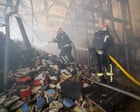
Russian missile strikes and drone bombardments have systematically destroyed roughly ten million books across Ukraine, obliterating nearly a third of the nation's annual publishing output in a matter of weeks. The Ukrainian Book Institute, alongside devastated houses like Ranok, BookChef, and Knygolav, has issued urgent international appeals for assistance as financial collapse threatens the surviving infrastructure of Ukrainian literature.
This is not accidental collateral damage. The physical anatomy of modern publishing relies on centralized nodes—massive printing presses, automated distribution centers, and sprawling suburban warehouses.
Kharkiv remains the beating heart of Ukrainian print production. It is also sitting within brutal artillery and aerial range. When dual jet-powered drones targeted a massive distribution facility outside Kharkiv on August 1, they ignited a ten-thousand-square-meter blaze that consumed eight million books in a single night. Among the ashes were hundreds of thousands of school textbooks scheduled for delivery ahead of the September term.
Publishers watch their life's work vanish into gray soot. BookChef lost hundreds of thousands of volumes across consecutive strikes in July. Printers like the Konvi Group report facilities reduced to skeletal metal frames, taking hundreds of thousands of ordered volumes with them.
The Logistics of Cultural Erase
To understand the crisis, look at the supply chain. Paper is scarce. Specialized ink is imported. Printing machinery cannot be bought off a standard shelf; replacement units require custom manufacturing, months of transit, and exorbitant war-risk insurance premiums.
When a warehouse burns down in peacetime, insurance cushions the blow. When a warehouse burns down under a persistent air campaign, insurance markets retreat. Ukrainian publishing houses operate in an environment where financial liquidity evaporates overnight. Companies face catastrophic revenue drops while fixed overhead costs—salaries for editors, translators, designers, and surviving staff—remain stubbornly present.
The assault targets foundational literacy. Destroying textbooks means targeting the pipeline of the next generation. When children return to empty classrooms without primers or literature in their native language, the disruption mimics historical imperial edicts designed to suppress national identity.
Beyond Financial Appeals
The Ukrainian Book Institute asks for grants, printing partnerships, and direct financial backing from global publishing houses. State subsidies exist, such as governmental reconstruction grants and war-risk loan programs administered through national ministries. Yet, capital alone cannot rebuild a burned factory while air raid sirens wail.
International publishers can offer concrete relief through distributed printing rights. Allowing Ukrainian publishers to license their titles out to European and North American presses for local printing keeps royalties flowing and titles in circulation. Digital distribution helps bridge the gap for adult fiction and nonfiction, though it offers cold comfort for tactile children's books and educational primers.
The resilient pulse of Ukrainian readers keeps bookstores surprisingly crowded in cities farther from the front lines. Demand for contemporary fiction, genre work, and local history has surged despite the war. Readers want their stories. Publishers want to supply them.
The physical books may turn to ash, but the infrastructure of the mind proves remarkably stubborn against falling iron. Surrounding European literary agencies now face a choice between passive solidarity statements and active, logistical integration of Ukrainian houses into Western distribution networks. The outcome will decide whether a national literature survives the burning of its warehouses.