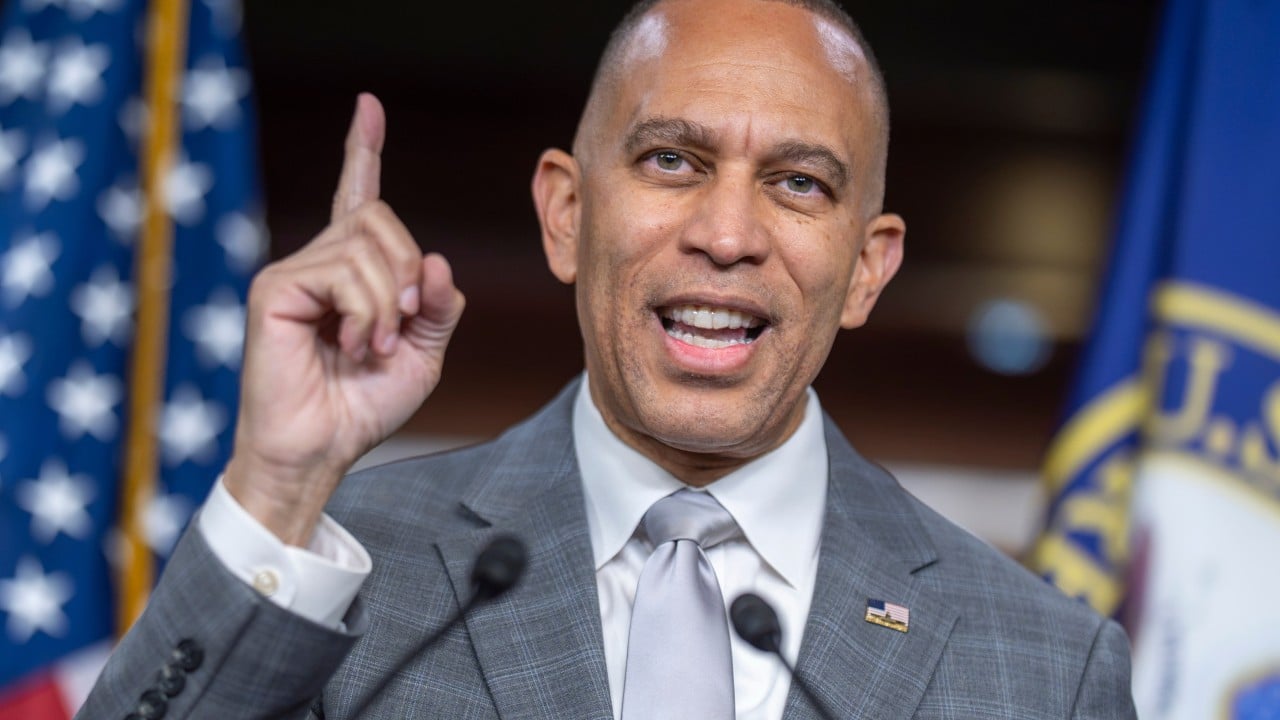
The unanimous nomination of Representative Hakeem Jeffries of New York by the House Democratic Caucus to serve as its leader—and as the party's candidate for Speaker of the House—represents an institutional transition rather than a mere symbolic milestone. While conventional political reporting frames the event primarily around the historic nature of nominating the first Black lawmaker to lead a major party in either chamber of Congress, an operational analysis reveals a calculated effort to maintain caucus cohesion across ideological factions during a period of divided government. Understanding this transition requires examining the structural rules governing House leadership elections, the coalition dynamics of the Democratic caucus, and the procedural constraints faced by a minority-party leader in the lower chamber.
The Mechanics of Caucus Nomination Versus Floor Election
A common misconception in public commentary conflates a party's internal leadership nomination with the constitutional election of the Speaker of the House. The two processes operate under distinct rules and mathematical thresholds.
- Internal Caucus Balloting: Within the House Democratic Caucus, leadership positions are determined by a simple majority vote of the members-elect present and voting in a closed-door organizational meeting. When the caucus selected Jeffries to succeed longtime Speaker Nancy Pelosi, the vote occurred without formal opposition, signaling pre-negotiated consensus among the party's competing wings.
- Constitutional Floor Threshold: Under Article I, Section 2 of the U.S. Constitution, the House chooses its Speaker on the opening day of a new Congress through a public roll-call vote of the entire chamber. Winning the gavel requires an absolute majority of members voting for a candidate by name—typically 218 votes when all 435 seats are filled and no members vote "present."
Because the Republican Party won a narrow majority in the House following the midterm elections, Jeffries's nomination positioned him as the House Minority Leader rather than the sitting Speaker. In parliamentary systems, this role functions similarly to a Leader of the Opposition, though the U.S. House rules grant the minority leader far fewer formal procedural powers than the Speaker.
The Generational Succession Architecture
For roughly two decades, House Democratic leadership was consolidated under a trio of octogenarian lawmakers: Speaker Nancy Pelosi of California, Majority Leader Steny Hoyer of Maryland, and Majority Whip Jim Clyburn of South Carolina. That concentration of power created an upward mobility bottleneck for younger members elected during the 2006, 2008, and 2018 wave cycles.
When Pelosi, Hoyer, and Clyburn stepped aside from their top leadership posts, the caucus executed a coordinated generational handoff rather than an open-floor contest. Alongside Jeffries as Democratic Leader, the caucus elevated Representative Katherine Clark of Massachusetts to Democratic Whip and Representative Pete Aguilar of California to Caucus Chair.
This troika was structured to balance three primary variables within the party:
- Geographic Distribution: Representing New York, Massachusetts, and California anchors the leadership team in major Democratic fundraising hubs on both coasts while maintaining ties to suburban battleground districts where party majorities are won or lost.
- Ideological Positioning: Jeffries, a former chair of the Democratic Caucus and member of the Congressional Progressive Caucus who also maintains strong relationships with moderate coalitions like the New Democrat Coalition, occupies a centrist-progressive nexus. Clark brings stronger alignment with the progressive wing, while Aguilar provides institutional links to frontline moderate members.
- Demographic Representation: The leadership slate reflects the modern Democratic electoral coalition, combining historic Black representation at the top of the ticket with gender diversity and Hispanic representation in the third-ranking slot.
Cause-and-Effect in Minority-Party Leverage
Operating in the minority fundamentally alters the strategic calculus of a House leader. Without control of the House Rules Committee or the floor schedule, the Minority Leader cannot bring legislation to a vote unilaterally. Instead, minority leverage depends on exploiting the majority party's internal divisions.
When the majority party holds a slim margin—where the defection of only a handful of members can defeat a bill on the floor—the Minority Leader's primary asset is caucus discipline. If Jeffries can keep Democratic votes unified against partisan majority bills, the Republican Speaker is forced into a binary operational dilemma:
- Concede to Internal Factions: The Speaker can negotiate exclusively with the most conservative members of the Republican conference to secure their votes, which often produces legislation too far to the right to pass the Senate or avoid a presidential veto.
- Form Bipartisan Coalitions: On must-pass legislation—such as raising the federal debt ceiling, funding the government to avoid shutdowns, or passing the National Defense Authorization Act—the Speaker must rely on Democratic votes to pass the bill under suspension of the rules or through negotiated compromises.
In the second scenario, Jeffries's ability to deliver a predictable bloc of Democratic votes converts minority status into de facto co-governance on fiscal and operational deadlines. Conversely, any fragmentation within the Democratic caucus reduces the price the majority must pay for Democratic support.
Historical Context and Institutional Precedent
The nomination of Hakeem Jeffries sits at the intersection of two long-term trajectories in the U.S. House of Representatives: the evolution of the speakership and the integration of congressional leadership.
Historically, the speakership transformed from a largely ceremonial presiding officer in the early republic into a centralized legislative gatekeeper under figures like Thomas Brackett Reed and Joseph Gurney Cannon in the late nineteenth and early twentieth centuries. Following the 1910 revolt against Cannon, power decentralized to committee chairs before recentralizing in the speaker's office after the 1970s reforms and the 1994 Republican Revolution. Modern House leaders exercise substantial control over committee assignments, campaign fundraising distribution through the Democratic Congressional Campaign Committee (DCCC), and legislative messaging.
Simultaneously, Black representation in House leadership progressed incrementally following the founding of the Congressional Black Caucus (CBC) in 1971. Jim Clyburn's rise to Majority Whip in 2007 and Assistant Democratic Leader in 2011 established the highest-ranking precedents for Black lawmakers prior to Jeffries. Jeffries's ascent from CBC member to Caucus Chair in 2019 and subsequently to party leader marks the first time a Black lawmaker has held the top leadership post of either major party in Congress.
Structural Constraints and Leadership Vulnerabilities
While the unanimous caucus vote projected unity, the leadership model face inherent operational limitations that test any modern House leader:
- The Asymmetry of Social Media and Fundraising: Modern House members can build national fundraising networks independently of party leadership through small-dollar online donations. This reduces the financial discipline that leadership historically enforced through DCCC allocations and campaign support.
- Ideological Polarization Between Safe and Swing Seats: Members representing deep-blue urban districts face primary election pressures from the left, whereas members in competitive suburban or rural districts face general election pressures from the center. Bridging these competing electoral incentives requires constant legislative triage, particularly when drafting messaging bills versus governing compromises.
- Dependence on Senate and Executive Alignment: In a divided Congress, House Democratic strategy relies heavily on coordination with the Senate Majority Leader and the White House. If the administration negotiates directly with House Republican leadership, the House Minority Leader risks being sidelined unless closely integrated into executive branch strategy.
Strategic Imperatives for Minority Caucus Management
To convert a historic nomination into durable legislative power, the House Democratic leadership structure relies on three operational priorities:
- Enforcing Procedural Discipline on Rule Votes: In the House, votes on the "rule" governing floor debate are traditionally strict party-line tests. Maintaining absolute unity on procedural votes denies the majority party any margin for error when its own members defect.
- Centralizing Information Flows Through Committee Ranking Members: Because the minority party cannot hold majority hearings, the ranking members of key committees—such as Appropriations, Ways and Means, Energy and Commerce, and Rules—serve as the primary intelligence and policy engines for the caucus. Integrating committee leadership into daily floor strategy prevents silos from forming.
- Focusing DCCC Resources on Structural Battlegrounds: Retaining caucus cohesion is directly tied to the realistic prospect of regaining the majority in the subsequent election cycle. Members are significantly more willing to cast difficult procedural votes when leadership demonstrates a credible, data-backed path back to the 218-seat threshold.
The elevation of Hakeem Jeffries demonstrates how modern congressional parties manage leadership transitions: by pre-clearing ideological hurdles internally, balancing geographic and demographic representation across the leadership slate, and centralizing caucus discipline to maximize leverage against a narrow opposing majority.