Homeowners routinely lose six-figure property insurance disputes over attic leaks because standard policies cover sudden water damage while strictly excluding the gradual wear, tear, or maintenance failures that caused the breach. When an insurer pays $13,844 instead of a $112,000 contractor estimate, the carrier is rarely ignoring the damage. Instead, the adjuster is separating the covered ensuing loss—the ruined drywall, wet insulation, and stained ceilings—from the excluded proximate cause, such as an aging roof, degraded flashing, or poor ventilation. Understanding how carriers weaponize policy exclusions and valuation software is the only way to survive a major property claim without funding the rebuild out of pocket.
The Anatomy of a $98,156 Valuation Gap
Most policyholders view their home as a single interconnected system. If water enters through the roof and destroys the master bedroom below, the homeowner expects the policy to restore the entire structure to its pre-loss condition. Insurance contracts do not operate on common sense. They operate on strict legal causation.
Consider a hypothetical scenario that mirrors thousands of disputed claims across the country. A severe rainstorm hits a neighborhood, and water pours through a second-story ceiling. The homeowner hires a general contractor who inspects the attic, finds rotted decking, compromised underlayment, and widespread moisture intrusion, and writes an estimate for $112,000 to replace the roof system and rebuild the interior.
The insurance carrier sends an independent adjuster. Two weeks later, a check arrives for $13,844.
The gap between those two numbers is not a math error. It is the financial manifestation of the wear and tear exclusion. Under a standard HO-3 homeowners policy, the insurer agrees to pay for direct physical loss to property unless the loss is excluded. Every standard policy contains explicit exclusions for wear and tear, marring, deterioration, inherent vice, latent defect, and mechanical breakdown.
If the adjuster determines that wind did not rip the shingles off, and instead concludes that twenty-year-old sealant failed around a plumbing vent, the roof itself receives zero dollars. The $13,844 payout covers only the interior water damage that ensued after the water entered the structure. You get paid to repaint the ceiling and replace a few sheets of drywall, while the actual hole in your roof remains entirely your financial responsibility.
Sudden and Accidental Versus Repeated Seepage
The battleground in almost every attic leak claim centers on timing. Insurance policies are designed to absorb sudden, accidental shocks. They are not home warranty programs or deferred maintenance funds.
To enforce this boundary, carriers rely heavily on the constant or repeated seepage exclusion. Most modern policies specify that water damage occurring over a period of 14 days or more—sometimes phrased simply as "weeks, months, or years"—is completely excluded from coverage.
Adjusters and forensic engineers look for specific physical signatures to trigger this clause:
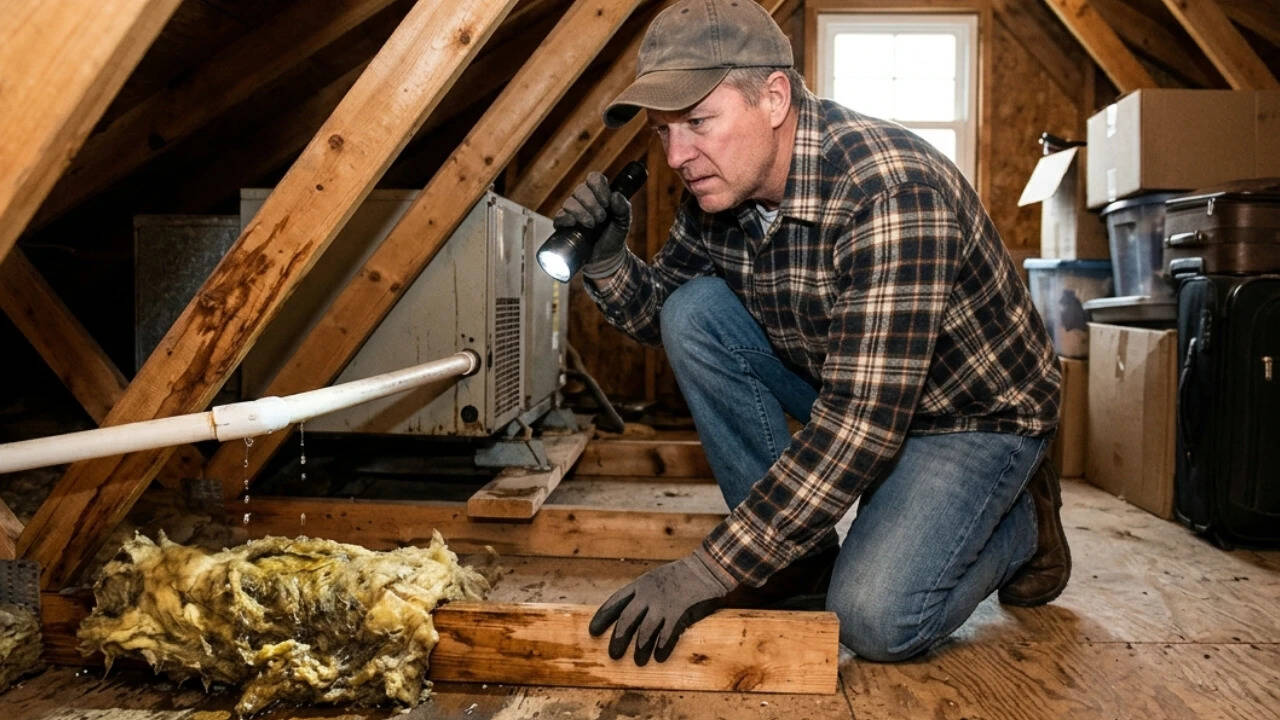
- Darkened or black wood staining on roof trusses and decking, which indicates prolonged fungal growth rather than fresh water contact.
- Rusted nail heads protruding through the underside of the roof sheathing, proving the metal was exposed to moisture across multiple weather cycles.
- Compressed or matted fiberglass insulation that has lost its loft over time due to chronic dampness.
- Efflorescence or mineral deposits on masonry chimneys and flashing joints.
Once an adjuster documents dark staining on the rafters, the claim shifts from a covered storm event to an excluded maintenance failure. Even if a torrential downpour finally pushed the water through your ceiling last Tuesday, the carrier will argue the breach existed for months. That single determination can wipe out ninety percent of a claim's value.
How Estimating Software Compresses Payouts
Even when a carrier agrees that a loss is covered, the pricing mechanism used to calculate the payout heavily favors the insurer. Contractors and insurance adjusters rarely speak the same financial language, and the discrepancy stems from software.
Most major insurance carriers mandate the use of centralized estimating platforms—most notably Xactimate—to price repairs. While insurers present these platforms as objective, market-driven databases, the reality inside the claims industry is far more complicated.
Estimating software relies on localized price lists that aggregate material costs and labor rates. However, those price lists often lag behind real-time market inflation, supply chain spikes, and regional labor shortages. When a severe storm strikes a region, local roofing and restoration contractors immediately raise their rates to meet surging demand and overtime labor costs. The software price list remains anchored to historical averages.
Furthermore, adjusters are trained to write minimalist scopes of work. A general contractor bidding $112,000 prices the job to guarantee structural integrity, pass municipal code inspections, and protect their business warranty. They include line items for steep-slope labor charges, debris hauling, permit fees, project supervision, and matching materials.
An insurance desk examiner reviewing that estimate systematically strips out line items deemed "unnecessary" or "overhead." They might pay to replace only the damaged slope of a roof rather than the entire system, ignoring the fact that the existing shingles are discontinued and cannot be properly woven into new materials. They apply aggressive depreciation to materials and labor, holding back thousands of dollars in Actual Cash Value deductions until the homeowner proves the work is finished—a financial hurdle that prevents many policyholders from ever starting the repairs.
The Matching Trap and Code Upgrade Blind Spots
A massive portion of the gap between a $13,844 payout and a $112,000 rebuild hides in two obscure policy provisions: matching statutes and Ordinance or Law coverage.
Suppose a windstorm tears shingles off the north slope of your roof, and water leaks into the attic. The insurer agrees to pay for that single slope. However, your roof was installed twelve years ago, and the manufacturer no longer produces that specific shingle color or dimension. Installing modern shingles on one side of the house creates a mismatched patchwork that lowers property value and compromises the ridge cap seal.
In states without strict matching laws, carriers routinely refuse to pay for the undamaged slopes. Their contract obligates them to pay only for "direct physical loss" to the damaged property, not aesthetic uniformity.
The second trap is building code compliance. When a contractor opens up an attic to repair water damage, they are legally required by local municipalities to bring the affected systems up to current building codes. This often means upgrading electrical wiring, installing ice and water shield membranes, adding ridge vents for proper airflow, or replacing spaced decking with solid plywood sheathing.
Standard homeowners policies exclude the increased cost of construction required by building codes unless the policyholder specifically purchased an Ordinance or Law endorsement. Without that endorsement—or if the endorsement is capped at a low percentage like 10% of the dwelling limit—the homeowner must pay out of pocket for every code-mandated upgrade the contractor performs.
The Structural Incentives Driving Claim Denials
To understand why legitimate claims get slashed, you have to follow the money inside the insurance industry. Property and casualty insurers face relentless pressure from severe convective storms, rising reinsurance costs, and inflated construction expenses. When underwriting margins shrink, carriers tighten their claims handling guidelines to protect their combined ratios.
Desk adjusters and third-party administrators are frequently evaluated on severity metrics—the average dollar amount paid per claim—and file closure speed. An adjuster who routinely approves $112,000 estimates faces intense scrutiny from file reviewers and management. An adjuster who invokes the wear and tear exclusion and closes the file for $13,844 is rewarded for controlling loss leakage.
This dynamic has given rise to the widespread use of preferred engineering firms. When a homeowner submits a massive contractor estimate for an attic leak, the insurer rarely takes the contractor's word for it. Instead, the carrier hires a forensic engineering firm to inspect the roof.
While many engineers operate with strict integrity, the economic reality of the vendor relationship creates a massive conflict of interest. Insurance companies generate millions of dollars in repeat business for engineering firms. Contractors and individual homeowners do not. Engineers who consistently find wind or hail damage get dropped from carrier vendor lists. Engineers who routinely attribute roof leaks to "thermal expansion, installation defects, and age-related granule loss" stay busy year-round.
Why Contractor Estimates Often Inflate the Divide
Blame does not rest exclusively with the insurance companies. Homeowners frequently sabotage their own claims by relying on aggressive contractors who treat an insurance policy like a blank check.
When a storm hits, storm-chasing roofing companies flood neighborhoods promising "free roofs" paid for by the insurer. These contractors often write bloated, kitchen-sink estimates that include full roof replacements, unnecessary structural rebuilds, and arbitrary markup fees without documenting the actual cause of loss.
When a contractor hands a $112,000 estimate to an insurance carrier without a single photograph proving storm-created openings, the insurer immediately goes on the defensive. The claim gets flagged for Special Investigations Unit review or handed to a senior desk examiner who will scrutinize every square inch of the property for pre-existing defects.
Contractors are also legally barred in most states from negotiating insurance claims unless they hold a public adjuster license. When a roofer argues policy coverage with an insurance adjuster, the adjuster can legally ignore them. The carrier owes a fiduciary duty to the policyholder, not the roofer. If the homeowner fails to formally document the loss within the rules of the contract, the contractor's high-dollar estimate becomes legally irrelevant.
How to Audit a Lowball Attic Leak Settlement
If you are staring at a settlement check that covers barely ten percent of your contractor's bid, accepting the money as final is a mistake. Cashing an initial Actual Cash Value check does not legally close your claim in most jurisdictions, provided you do not sign a formal release of all claims. It simply provides the baseline capital to begin fighting the valuation.
1. Demand the Unredacted Estimate and Engineering Report
Never argue over a lump-sum payout number. Demand the carrier's complete, line-by-line Xactimate estimate, including the sketch measurements and pricing database date. If the insurer used an engineer or an independent adjuster to deny the roof portion of the claim, request the full, unredacted report and every photograph taken during the inspection. You cannot dismantle an argument you have not read.
2. Separate Causation From Pricing
Look closely at why the claim dropped from $112,000 to $13,844. Is the carrier denying coverage for the roof entirely based on an exclusion, or are they covering the roof and simply underpricing the labor and materials?
- If it is a pricing dispute: Have your contractor perform a line-by-line comparison against the insurer's estimate. Submit a formal supplement backed by material invoices, subcontractor bids, and municipal code citations.
- If it is a causation dispute: Pricing arguments will get you nowhere. You must prove that a covered peril—such as wind, hail, or a falling tree limb—created the physical opening that allowed water to enter.
3. Build an Independent Evidentiary Record
Do not rely on your roofer's verbal opinion to overturn an engineer's report. Hire an independent, licensed building consultant or structural engineer who works directly for property owners. Have them conduct a brittle test on the shingles, document wind-creased tabs, map the moisture intrusion path using thermal imaging, and correlate the damage with localized National Weather Service storm data from the date of loss.
4. Invoke the Policy Appraisal Clause
Almost every standard homeowners policy contains an Appraisal Clause. This is a binding dispute resolution mechanism designed specifically for valuation disagreements. When you and the insurer cannot agree on the amount of the loss, either party can demand appraisal in writing.
Each side hires an independent, competent appraiser. The two appraisers inspect the property and attempt to agree on the valuation. If they cannot agree, they submit their differences to a neutral umpire whom both appraisers selected beforehand. An agreement signed by any two of the three—your appraiser, the carrier's appraiser, or the umpire—sets the binding payout amount. Appraisal bypasses slow litigation and forces the insurer to pay fair market value, though it cannot be used to resolve pure coverage denials where the carrier claims no covered event occurred at all.
5. Scrutinize Your Policy Declarations Before the Next Storm
The outcome of a six-figure property claim is usually decided years before the water hits your ceiling, at the moment you bind the policy. Policyholders routinely select cheap premiums without realizing their agent stripped out vital protections.
Check your current declarations page for three specific traps:
- Actual Cash Value Roof Endorsements: Many carriers now automatically convert roofs over ten or fifteen years old from Replacement Cost Value to Actual Cash Value. Under an ACV endorsement, if your 18-year-old roof is destroyed by a hurricane, the insurer deducts 75% for depreciation, leaving you to pay the vast majority of the replacement cost even on a fully covered claim.
- Cosmetic Damage Exclusions: Common in hail-prone states, these clauses allow insurers to deny roof replacements if hail dents metal panels or bruises shingles without immediately puncturing the waterproof membrane.
- Water Back-Up and Seepage Sub-Limits: Verify whether your policy caps water damage from specific sources at $5,000 or $10,000, regardless of your overall dwelling coverage limit.
When an insurance carrier hands you $13,844 for a $112,000 problem, they are betting that exhaustion, confusing policy jargon, and financial pressure will force you to settle. Treat the initial payout as an opening bid, document the physical evidence before any demolition begins, and force the carrier to defend every excluded line item against the exact text of your contract.