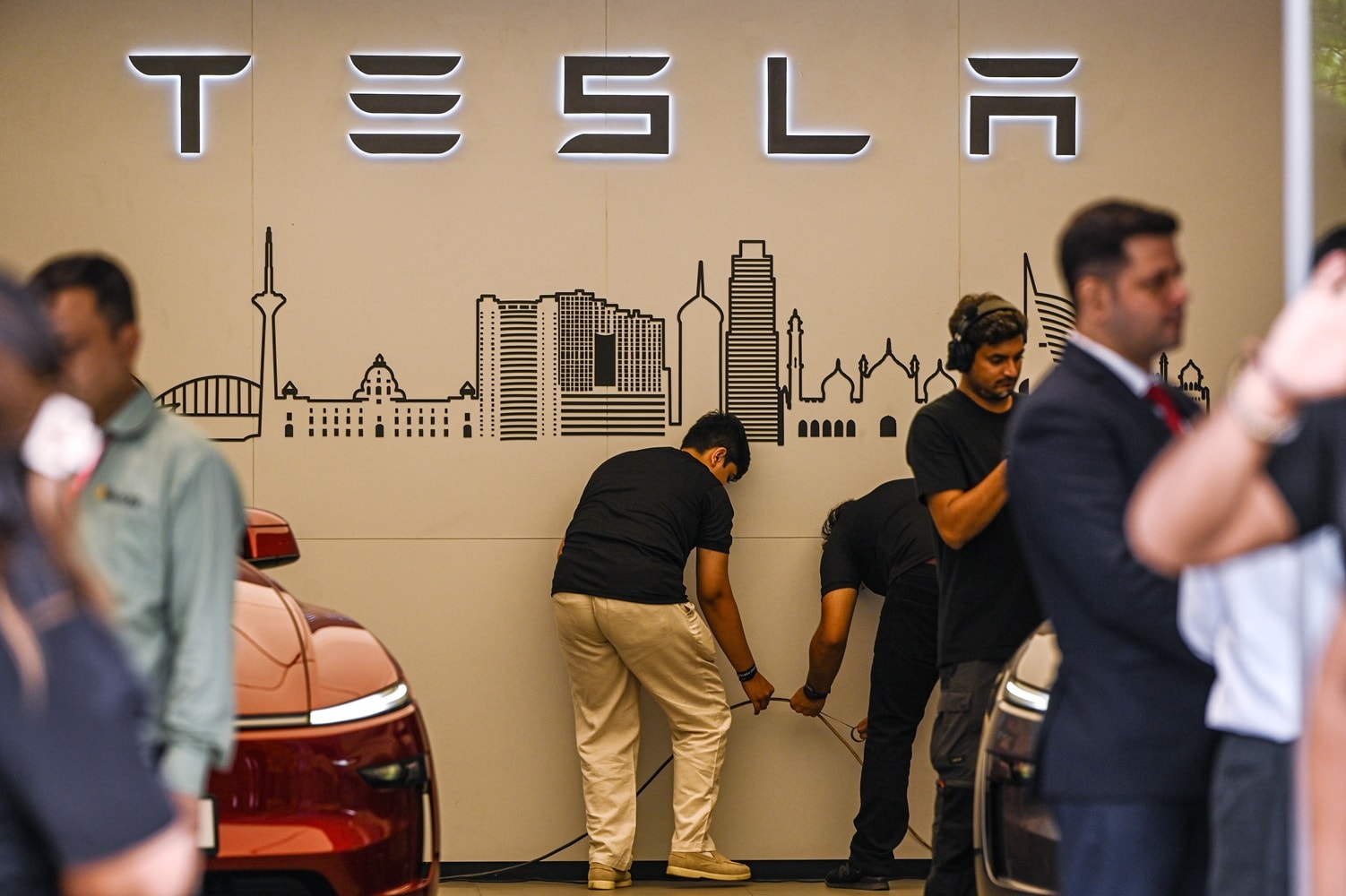
The tech press is currently swooning over the "historic" alliance between Intel and Tesla. They see it as a lifeline for Intel Foundry and a vertical integration masterstroke for Elon Musk. The narrative is tidy: Intel finally lands its "whale" customer for the 14A process, and Tesla secures a domestic pipeline for its massive Terafab ambitions.
It is a beautiful story. It is also fundamentally wrong.
The assumption that this partnership stabilizes the semiconductor industry is a fantasy. In reality, we are witnessing the birth of a "too big to fail" hardware conglomerate that prioritizes capital preservation over genuine architectural innovation. By tethering the future of Tesla’s AI—including the Optimus robots and the Cybercab—to Intel’s unproven 14A node, Musk isn't just diversifying; he’s doubling down on a centralized, fragile manufacturing model that the rest of the world is desperately trying to escape.
The 14A Yield Trap
Intel CEO Lip-Bu Tan has been vocal about the stakes: if Intel fails to secure external customers for 14A, they might exit manufacturing entirely. This isn't the language of a market leader; it’s a hostage negotiation. Tesla has stepped in as the negotiator, but at what cost?
The 14A node relies heavily on High-NA EUV (Extreme Ultraviolet) lithography. These machines cost roughly $400 million a pop. While Intel was the first to receive these units from ASML, being first is often a curse in the foundry world. History is littered with the corpses of companies that chased "bleeding-edge" nodes only to be throttled by poor yields and astronomical wafer costs.
Intel’s track record with 10nm and 7nm was a multi-year masterclass in delays. To believe they will suddenly achieve "prime time" maturity with 14A—a node that is essentially an experimental leap into 1.4nm territory—is to ignore a decade of manufacturing hubris. Tesla is betting the brains of its future fleet on Intel’s ability to fix its culture and its chemistry simultaneously.
Terafab is an Ego Project, Not an Infrastructure Win
The Terafab project is being sold as a $25 billion revolution in U.S. chip making. Musk claims it will eventually produce one terawatt of annual compute capacity.
But look at the mechanics. A "Terafab" owned by Tesla but using Intel’s 14A process creates a bizarre, hybrid ownership structure that complicates intellectual property and operational agility. If Tesla is building the fab but Intel is providing the process recipe, who owns the yield? Who bears the cost when the first three batches of AI5 chips come off the line as expensive silicon bricks?
I have seen companies blow billions on "bespoke" manufacturing facilities that eventually become anchors. By the time Terafab scales, the AI industry will likely have shifted from massive, centralized training models to highly efficient, distributed edge inference. Tesla is building a cathedral for 2024-era AI logic in a world that is moving toward agentic, lean architectures.
The Myth of "Domestic Security"
The "National Champion" narrative is the most dangerous part of this deal. With the U.S. government holding a 9.9% stake in Intel, this partnership is more about geopolitical posturing than it is about building better chips.
When a company becomes a strategic asset of the state, innovation dies. It gets replaced by compliance and "safe" roadmaps. Intel’s 14A isn't being chosen because it’s the best; it’s being chosen because it’s the only option that satisfies the current political appetite for "Made in America" silicon.
Compare this to the decentralized approach. True resilience in the chip world comes from geographic diversity—Samsung in Korea, TSMC in Taiwan and Arizona, and specialized fabs in Europe. By consolidating its future in a single, government-subsidized basket, Tesla is actually increasing its systemic risk. One manufacturing hiccup in Ohio or Texas, and the entire "Robotaxi" dream grinds to a halt.
Why Nvidia Should Be Laughing
The consensus says this deal threatens Nvidia’s dominance. The logic is that if Tesla makes its own chips at 10% of the cost of a Blackwell GPU, Nvidia loses its biggest customer.
This ignores the software moat. Nvidia isn't a chip company; it’s a CUDA company. Tesla can build all the 14A silicon it wants, but if those chips require a proprietary, closed-loop software stack that only works within the Musk-managed ecosystem (Tesla, SpaceX, xAI), they will never achieve the scale needed to drive down costs.
Nvidia’s chips are expensive because they are universal. Tesla’s chips will be "cheap" only if you ignore the $25 billion entry fee to build the fab. It’s like saying your home-grown tomatoes are free after you’ve spent $10,000 on a temperature-controlled greenhouse.
The Real Question Nobody Is Asking
Is 1.4nm even necessary for AI?
The industry is obsessed with "smaller is better," but we are hitting the limits of physics. Tunneling effects and heat dissipation at the 14A level are nightmare scenarios for sustained AI workloads.
Most of the gains in AI today are coming from better interconnects, advanced packaging, and smarter algorithms—not just packing more transistors onto a die. Intel’s "PowerDirect" (backside power delivery) is a genuine step forward, but it doesn't require a 1.4nm node to be effective. Tesla is chasing a vanity metric—the smallest nanometer number—while the real battle is being won in the software-hardware co-design layer.
The Downside of Being the "First Customer"
Being the "alpha" customer for a struggling foundry is like being the first person to cross a bridge made of experimental glass. You get a great view, but you’re the one who finds the cracks.
Intel needs Tesla’s volume to refine its 14A yields. In the industry, this is called "cleaning the pipes." Tesla is effectively paying Intel $25 billion for the privilege of being their lead tester. Every delay in 14A development becomes a delay in the Tesla roadmap. If Intel’s 18A node—the predecessor to 14A—shows even a hint of the old Intel "stagnation," the Terafab project will become the most expensive parking lot in Austin.
Stop celebrating the "lifeline." Start questioning why the world’s most advanced AI company is tethering its soul to a legacy manufacturer that hasn't led the world in process technology since the Obama administration.
The Intel-Tesla deal isn't a glimpse into the future. It’s a desperate attempt to reconstruct the industrial monopolies of the past. If you want to see where real innovation is happening, look at the companies diversifying their supply chains and focusing on architectural efficiency over raw node shrinkage.
Tesla just bought a very expensive seat on a very shaky boat.