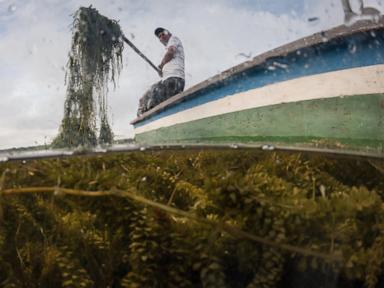
Stop crying over the water hyacinth.
The standard narrative surrounding Colombia’s Ciénaga Grande de Santa Marta is a tired script of ecological victimhood. Conservationists and local bureaucrats love to point at Eichhornia crassipes—the common water hyacinth—and scream "invasion." They frame it as a biological hijackers strangling the largest coastal lagoon in the country, destroying the livelihoods of fishers, and demanding endless cycles of public funding for manual removal. Meanwhile, you can read other developments here: The Brazilian Racial Paradox Institutional Friction and the Persistence of Disparate Outcomes.
They are looking at the symptoms and calling it the disease.
The water hyacinth isn't the villain of this story. It is the janitor. If you remove the "invasive" plants without fixing the underlying systemic rot, you aren't saving the wetland; you are just killing the only thing left that's actually working to keep the water from becoming a toxic soup. To understand the complete picture, check out the excellent article by NPR.
The Fertilizer Trap
Most reports on the Ciénaga Grande treat the plant’s rapid growth as an inexplicable act of nature. It isn’t. The hyacinth is a nutrient sponge. It thrives because the Magdalena River and the surrounding agricultural zones are dumping massive amounts of nitrogen and phosphorus into the system.
When you see a carpet of green covering a canal, you aren't looking at an "invasion." You are looking at a massive, natural bio-filter reacting to human incompetence. The plants are doing what plants do: consuming the excess fertilizer that would otherwise trigger massive, oxygen-depleting algal blooms.
If you successfully "eradicate" the hyacinth tomorrow, the nutrient levels in the water wouldn't magically drop. Instead, that energy would shift to phytoplankton and cyanobacteria. You’d trade a visible, manageable plant for a microscopic, toxic "red tide" that kills fish by the millions and poisons the air.
Government agencies spend millions of pesos every year on manual removal. It’s theater. They hire local workers to pull plants out of the water, toss them on the banks to rot (where the nutrients just leach back into the soil), and then act surprised when the plants grow back in three weeks. It’s a job-creation program disguised as environmentalism.
The Oxygen Paradox
The biggest lie told about invasive aquatic plants is that they "suffocate" the water.
While it’s true that a dense mat of hyacinth prevents atmospheric oxygen from dissolving into the surface, this ignores the internal mechanics of a tropical wetland. In the Ciénaga Grande, the primary threat to fish stocks isn't the plants; it's the hypersalinity caused by blocked freshwater channels and the siltation from poorly managed infrastructure.
I have seen regional authorities spend more time debating the "menace" of the hyacinth than addressing the fact that the Highway 90 (the coastal road) acted as a literal dam for decades, cutting off the natural flow of the sea. They focus on the green leaves because they are easy to see and easy to blame.
The water hyacinth actually provides critical shade in a warming climate. In shallow lagoons, high water temperatures can be just as lethal as low oxygen. By shielding the water from the direct Colombian sun, these plants maintain a cooler micro-environment that can actually preserve certain species during the peak of the dry season.
Turning a Nuisance into a Resource
If the industry was serious about the Ciénaga Grande, they’d stop trying to "kill" the hyacinth and start harvesting it for profit.
This isn't a thought experiment; it's a missed industrial opportunity. Water hyacinths have a high fiber content and an incredible capacity for heavy metal absorption. In other parts of the world, these "pests" are processed into:
- Biofuel: High biomass yields make them ideal for anaerobic digestion.
- Animal Feed: When processed correctly, they are a high-protein supplement for livestock.
- Woven Goods: The stems are stronger than many traditional grasses used in Colombian artisanal crafts.
Instead of paying people to throw weeds into the mud, the government should be subsidizing decentralized processing plants. You don't "fix" an invasive species by fighting biology; you fix it by integrating it into the local economy so that its removal pays for itself.
The Hypersalinity Red Herring
The obsession with the hyacinth allows officials to ignore the much harder, more expensive problem: the death of the mangroves.
The Ciénaga Grande is a delicate balance of salt and fresh water. Because of decades of diverted rivers and blocked pipes, the salinity in many parts of the lagoon has reached levels that kill even the hardy red mangroves. When the mangroves die, the entire coastal defense system collapses.
The "invasive" plants can only survive in the freshwater zones. Their presence is actually a diagnostic tool. If you see hyacinths, the water is fresh enough to support a variety of life. Where they disappear and leave only bare, salty mud—that’s where the real tragedy is happening.
We are attacking the messenger because we don't like the message. The message is that our land-use policies are a disaster.
The Actionable Pivot
Stop funding "clearance" projects. They are a black hole for capital.
The only way to manage the Ciénaga Grande is through hydraulic restoration. You must force the freshwater back into the system. When the natural flow is restored, the hyacinth population will naturally find its equilibrium. It will be pushed out to the brackish zones where it cannot survive, and the "infestation" will vanish without a single herbicide or machete.
If you are a fisher in the Ciénaga, stop asking for the plants to be gone. Start asking why the river water that feeds your lagoon is so thick with agricultural runoff that the plants have no choice but to explode.
Fix the water quality at the source, or learn to love the green carpet. It's the only thing keeping the ecosystem's heart beating, even if it looks like a weed.
Stop fighting the janitor and start cleaning the house.