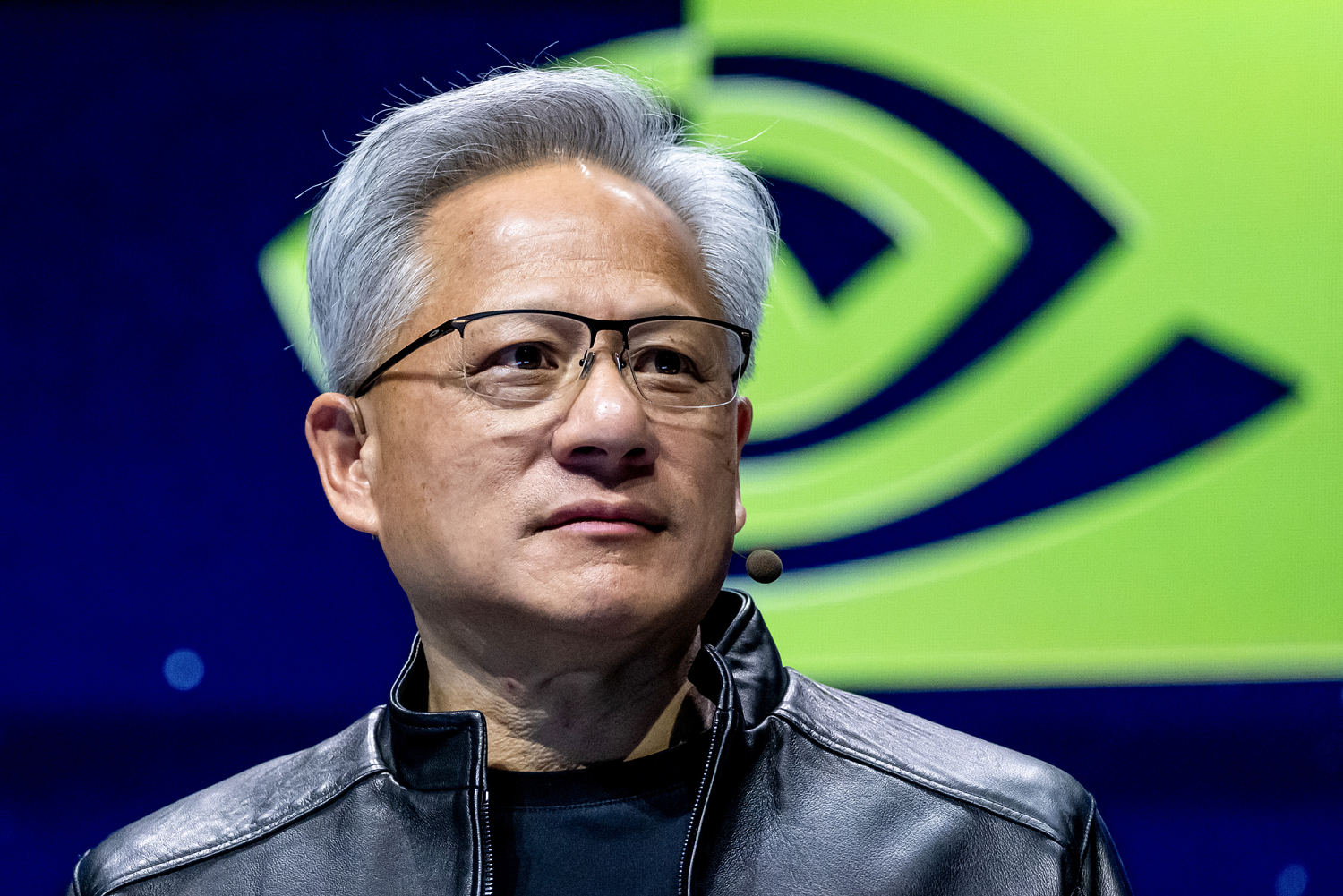
Everyone loves a good founder myth. For over three decades, Wall Street and Silicon Valley treated Nvidia and Jensen Huang as a single organism, assuming that the moment the leather-jacketed co-founder stepped back, the company's trillion-dollar valuation would evaporate overnight.
That assumption is flat-out wrong. You might also find this connected article insightful: Every New Java Security Flaw Is a Distraction From Your Terrible Architecture.
While the headline "Nvidia enters the post-Jensen Huang era with a bang" captures the shockwaves hitting tech desks right now, it misses the actual story underneath. Nvidia didn't just stumble into a smooth transition or ride a lucky wave of artificial intelligence hype into its next chapter. The company spent years quietly engineering a leadership bench and a software moat designed specifically to outlive its founder's daily presence. If you think Nvidia's dominance was purely a cult of personality, you haven't been paying attention to how the hardware and software stack actually works.
Why the Founder Myth Blinds Wall Street
Investors have a terrible habit of projecting Apple's post-Steve Jobs anxiety onto every other hardware giant. I see this constantly when talking to institutional tech analysts. They look at a charismatic CEO who commands a keynote stage for two hours without a teleprompter, and they conclude that the entire enterprise lives inside that one person's head. As discussed in recent articles by Ars Technica, the results are widespread.
It's a lazy shortcut.
Jensen Huang founded Nvidia in 1993 alongside Chris Malachowsky and Curtis Priem, and yes, his fingerprints are on every major pivot the company ever made. He bet the farm on programmable shaders in the late nineties. He pushed CUDA out the door in 2006 when Wall Street punished the stock for burning cash on a feature nobody wanted yet. Those were massive, high-conviction bets that required a founder's insulation from short-term boardroom panic.
But here's what people miss about executive transitions in semiconductor companies. By the time a chipmaker hits multi-trillion-dollar scale, product roadmaps aren't sketched on Denny's napkins anymore. Silicon architecture operates on rigid three-to-five-year development cycles. The chips shipping today were greenlit years ago, and the architectures defining the late 2020s are already locked in simulation labs across Santa Clara, Taipei, and Tel Aviv.
When Nvidia enters its post-Jensen Huang era, the immediate product pipeline doesn't suddenly reset to zero. What changes isn't the silicon on the loading dock. What changes is how the company navigates political blowback, hyperscaler rebellion, and the next major architectural shift once the original visionary isn't in the room to force a consensus.
The Architecture of Succession Nobody Talks About
If you want to understand why Nvidia's transition kicked off with such momentum rather than a stock crash, look at the flat organizational structure Huang built long before stepping aside. Most Fortune 500 companies run on bloated layers of middle management where vice presidents spend half their week managing upward. Nvidia famously operated with dozens of direct reports answering straight to the top, stripping out corporate insulation so technical problems surfaced immediately.
That structure forced operational veterans to carry massive weight early on. Look at the executives who shaped the modern machine:
- Colette Kress turned Nvidia's financial engine into one of the most disciplined capital-allocation machines in the semiconductor sector, managing supply chain prepayments with TSMC that locked out competitors for years.
- Jay Puri spent decades building the global field operations and enterprise sales relationships that turned Nvidia from a PC gaming component vendor into the backbone of sovereign AI data centers.
- Ian Buck, the mind behind CUDA, transformed a niche parallel-computing toolkit into an inescapable software standard used by millions of developers worldwide.
- Jonah Alben and Dwight Diercks oversaw the relentless cadence of GPU engineering and system software that kept competitors perpetually playing catch-up.
You don't build a bench like that by accident. Unlike founders who hoard authority until the day they retire, leaving a vacuum filled by untested lieutenants, Nvidia's senior leadership spent more than a decade running billion-dollar business units with extreme autonomy. When the transition arrived, the people taking the wheel weren't learning how to drive. They had already been steering the car at two hundred miles an hour.
CUDA Is the Real Moat Not the Leather Jacket
Ask ten casual investors why Nvidia dominates AI infrastructure, and nine of them will mention fast GPUs or Jensen Huang's leadership. Ask an actual machine learning engineer running a thousand-node training cluster, and you'll get a completely different answer.
They will talk about CUDA, cuDNN, TensorRT, and NVLink.
Hardware leadership in semiconductors is notoriously fragile. History is littered with chip giants that owned a market for a decade before tripping over a single manufacturing node—just look at what happened to Intel when it stumbled on 10-nanometer production while AMD and TSMC executed cleanly. If Nvidia were merely selling fast graphics processors, rival silicon from AMD, Google's TPUs, or custom chips from Amazon and Microsoft would have eaten its lunch years ago.
Instead, Nvidia built an end-to-end computing platform. Every major AI framework, from PyTorch to JAX, is heavily optimized for Nvidia's software libraries first. When a cloud provider tries to swap out Nvidia hardware for an alternative accelerator, engineers immediately run into broken dependencies, unoptimized kernels, and weeks of painful debugging just to replicate baseline performance. Time-to-market matters more than hardware discounts when companies are burning millions of dollars a day training frontier models.
That software lock-in doesn't care who holds the CEO title. A leadership transition doesn't rewrite twenty years of C++ libraries or suddenly make competing software stacks easier to use. As long as developers default to CUDA because it saves them months of engineering headaches, Nvidia's pricing power remains intact.
Where the Post-Jensen Era Actually Faces Real Danger
Now, let's take off the rose-colored glasses. Saying Nvidia's transition started strong doesn't mean the next five years will be a victory lap. In fact, stepping out of the founder era exposes Nvidia to three massive vulnerabilities that a professionalized executive team will struggle to handle the same way Huang did.
1. The Hyperscaler Revolt Is Accelerating
Microsoft, Meta, Google, and Amazon account for a huge chunk of Nvidia's data center revenue, and every single one of them hates paying the "Nvidia tax." Under a founder-CEO, Nvidia negotiated with these tech giants from a position of near-mythic authority, dictating allocation terms and bundling networking gear like InfiniBand and Spectrum-X alongside GPUs.
Without the founder at the table, procurement chiefs at hyperscalers will push much harder on custom silicon—like AWS Trainium and Google's next-generation TPUs—and demand steeper volume discounts. A traditional corporate CEO tends to protect quarterly margins by compromising on bundle terms, whereas a founder is willing to risk short-term friction to preserve absolute ecosystem control.
2. Geopolitical Crossfire Gets Harder to Navigate
Semiconductors are no longer just commercial components; they are the primary ammunition in the tech standoff between Washington and Beijing. Navigating U.S. export controls while keeping global supply chains intact in Taiwan requires delicate, high-stakes diplomacy. Jensen Huang possessed a unique personal standing in Taipei and Washington—born in Taiwan, educated in the U.S., and respected across political aisles as an elder statesman of American tech. A successor without that personal pedigree faces a steeper uphill climb when lobbying regulators or securing priority wafer capacity during a geopolitical crisis.
3. The Risk of Playing Defense Instead of Offense
Great companies rarely die from external attacks. They die from internal conservatism. When a founder steps away, the natural instinct of a board-appointed successor is to protect the golden goose rather than risk breaking it.
Think back to 2006 again. Wall Street hated Nvidia's spending on GPU computing because it dragged down gross margins for years with zero immediate payoff. A conventional CEO answering to activist investors and quarterly earnings calls would have killed CUDA to boost earnings per share. Nvidia's biggest long-term threat in its new era isn't AMD's latest Instinct accelerator—it's the temptation to optimize current cash flows instead of funding the next crazy, unprofitable moonshot that won't pay off until 2035.
How to Evaluate Nvidia Without the Founder Halo
If you're tracking Nvidia as an investor, a technology buyer, or an industry analyst, you need to change how you measure the company's health right now. Stop obsessing over keynote applause lines and executive charisma. Watch the structural metrics that actually tell you whether the post-founder machine is holding its edge.
First, watch networking and software attachment rates in quarterly earnings reports. Selling standalone GPUs is a cyclical hardware business that eventually commoditizes. Selling full-rack systems combining compute, NVLink switches, InfiniBand networking, and Nvidia AI Enterprise software subscriptions is what turns Nvidia into an infrastructure monopoly. If networking revenue grows alongside compute, the moat is widening.
Second, track developer mindshare outside the big cloud providers. Sovereign AI projects, enterprise healthcare deployments, robotics simulation via Omniverse, and automotive platforms represent Nvidia's diversification away from four or five massive tech buyers. The faster enterprise customers adopt pre-packaged Nvidia inference microservices, the less vulnerable the company becomes when hyperscalers bring inference workloads onto their own custom chips.
Third, pay close attention to gross margin stability during architectural transitions. Every time Nvidia shifts from one major architecture to the next—moving from Hopper to Blackwell to Rubin and beyond—manufacturing complexity spikes. Liquid-cooled server racks, advanced CoWoS packaging at TSMC, and high-bandwidth memory bottlenecks can easily crush margins if execution slips even slightly. Clean ramps with steady margins above 70 percent prove that the operational bench is executing without missing a beat.
What You Should Do Right Now
Whether you hold Nvidia stock, manage enterprise cloud budgets, or build AI products, don't make knee-jerk decisions based on executive headlines.
If you're an investor, audit your thesis today. If your reason for owning Nvidia was simply "Jensen Huang is a genius," you were holding the stock for the wrong reason anyway—trim your exposure until you understand the underlying economics of data center interconnects and CUDA lock-in. If your thesis rests on Nvidia's full-stack architecture and enterprise software margins, focus strictly on capital expenditure guidance from Microsoft, Alphabet, Meta, and Amazon over the next four quarters rather than leadership gossip.
If you're an engineering leader or CTO, stop treating Nvidia's leadership transition as a reason to pause your infrastructure roadmap, but do use this moment to audit your portability. Keep building on Nvidia's stack where performance-per-watt dictates it, yet ensure your internal machine learning pipelines use abstraction layers like PyTorch 2.0 or OpenAI Triton so you aren't trapped if pricing shifts against you in two years.
Nvidia entered its post-Jensen Huang era with a bang because the company spent thirty years building an engine that doesn't require one man's hands on the pistons to run. The hardware is locked in, the software moat is deeper than ever, and the real test won't show up this quarter—it will show up the next time Nvidia has to bet the entire company on a technology nobody else believes in yet.