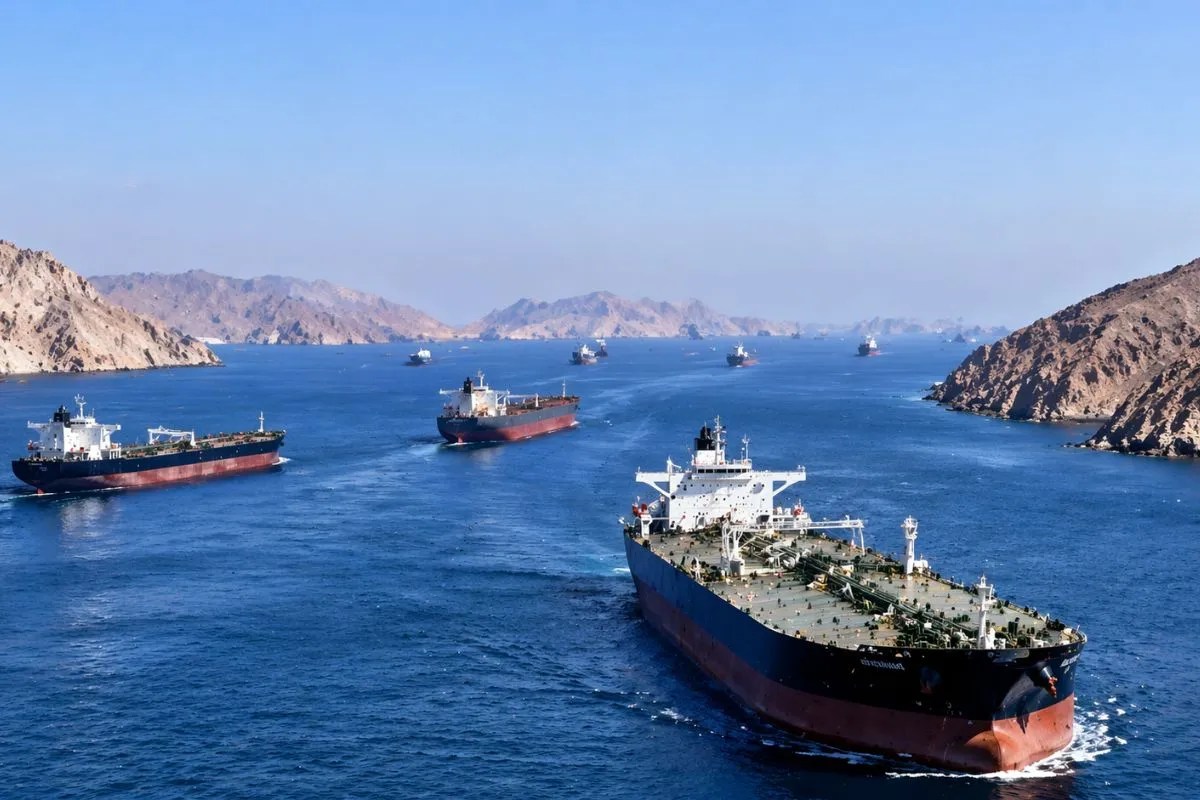
The sea does not care about slogans. It is a vast, indifferent expanse of turquoise and slate, yet it carries the weight of every light switch flipped in London and every engine started in New Delhi. At the narrowest point of the Strait of Hormuz, the water is only twenty-one miles wide. Stand on the deck of a massive crude carrier, and you can almost feel the presence of two giants leaning over the water, holding their breath, waiting for the other to blink.
The air here tastes of salt and anxiety.
Recently, the rhetoric coming out of Tehran has shifted from standard geopolitical posturing to something far more visceral. Iranian officials have begun speaking of "the last drop of blood." It is a phrase that suggests a threshold has been crossed. This isn't just about maritime law or territorial waters anymore. It is about a nation backed into a corner, using the world’s most vital energy artery as a metaphorical noose. If the Strait closes, the world holds its breath. If the Strait bleeds, the world starves.
The Captain’s Ghost
Consider a hypothetical merchant mariner named Elias. He is not a soldier. He has no stake in the ideological battle between Washington and Tehran. He is a man who thinks about his daughter’s tuition and the creeping corrosion on the ship’s hull. As his tanker approaches the Strait, the radar screen becomes crowded. Fast-attack boats from the Iranian Revolutionary Guard Corps (IRGC) zip across the wake like hornets.
Elias knows that nearly thirty percent of the world’s sea-borne oil passes through this needle’s eye. He also knows that a single mistake—a misinterpreted radio signal, a stray warning shot, a mechanical failure in a restricted lane—could ignite a conflagration that spans continents. For Elias, the "threat to the U.S." isn't a headline. It is the physical vibration of the deck beneath his boots as a foreign navy shadows his every move.
Iran’s message is clear: if we cannot export our lifeblood due to sanctions, we will ensure the pulse of the global economy skips a beat.
A Geography of Desperation
The Strait of Hormuz is a geographic fluke that became a geopolitical curse. To the north lies Iran, with a coastline jagged and perfect for hiding small, lethal submersibles and missile batteries. To the south lie the United Arab Emirates and Oman. The shipping lanes themselves are barely two miles wide in each direction.
When Tehran threatens to take revenge "until the last drop of blood," they are acknowledging their own fragility. Sanctions have squeezed the Iranian economy until it has turned blue. Inflation is a predatory beast in the streets of Shiraz and Tabriz. When a government can no longer provide bread, it provides pride. It provides the image of a defiant warrior standing at the gates of the world’s oil supply, hand on the lever, ready to pull.
Washington views this as state-sponsored piracy or, at best, reckless brinkmanship. The U.S. Fifth Fleet, stationed in Bahrain, is the counter-weight. It is a massive, steel-clad insurance policy designed to keep the oil flowing. But insurance policies don't stop the North Wind from blowing, and they don't stop a desperate actor from deciding that if they must go down, they will take the neighborhood with them.
The Mathematics of Chaos
We often talk about war in the abstract, as if it is a chess game played with plastic pieces. It is actually a sequence of supply chain failures.
If the threats from Tehran manifest into a physical blockade, the impact is instantaneous. Crude oil prices wouldn't just rise; they would leap. In the glass towers of Manhattan, analysts would scramble to recalibrate portfolios. In rural villages in India, the price of kerosene would double, plunging families into darkness.
The "revenge" Iran speaks of isn't just aimed at the American military. It is aimed at the very idea of global stability. By threatening the Strait, Iran is telling the West that their comfort is a fragile illusion. They are pointing out that the high-speed internet, the refrigerated food, and the cheap flights all depend on a twenty-one-mile stretch of water controlled by people who feel they have nothing left to lose.
The Shadow in the Water
Tensions in the Middle East have a way of simmering for decades before they suddenly boil over. The current escalation follows a predictable but deadly rhythm. The U.S. increases pressure; Iran pushes back in the shadows. Mines are placed on tanker hulls. Drones are downed. Spec ops teams board vessels in the dead of night.
Each incident is a data point in a larger, more terrifying trend. We are moving away from the era of "rules-based order" and into an era of "asymmetric consequence." Iran knows it cannot win a traditional naval battle against a U.S. carrier strike group. It wouldn't even try. Instead, it would use the "thousand stings" strategy—swarms of fast boats, sea mines, and land-based missiles—to make the cost of transit too high for any commercial insurer to bear.
When the cost of insurance exceeds the value of the cargo, the Strait is effectively closed without a single ship being sunk.
The Human Toll of the Threat
Behind every fiery speech in Tehran or stern briefing at the Pentagon, there are people living in the splash zone. There are the families of the IRGC sailors, taught that they are the thin line defending their faith and sovereignty. There are the American sailors on the USS Dwight D. Eisenhower, months into a deployment, staring at green phosphor screens, waiting for a blip to turn into a threat.
There is a profound exhaustion in this part of the world. The rhetoric of "blood" and "revenge" is an old song, but it is being played on newer, sharper instruments. The introduction of hypersonic technology and advanced drone swarms means that the reaction time for a commander on the ground has shrunk from minutes to seconds.
Decisions that could alter the course of the century are being made by twenty-two-year-olds with their fingers on triggers, operating on three hours of sleep and high-octane coffee.
The Broken Mirror
The tragedy of the situation is that both sides are reading from different scripts of the same play. The U.S. sees itself as the guardian of the commons, ensuring that the world can trade and eat. Iran sees itself as a victim of "economic terrorism," fighting back with the only tools it has left.
When Iran warns that moving forward in the Strait will be "fatal," they aren't just talking about a military strike. They are talking about the fatality of the current diplomatic path. They are saying that the road of sanctions and isolation leads only to a cliff.
We tend to look at these headlines and think of them as "over there." We assume that the geography of the Middle East is a distant concern. But our world is a web. You pull a thread in the Persian Gulf, and the fabric frays in Ohio. You spill blood in the Strait of Hormuz, and the stain spreads to every stock exchange on the planet.
The threat of "the last drop of blood" is a chilling reminder that we have built a modern civilization on a foundation of liquid gold, guarded by men who are increasingly willing to set it on fire just to see their enemies burn in the light.
As the sun sets over the Strait, the shadows of the tankers grow long and thin, stretching toward a horizon that feels more precarious with every passing hour. The water remains calm for now, but the silence is not peace. It is the heavy, suffocating stillness that comes just before the storm breaks the glass.