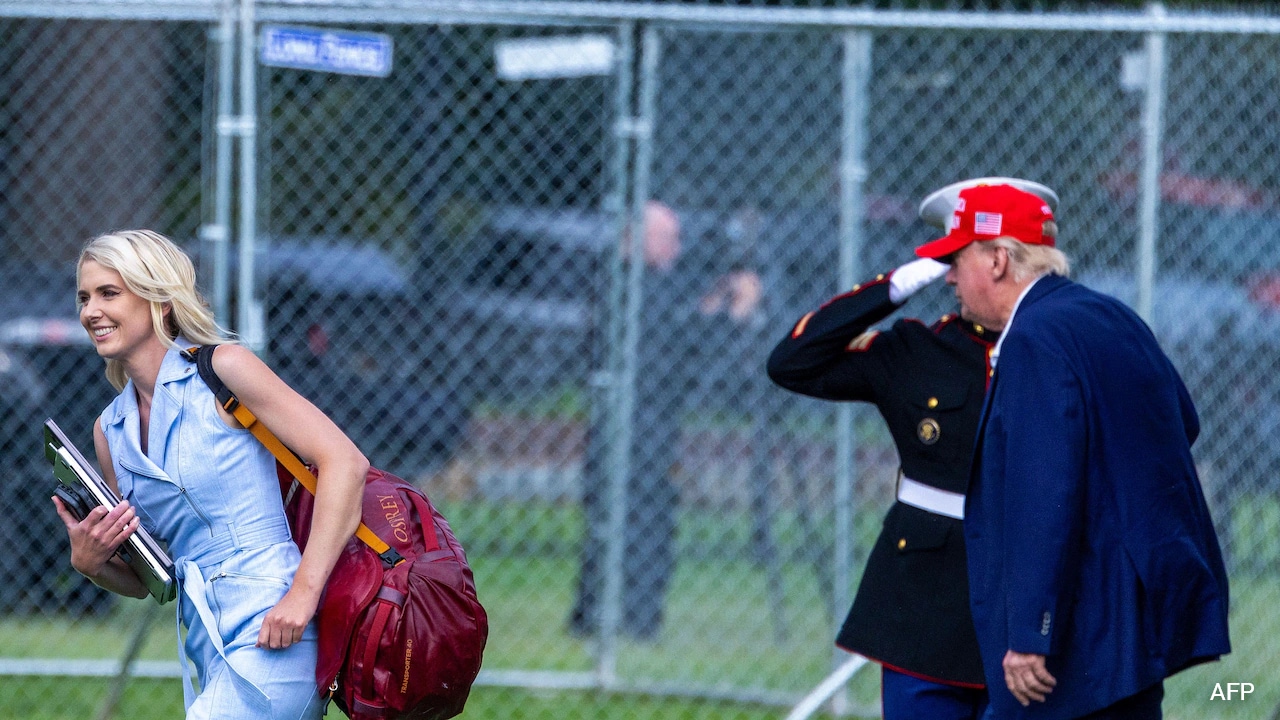
In the high-stakes theater of modern governance, proximity is power. While Cabinet secretaries wrestle with the slow grind of bureaucracy, a quiet cadre of personal aides occupies the true inner sanctum of the Oval Office. Natalie Harp, long defined by the unusual moniker of "the human printer," has recently ascended from a behind-the-scenes content manager to a central figure in one of the most bizarre security episodes of the decade. Her presence on a nondescript catering truck—used as a decoy vehicle to spirit Donald Trump away from Air Force One in Turkey—reveals more about the current administration than any official press release ever could.
The incident itself, spurred by what officials describe as an urgent Iranian assassination threat, functioned as a masterclass in obfuscation. While the public and the majority of the traveling press corps were kept in the dark, effectively held captive on the tarmac, the core of the Trump operation was being extracted through the back door. That Harp was among the chosen few to accompany the President is not a mere footnote. It is evidence of a shift in the executive branch where institutional protocol has been systematically replaced by personal loyalty. Meanwhile, you can explore similar stories here: Why You Cannot Trust Anything You Read On X During A Crisis.
For years, the professional political class dismissed Harp as a curiosity. She arrived in the Trump orbit after a public battle with stage II bone cancer, during which she championed the Right to Try legislation. Her narrative arc—from a patient failed by the medical establishment to a staunch defender of the President—mirrored the populist sentiment that propelled Trump to power. However, her evolution into an essential aide highlights a darker trend. The administration no longer relies solely on career civil servants or policy experts to maintain its momentum. Instead, it leans on a curated circle of individuals whose primary qualification is their ability to anticipate the President’s temperamental needs and information diet.
The "human printer" title, while often treated as a punchline in media circles, serves as a functional descriptor for her influence. By physically delivering curated news and social media feedback to Trump’s desk, Harp controls the input stream of the most powerful person on the planet. In the vacuum of traditional briefing structures, this act of curation is a form of governance. When you decide what the President reads, you decide the lenses through which he views reality. Her role as the gatekeeper of his Truth Social presence further cements this dynamic. She is not just an assistant; she is the curator of his digital consciousness. To understand the bigger picture, we recommend the excellent analysis by NPR.
This arrangement creates a dangerous feedback loop. When a leader is surrounded by aides whose primary directive is to maintain his mood and validate his impulses, the margin for error during a crisis—such as the Turkey security scare—narrows significantly. The decoy operation, while effective in its immediate objective of physical safety, highlights the administration's willingness to bypass accountability. By misleading hundreds of officials, aides, and reporters, the inner circle signaled that they operate under a different set of rules than the rest of the government.
Questions remain regarding the collateral fallout of this secrecy. The sudden, unexplained departure of Press Secretary Karoline Leavitt has fueled fevered speculation across the political landscape. While the official narrative points to a desire to spend time with family, the timing of her exit in the wake of the Turkey flight mystery suggests deeper friction. Whether or not Harp’s prominence contributed to the shift in the press office remains a matter of conjecture, but the optics are undeniable. The proximity of loyalists like Harp, Dan Scavino, and Walt Nauta creates a fortress mentality. It shuts out dissenting voices and creates a culture where the only currency that matters is unconditional fealty.
The Turkey episode demonstrates that in the current administration, the most critical decisions are made not in the Situation Room, but in the confined, mobile spaces where Trump feels most secure. These spaces are reserved for those who have proven they will follow him into the shadows, even when the rest of the world is left waiting on the tarmac. As the administration moves forward, the influence of these personal aides will only intensify. The public is watching the front stage, yet the actual mechanics of power are being managed by individuals who have no mandate, no confirmation, and no allegiance to anything other than the person they serve.
This is the reality of the new executive order. When the institutional guardrails are dismantled, the remaining structure is held together by the people who carry the laptops, the printers, and the decoy plans. It is a fragile, personalized form of authority that hinges entirely on the health and inclination of one man. As the tension with adversaries like the Islamic Revolutionary Guard Corps simmers, the risks of such a closed-loop system become increasingly apparent. The reliance on a small, vetted inner circle may protect the President from physical threats in the short term, but it leaves the executive branch increasingly isolated from the very reality it claims to be navigating.
The next time the plane lands, look past the official press secretaries and the Cabinet members. Search for the aides in the background. They are the ones holding the actual map of the operation, ensuring that the President’s view of the world stays exactly as he expects it to be.
The truth behind the Turkey flight decoy mystery
This video provides critical context regarding the speculation surrounding the decoy plane operation and the evolving roles of key staffers like Natalie Harp in the current administration.