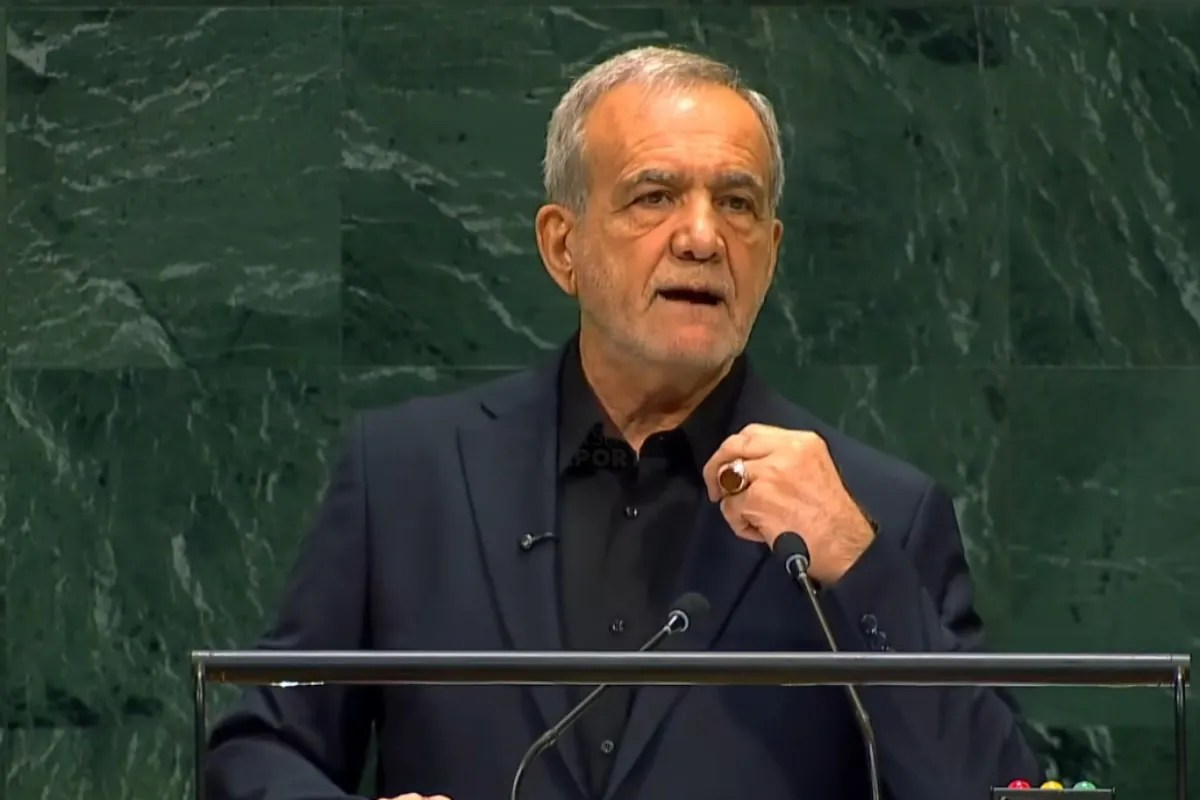
Every autumn, global media outlets line up to transcribe the predictable fury echoing from the podium of the United Nations General Assembly. When Masoud Pezeshkian stepped up to deliver his address, the headlines wrote themselves before he even opened his mouth. Tehran claims it will never bow down. Tehran insists it needs no permission to defend its borders. Western commentators nod solemnly, treating the rhetoric as a declaration of unyielding military might.
It is nothing of the sort.
If you view Pezeshkian's speech through the lens of traditional geopolitics, you miss the entire point. This was not a message directed at Washington or Jerusalem. It was an internal broadcast designed for the ears of the Islamic Revolutionary Guard Corps, nervous domestic constituents, and a fractured regional network watching its sponsor bleed out from within.
Let us strip away the diplomatic varnish and examine the structural reality. For decades, the conventional wisdom has treated Iranian defiance as an immutable constant, an elemental force of nature that operates outside the laws of economic gravity. Analysts spend hours dissecting the ideological purity of Tehran's leadership while ignoring the balance sheets. They mistake volume for velocity. They mistake noise for power.
When a state apparatus spends billions subsidizing proxy militias across the Levant while inflation hollows out its middle class, bravado is not a sign of strength. It is a camouflage.
Consider the financial ecosystem sustaining the Iranian state. The rial has endured a catastrophic descent, trading at hundreds of thousands to the dollar. Ordinary citizens watch their life savings evaporate before breakfast. Basic commodities require an acrobat's budget to secure. In any functional economy, a government facing this level of domestic friction would pivot toward stabilization, trade normalization, and institutional reform.
Instead, the leadership doubles down on confrontation. Why? Because confrontation is the only product the current administration manufactures efficiently.
When you have failed to deliver sustainable economic growth, when your currency is worth less than the paper it is printed on, and when your youth view emigration as the only escape hatch, you do not talk about supply chains or tax reforms. You talk about sovereignty. You wave the flag. You stand at a global podium and proclaim that nobody tells you how to run your house. It is political misdirection on a grand scale.
Look at how the mainstream defense establishment analyzes these speeches. They treat every threat as an existential escalation. They model worst-case military scenarios as if Tehran possessed unlimited industrial capacity. In reality, Iran's military procurement is hamstrung by decades of technological embargoes, aging airframes, and fragmented supply chains. While missile technology has seen localized advancements through reverse-engineering and foreign smuggling rings, the broader industrial base is rotting.
I have watched defense contractors and intelligence analysts blow millions modeling complex conflict scenarios based on what Tehran says, rather than what Tehran can actually sustain for ninety days. It is an expensive hallucination.
The disconnect stems from a fundamental misunderstanding of how autocratic legitimacy functions. In a democratic system, leaders justify their position through economic performance, legislative delivery, and electoral mandates. In a revolutionary system, legitimacy is maintained through perpetual external threat. If the enemy is at the gates, internal dissent becomes treason. If the Great Satan is constantly plotting your downfall, nobody is allowed to complain about the price of bread.
Pezeshkian campaigned on a platform of moderation and economic engagement with the West. He was billed by hopeful diplomats as a pragmatist who would break the cycle of isolation. Yet within months of taking office, he finds himself trapped inside the exact same systemic machinery as his predecessors. The office shapes the occupant, not the other way around. To survive the internal power struggles of Tehran, a reformer must out-hawk the hardliners.
That is why the UNGA speech was so aggressive. Pezeshkian was not signaling confidence to the international community. He was paying protection money to the hardliners who control the real levers of state power, proving that he can talk the talk just as loudly as any cleric in the inner circle.
This brings us to the core deception of the regional proxy network. For years, conventional analysis held that Iran's "Axis of Resistance" provided an unbreakable defensive shield, projecting power deep into the Mediterranean and the Persian Gulf. The architecture looked formidable on paper. Hezbollah's rocket arsenals, the Houthis controlling maritime chokepoints, militias entrenched in Iraq and Syria—it all pointed to an expanding sphere of influence.
Events have brutally exposed the limits of that architecture. When strategic deterrence is tested by advanced kinetic operations, decentralized militias discover that underground tunnels and asymmetric skirmishes do not stop targeted intelligence penetration and precision airstrikes. The illusion of invincibility is fragile. Once cracked, it shatters entirely.
When regional proxies take heavy losses, Tehran cannot step in with conventional armor or open intervention without risking a total systemic collapse. Instead, it must rely on what it does best: more speeches, more defiant rhetoric, and more theatrical displays of resolve at international summits.
The media eats it up every single time. Headlines trumpet the defiance. Pundits debate the escalation risks. Markets twitch for a moment before realizing that the bark remains infinitely worse than the bite.
We need to stop evaluating these statements through the lens of martial capability. We need to start evaluating them through the lens of regime survival.
When a government tells you it will never bow down, look at who is holding up the knees. In Iran's case, it is a population that has demonstrated remarkable courage through wave after wave of domestic protests, risking imprisonment and worse to demand basic human dignity. The greatest threat to the regime is not sitting across a negotiating table in Geneva or New York. It is sitting in the tea houses, universities, and streets of Tehran, Isfahan, and Shiraz.
The leadership knows this. Every speech at the United Nations is an insurance policy against domestic collapse. By manufacturing an external adversary, they attempt to unify a fractured populace behind a nationalist flag.
It is an old playbook. It worked for decades. But the expiration date on manufactured outrage arrives quickly when empty stomachs outnumber ideological fervor.
Stop treating these declarations as military milestones. Stop building complex threat matrices based on podium bravado. Recognize the speech for what it is: the defensive reflex of a regime running out of time, money, and excuses.
The next time you read about Tehran refusing to bow, ask yourself a simpler question. If they were truly standing tall, why would they need to tell you about it every single day?


