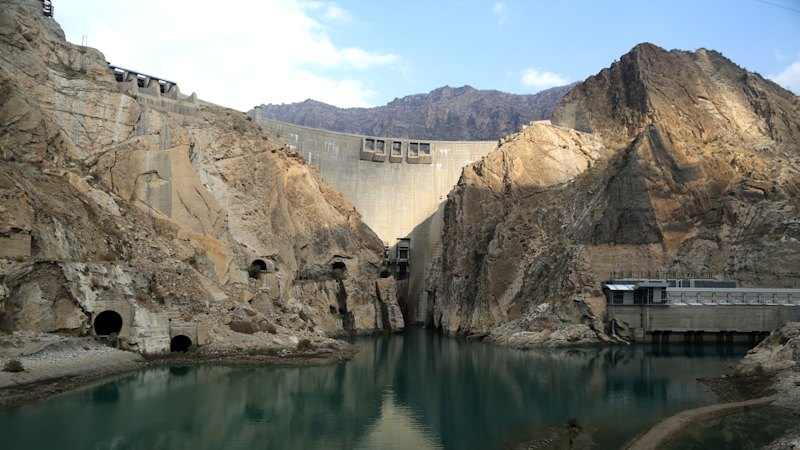
Military analysts love a neat kinetic puzzle. When missile strikes hit infrastructure in Iran, defense commentators immediately dust off their Cold War playbooks, squint at satellite imagery of massive concrete walls, and declare that Tehran’s decades-long dam-building frenzy is finally being exposed as a catastrophic strategic vulnerability. They frame the Islamic Republic’s obsession with hydrology as a misguided developmental vanity project that doubled as an accidental Achilles' heel.
They are completely wrong.
The lazy consensus in foreign policy circles treats Iran’s 600-plus large dams as failed public utilities—bloated, environmentally ruinous monuments to central planning that are now sitting ducks for precision-guided munitions. If you look at Iran’s water crisis through the lens of traditional civil engineering or conventional military targeting, the whole enterprise looks insane. Why build hundreds of colossal reservoirs in an arid plateau where evaporation eats up billions of cubic meters of water every year, drying up Lake Urmia and turning Khuzestan into a dust bowl?
Because the dams were never built to store water. They were built to store power, launder political patronage, and cement the economic hegemony of a parallel state.
The "Water Mafia" Is a Feature, Not a Bug
To understand why Tehran poured concrete across every river basin from the Zagros Mountains to the Caspian coast, you have to stop listening to hydrologists and start listening to forensic accountants. Over the last thirty years, dam construction became the primary financial engine of the Islamic Revolutionary Guard Corps (IRGC) and its engineering conglomerate, Khatam-al Anbiya.
In Western infrastructure markets, a dam is a capital-intensive headache with a thirty-year amortization schedule and razor-thin margins. In Iran’s sanctioned, state-dominated economy, a dam is an ATM.
When the state awards a no-bid, multi-billion-dollar mega-project to a military-affiliated contractor, the financial mechanics work in reverse of market logic:
- Cost overruns are the profit center. Delays, geological surprises, and design changes justify endless budget infusions from the central bank.
- Subcontracting buys loyalty. Hundreds of smaller firms tied to local clerics, provincial governors, and parliamentary representatives get a slice of the concrete, steel, and earth-moving contracts.
- Land speculation guarantees windfalls. Before a dam is even announced, insiders buy up worthless arid scrubland downstream. Once the canals are routed to their specific parcels, land values multiply overnight, turning agricultural wastelands into lucrative industrial farms or real estate developments.
Even Iranian researchers and former officials—like Kaveh Madani, the former deputy head of Iran’s Department of Environment—have spent years documenting what locals explicitly call the "water mafia." Yet defense pundits still write articles acting as if Tehran built these structures out of bureaucratic incompetence, and that a few bunker-busters will suddenly make the regime realize the error of its ways.
You cannot bomb a patronage network out of existence by blowing up the concrete it already got paid to pour.
Why Precision Strikes on Dams Are a Strategic Trap
Let’s dismantle the second half of the mainstream narrative: the idea that missile strikes on Iranian dams represent a clever, high-leverage military option that "solves" the puzzle of Tehran's infrastructure.
I have spent years analyzing critical infrastructure vulnerabilities across the Middle East, and there is no faster way to turn a tactical military strike into a generational geopolitical disaster than targeting hydrological assets. Even if we ignore the Geneva Conventions—specifically Additional Protocol I, Article 56, which explicitly prohibits attacks on dams and dikes due to the severe civilian losses caused by the release of dangerous forces—the pure military math makes zero sense.
The Physics of Concrete vs. Warheads
Modern gravity and arch dams are among the hardest structures on earth to destroy with conventional air-to-ground ordnance. During World War II, the Royal Air Force needed the custom-engineered, bouncing Upkeep bomb—and suffered a nearly 50 percent casualty rate—just to breach the Möhne and Edersee dams in Germany.
Today’s precision-guided munitions, like the GBU-31 JDAM or standard air-launched cruise missiles, are designed to penetrate hardened aircraft shelters or bunkers, not thirty-meter-thick walls of reinforced mass concrete backed by millions of tons of hydrostatic pressure. Cracking the crest of a dam might disable a spillway gate or knock out an adjacent hydroelectric turbine hall, causing temporary grid disruptions. Actually inducing a catastrophic structural collapse requires repeated, heavy-payload strikes on the exact same structural weak points—a luxury no air campaign enjoys against an integrated air defense network without total air supremacy.
The Blowback Matrix
Imagine a scenario where an adversary actually succeeds in breaching a major structure like the Karun-3 or Dez Dam in southwestern Iran. What happens in the next seventy-two hours?
- Zero degradation of military command. The IRGC’s missile silos, drone factories, and nuclear facilities are buried deep underground in hardened mountain complexes, completely detached from surface reservoir grids.
- Instant humanitarian catastrophe. Millions of civilians in the Khuzestan plain—ironically, the very ethnic Arab minority populations that Western strategists often hope will rise up against Tehran—would be displaced or drowned.
- The ultimate propaganda gift. Nothing unifies a fractured, deeply cynical populace faster than an external enemy literally flooding their homes and destroying their drinking water. A regime on the brink of domestic collapse gets an immediate, indisputable moral justification for total mobilization.
When commentators cheer strikes near or on water infrastructure as a "wake-up call" for Tehran, they are confusing physical destruction with strategic coercion. Knocking out a power substation is coercion; threatening a water table is an existential threat that forces irrational escalation.
Are You Asking the Wrong Question About Iran’s Infrastructure?
If you search for news on Iran's dams right now, you will run into the same recycled questions from readers trying to make sense of the headlines. Almost all of them are built on flawed premises.
"Why did Iran build so many dams if they don't have enough water?"
Because supply-side engineering is politically easy, while demand-side reform is politically fatal.
Iran’s agricultural sector consumes roughly 90 percent of the country’s water, yet contributes barely 10 percent to its GDP. Traditional flood irrigation wastes staggering amounts of water to grow water-intensive crops like rice, watermelon, and sugar beets in the middle of a desert. Fixing that requires forcing millions of rural farmers to change their livelihoods, pricing water at its true market value, and dismantling agricultural subsidies. No politician in Tehran wants to spark a peasant revolt. Building a massive new dam lets politicians cut ribbons, claim they are "creating" water out of thin air, and kick the ecological bankruptcy down the road for another electoral cycle.
"Does Iran rely on these dams for most of its electricity?"
No. This is one of the most persistent myths in energy reporting. Hydroelectric power accounts for less than 10 to 15 percent of Iran’s total electricity generation capacity—and during drought years, that number plummets into the single digits because reservoir levels drop below the turbine intakes. Iran runs on natural gas and thermal power plants. Taking out every hydroelectric turbine in the country would cause localized brownouts, not a national blackout.
"Will destroying dams force Iran to stop funding regional proxies?"
Not a chance. Proxy warfare is dirt cheap compared to conventional infrastructure. The entire annual budget for armed groups across the Levant and Yemen costs Tehran a fraction of what it spends subsidizing domestic gasoline and concrete. If you destroy domestic civilian infrastructure, the regime will simply divert even more capital away from domestic reconstruction and double down on asymmetric deterrence, because asymmetric warfare becomes the only tool it has left.
The Real Vulnerability Nobody Is Watching
If military planners and defense analysts want to understand where Iran’s water-energy nexus actually cracks under pressure, they need to stop looking at the giant concrete walls in the mountains and start looking at the grid transformers and desalination plants along the Persian Gulf.
As Iran’s inland aquifers have collapsed from decades of over-pumping—causing entire sections of Tehran, Isfahan, and Shiraz to literally sink by up to 25 centimeters a year due to land subsidence—the regime has quietly shifted its strategic bet. They know the dams are drying up. Silted reservoirs and evaporating lakes can no longer sustain the major urban centers.
Tehran’s new lifeline is massive water transfer pipelines pumping desalinated water from the Persian Gulf and the Sea of Oman hundreds of kilometers uphill into the central plateau to keep heavy industries—steel, copper, and petrochemicals—running.
Look at the economics and physics of that shift:
- Dams generate power; desalination burns it. Pumping seawater across mountain ranges requires massive, continuous baseload electricity.
- Coastal plants are exposed. Unlike mountain dams tucked inside rugged canyons, coastal desalination facilities and high-voltage pumping stations sit flat on open shorelines, exposed to both maritime interdiction and basic grid failures.
- Industrial dependence is total. Without that piped water, Iran’s domestic steel and petrochemical sectors—the exact industries keeping its sanctioned economy afloat—grind to a halt within days.
The Downside of the Contrarian View
Admitting that Iran’s dams are political slush funds rather than vital military targets comes with an uncomfortable reality for Western policymakers: it means there is no quick, clean kinetic fix to Iran’s internal rot.
If the dams were truly the load-bearing pillars of the regime’s military machine, a well-coordinated air campaign could theoretically cripple Tehran in a weekend. Recognizing that the dams are merely symptoms of deep, systemic corruption and ecological mismanagement means accepting that external military pressure cannot accelerate the regime's collapse—and will almost certainly delay it.
Internal economic decay, hyperinflation, land subsidence, and chronic water mismanagement are doing far more damage to the Islamic Republic’s long-term viability than any cruise missile ever could. Every time an outside power strikes a piece of dual-use infrastructure, it hands the regime an external scapegoat for its own catastrophic governance. Suddenly, the water shortages aren't the fault of the IRGC’s concrete mafia; they are the fault of foreign aggression.
Stop treating Iran’s dams like strategic chess pieces that can be knocked off the board to win the game. Leave the concrete alone, let the compounding physics of evaporation, siltation, and economic insolvency run their course, and stop giving Tehran an excuse for the ruin it engineered itself.