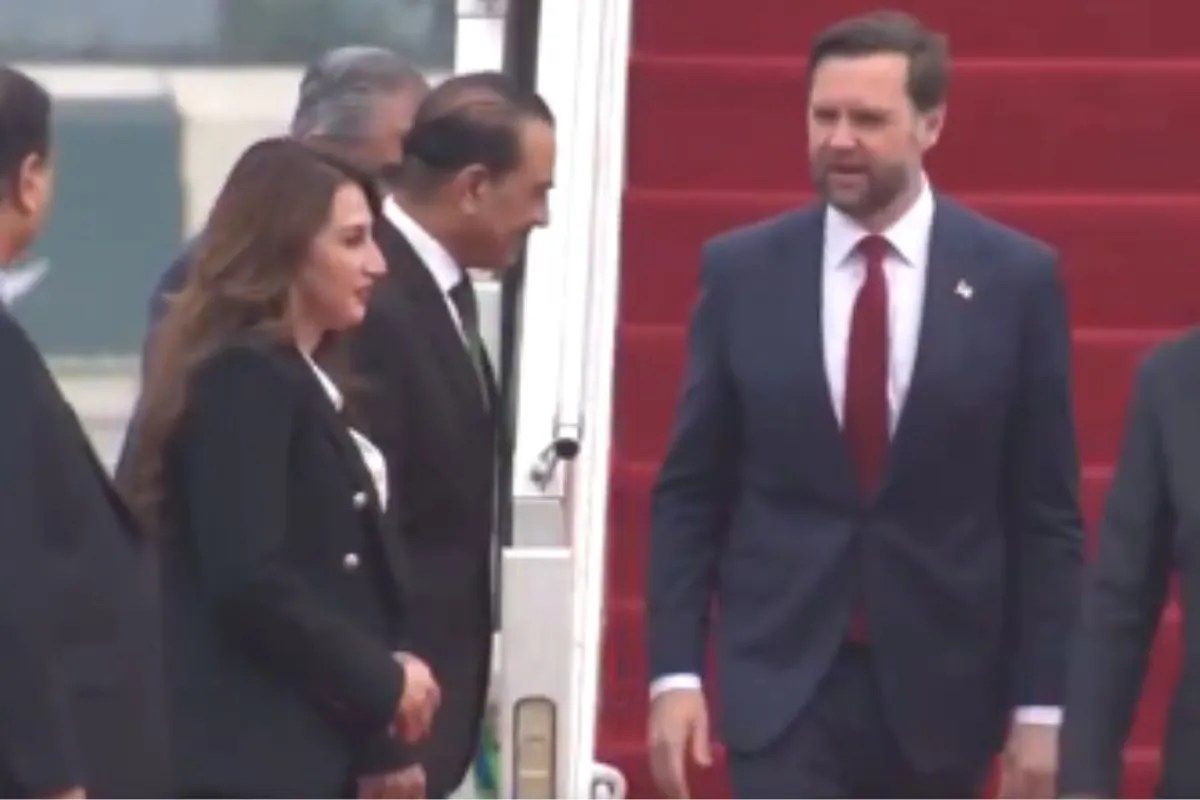
The arrival of Vice President JD Vance in Islamabad to meet Prime Minister Shehbaz Sharif marks a definitive shift from back-channel signaling to a structured mediation framework designed to stabilize the Persian Gulf through South Asian proximity. This diplomatic maneuver functions as a high-stakes stress test for Pakistan’s role as a regional "buffer state" capable of facilitating dialogue between Washington and Tehran. While the superficial narrative focuses on bilateral optics, the underlying mechanism is a calculated attempt to utilize Islamabad’s unique Islamic Republic status and its historical ties to both the American security apparatus and the Iranian leadership to bypass the deadlocked direct negotiation routes in Doha or Muscat.
The Strategic Logic of the Islamabad Hub
Washington’s choice of Islamabad as the primary node for this diplomatic push is not incidental. It is a response to the breakdown of traditional European-led mediation and the increasing volatility of the Strait of Hormuz. The strategy operates on three distinct geopolitical levers: For another perspective, consider: this related article.
- The Neutral Ground Mandate: Pakistan maintains a precarious but functional neutrality between its Saudi benefactors and its Iranian neighbors. By engaging Sharif first, Vance is operationalizing Pakistan as a "clearing house" for sensitive terms that neither Washington nor Tehran can yet afford to acknowledge publicly.
- The Security Guarantee Feedback Loop: Pakistan’s military establishment possesses the institutional memory of managing border friction with Iran (Sistan-Baluchestan) while simultaneously maintaining a deep-rooted intelligence sharing architecture with the United States. This dual-access makes them the only credible verifiers of ground-level de-escalation.
- The Economic Incentive Structure: For Pakistan, acting as the bridge for US-Iran talks is a survival mechanism. Success in this role provides Islamabad with the political capital necessary to negotiate more favorable terms with international lenders while potentially reviving the long-stalled Iran-Pakistan gas pipeline project under a US-sanctions waiver.
Quantifying the Incentives for De-escalation
The friction between the US and Iran is currently governed by a "Maximum Pressure vs. Maximum Resistance" cost function. Vance’s mission seeks to pivot this toward a "Managed Friction" model. The success of these talks depends on the calibration of four specific variables:
- Nuclear Breakout Thresholds: The primary American objective is the verifiable freezing of uranium enrichment at the 60% level.
- Regional Proxy Containment: Washington requires a reduction in kinetic activity from the "Axis of Resistance" in exchange for the unfreezing of specific Iranian assets held in third-country accounts.
- Sanctions Elasticity: Iran’s economy has developed a high tolerance for existing sanctions through "grey market" oil sales to East Asia. The US realizes that further sanctions have diminishing returns; therefore, the incentive must be positive (re-entry into SWIFT or sectoral waivers) rather than punitive.
- Energy Market Stability: With global oil prices sensitive to any disruption in the Strait of Hormuz, the US seeks a "non-interference" pact to ensure the flow of 21 million barrels of oil per day.
The Sharif-Vance Interaction as a Force Multiplier
The initial meeting with Shehbaz Sharif is designed to establish the "Rules of Engagement" for the broader regional dialogue. Sharif’s government, currently navigating an internal economic crisis and political polarization, views the Vance visit as a validation of its legitimacy. However, the strategic value for the US lies in Sharif’s ability to act as a civilian front for a policy that is ultimately underwritten by the Pakistani military. Similar coverage on this matter has been published by Associated Press.
The conversation is likely structured around the "Two-Track Verification" system. Track One involves formal diplomatic communiqués regarding nuclear compliance. Track Two involves the "silent" security guarantees—ensuring that if the US eases naval pressure in the Gulf, Iran restricts the supply of precision-guided munitions to its regional affiliates. Pakistan’s role is to act as the intermediary for Track Two, where the most significant risks of miscalculation reside.
The Structural Bottlenecks of Pakistani Mediation
While the Islamabad route offers a fresh path, it is constrained by internal and external friction points that could derail the mission:
- Domestic Instability: The Sharif administration’s thin mandate limits its ability to make bold foreign policy shifts that might be perceived as "pro-American" by a skeptical public or "pro-Iranian" by Gulf allies.
- The Riyadh Factor: Saudi Arabia remains the primary financier of the Pakistani state. Any US-Iran deal brokered in Islamabad must be pre-cleared by Riyadh to ensure it does not undermine the Saudi-led regional security architecture.
- Intelligence Leakage: The high density of competing intelligence interests in Islamabad (ISI, CIA, RAW, and Iranian intelligence) creates a high-entropy environment where confidential terms can be leaked to sabotage the process.
Mechanisms of Verification and Compliance
For the Vance-Sharif talks to translate into a broader US-Iran breakthrough, the parties must move toward a decentralized verification model. Unlike the JCPOA, which relied on a centralized international body (the IAEA), this new framework suggests a regional "Peer Review" system.
Under this model, regional neighbors—led by Pakistan—would provide "atmospheric" verification. If Tehran moves toward de-escalation, the evidence would be felt in the reduced frequency of maritime harassment and the cooling of rhetoric in the Urdu and Persian-language media spheres. The US, in turn, would provide "incremental rewards" rather than a comprehensive "Grand Bargain." This modular approach allows both sides to retreat without losing face if the process fails.
The immediate objective in Islamabad is the creation of a "Hotline Mechanism" between the US military command in the region and Iranian leadership, with Pakistan acting as the switchboard. This reduces the time-lag in communication during a crisis, preventing a tactical error from spiraling into a strategic conflict.
Strategic Forecast: The Shift Toward Regionalized Diplomacy
The Vance visit signals the end of the "Washington-Centric" era of Middle Eastern diplomacy. By choosing Islamabad, the US is acknowledging that regional stability is best maintained through local actors who have a direct stake in the outcome. The pivot to Pakistan suggests that the US is ready to trade a degree of direct control for a higher probability of localized compliance.
The success of this initiative will be measured not by a signed treaty, but by the absence of headlines. If the Islamabad Protocol holds, the world will see a quiet stabilization of energy prices and a shift in Iran’s tactical posture from expansion to consolidation.
The strategic play for the US is to bind Pakistan’s economic recovery to the success of these negotiations. By making Islamabad a stakeholder in US-Iran peace, Washington creates a self-enforcing mechanism where Pakistan’s own financial interests dictate that it must prevent the talks from failing. This effectively outsources the "policing" of the dialogue to a party that cannot afford to let it collapse.
The next 72 hours in Islamabad will determine if the Sharif government can transform from a recipient of aid into a broker of global security. The focus now shifts to the quiet arrival of Iranian intermediaries in the Pakistani capital—the true indicator that the Vance mission has moved from a courtesy call to a functional negotiation.