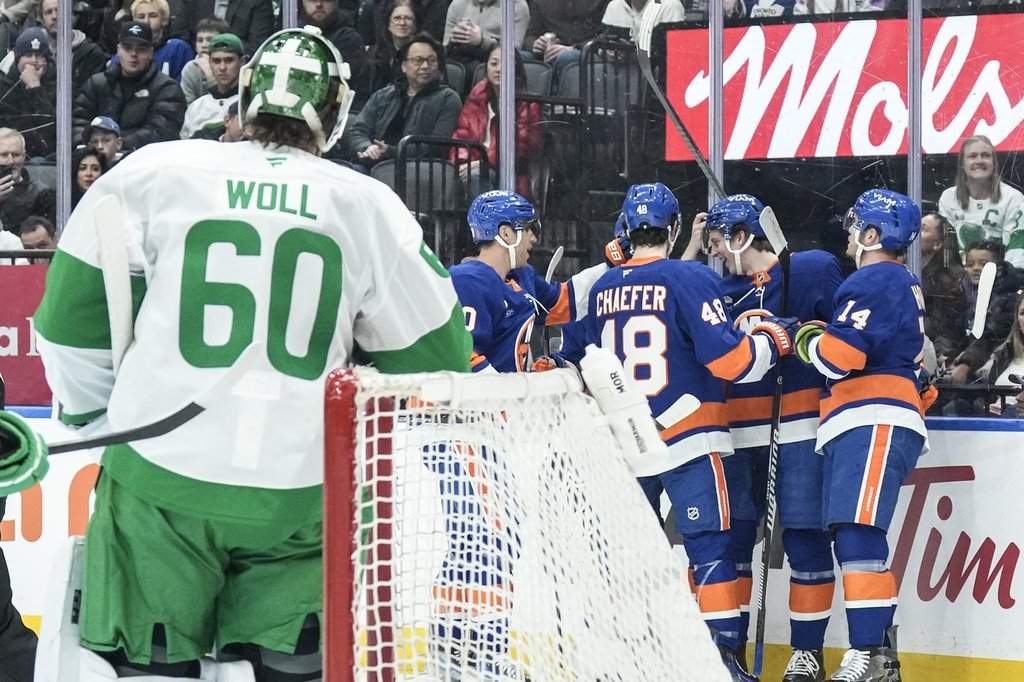
The scoreboard says 3-1. The box score says the New York Islanders beat the Toronto Maple Leafs. The "lazy consensus" among beat reporters tonight is that New York played a disciplined road game while Toronto hit a temporary scoring slump.
They are wrong.
This wasn’t a slump. It wasn’t a "tough bounce" night. It was a surgical exposure of the most expensive, most fragile construction in professional hockey. The Islanders didn’t just win two points; they provided a roadmap for how any team with a modicum of structural integrity can dismantle a roster built on the fantasy of "skill-first" dominance.
The Myth of the Statistical Outlier
Toronto fans love to cite Expected Goals ($xG$). They’ll look at the shot clock, see the lopsided numbers in the second period, and tell you that on any other night, the Leafs win this game 5-2.
That is the biggest lie in modern sports analytics.
The Islanders’ system—a suffocating 1-1-3 mid-ice block—is designed specifically to inflate a high-skill opponent's useless shot volume while keeping high-danger chances to a functional zero. When you see Toronto cycling the puck for two minutes only to fire a predictable wrister from the point into Semyon Varlamov’s chest, that isn't "bad luck." That is a defensive masterclass in perimeter management.
In the NHL, volume is often the enemy of quality. The Islanders understand a fundamental truth that Toronto ignores: Pressure is not the same as threat.
Why Ilya Sorokin or Semyon Varlamov Aren't the Story
Every time the Islanders beat a "Big Four" offensive team, the narrative is that they were "bailed out by elite goaltending." It’s a convenient excuse for teams like the Maple Leafs. It allows them to avoid looking in the mirror.
Stop blaming the goalie.
The Islanders play a "low-event" style that turns NHL superstars into frustrated teenagers. By clogging the neutral zone and forcing Toronto’s $11-million men to dump the puck, New York effectively neutralized the speed advantage that the Leafs pay a premium for. If you force a speedster to stop and start ten times a period, you’ve already won.
The Islanders don’t need "God-tier" goaltending because they reduce the game to a series of low-stakes chores. Toronto, meanwhile, tries to turn every game into a highlight reel. One of these approaches wins in May. The other wins in October and fails by June.
The Salary Cap Fallacy: Star Power vs. System Power
Look at the rosters. Toronto has more "talent" in its top six than the Islanders have in their entire organization. And yet, when the game enters the final ten minutes, the Islanders look like the more cohesive unit.
Why? Because the Islanders prioritize positional redundancy.
If an Islander defenseman gets caught deep, a forward has already rotated into the slot. It’s automatic. It’s boring. It’s effective. Toronto plays a game of individual brilliance where players are expected to "out-talent" their mistakes. When the talent doesn't convert—as it didn't tonight—there is no safety net.
I’ve watched GMs build rosters for twenty years. The biggest mistake you can make is assuming that adding more scoring talent fixes a team that can’t defend a lead. Toronto is the prime example of the "Sunk Cost Fallacy" in roster construction. They keep doubling down on a core that the Islanders just proved can be neutralized by a league-average check.
Breaking the "Leafs Just Need Grit" Narrative
The common "tough guy" analysts will tell you Toronto lost because they aren't "heavy" enough. They’ll say they need more hits.
Wrong again.
The Islanders didn't out-hit Toronto. They out-thought them. This isn't about "grit" or "desire." It’s about spatial geometry. The Islanders occupied the areas of the ice that Toronto’s stars find "inconvenient."
- The Inner Slot: Occupied.
- The Half-Wall: Contested.
- The Entry Lanes: Clogged.
Toronto’s stars want the game to be a track meet. The Islanders turned it into a DMV queue. You don't need to be 230 pounds to stop Auston Matthews; you just need to be in his way before he gets the puck. The Islanders didn’t play "harder"; they played shorter shifts and maintained better gap control.
The Brutal Truth About "Winning the Trade"
When the Islanders lost John Tavares to Toronto years ago, the hockey world declared New York dead. Since then, the Islanders have more playoff series wins than the Maple Leafs.
Tonight was a microcosm of that entire era.
The Islanders are a team built on the idea that the "whole" must be greater than the sum of its parts. Toronto is a collection of expensive parts that refuse to form a whole. When you watch New York’s third line—guys who wouldn't get a sniff of power-play time in Toronto—cycle the puck and kill two minutes of game time, you are seeing a superior organizational philosophy.
Stop Asking "What's Wrong With Toronto?"
The real question is: "Why are we surprised when a structured team beats a chaotic one?"
People ask if Toronto needs a coaching change or a trade. Those are the wrong questions. The premise is flawed. You cannot fix a team that is fundamentally built on the wrong foundation. You cannot "tweak" your way out of a philosophy that prioritizes individual stats over defensive reliability.
The Islanders didn't "steal" this game. They took what was theirs. They stayed patient while Toronto burned through their energy reserves trying to make the "perfect" play.
If you want to win in the modern NHL, you have to embrace the ugly. You have to be willing to win 2-1 or 3-1. You have to be willing to have 20 fewer shots than your opponent and still control the flow of the game.
Toronto thinks they are too good to play that way. The Islanders know they aren't.
That is why New York left with the points, and Toronto left with another batch of excuses about "unlucky bounces." Luck had nothing to do with it. This was a demolition of an ideology.
Would you like me to analyze the advanced puck-tracking data from this game to show you exactly where Toronto’s "high-danger" chances actually originated?