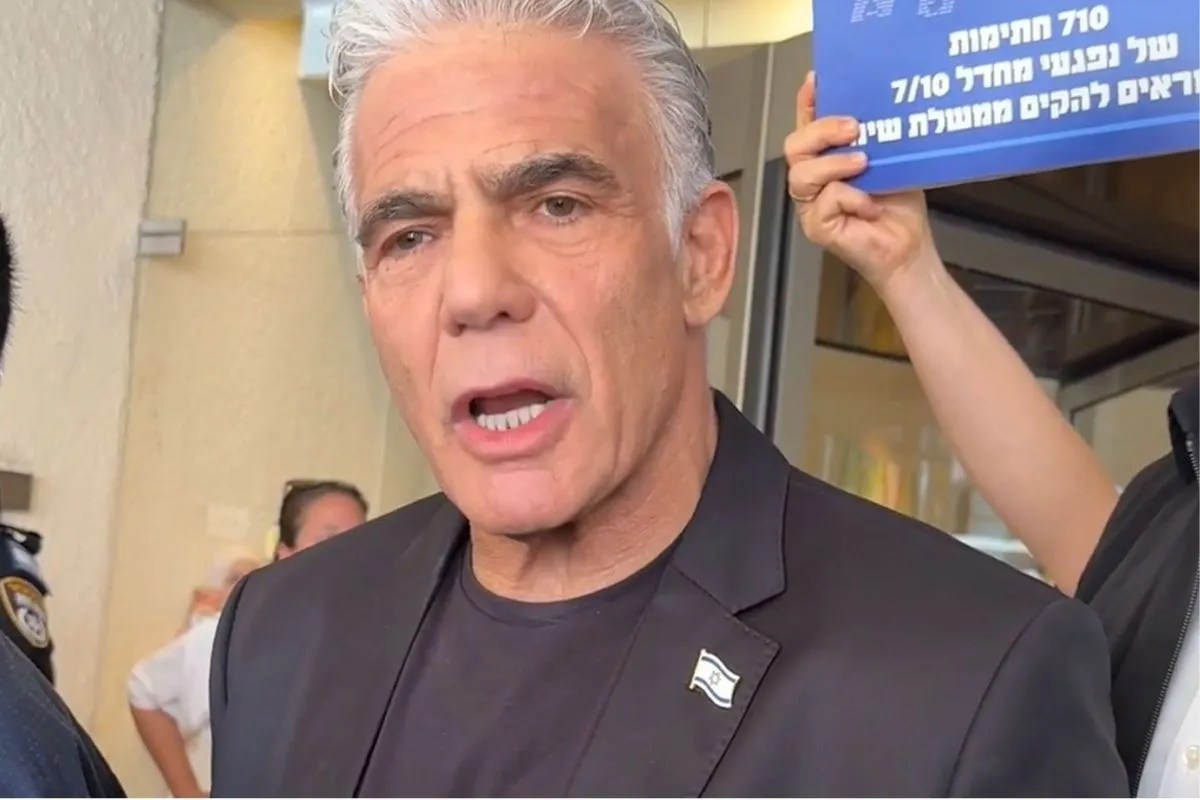
The Arithmetic Bottleneck Behind Removal Rhetoric
Yair Lapid's demand to remove Benjamin Netanyahu from the Prime Minister's Office runs directly into a 120-seat parliamentary arithmetic problem following Israel's October 27, 2026 legislative election. Surface coverage frames calls to unseat the incumbent premier as a straightforward political clash between opposition leaders and a beleaguered leader. That framing misses the structural mechanism governing coalition assembly in Israel's proportional representation system: a candidate for prime minister must command 61 Knesset seats, yet no major faction cleared that threshold alone or within a friction-free bloc.
Following the October 27, 2026 vote and official confirmation on November 4, 2026, Netanyahu's bloc held roughly 53 seats, an anti-Netanyahu camp associated with Gadi Eisenkot's Yashar party held around 48 seats, and Arab parties—led by the Joint List and Ra'am—held 19 seats. President Isaac Herzog tasked Eisenkot with forming the next government, leaving Netanyahu as caretaker prime minister with a 28-day statutory window expiring on December 6, 2026, subject to a potential 14-day extension.
Standard commentary often treats a public call to oust a prime minister as equivalent to having the parliamentary votes to do so. In reality, rhetoric and vote assembly operate on separate tracks. Public pressure from Lapid shapes media narratives and signals bloc discipline, but cabinet formation requires binding legislative arithmetic where ideological red lines and minority-party dynamics create severe friction.
What Standard Headlines Miss
Conventional reporting on Yair Lapid's push to remove Benjamin Netanyahu from the Prime Minister's Office typically treats the dispute as a binary contest between continuity and change. Three analytical omissions distort that picture:
- Seat count versus coalition viability: Having roughly 48 seats in the anti-Netanyahu camp leaves a 13-seat deficit short of a 61-seat majority, making arithmetic bridging mandatory rather than optional.
- Ideological incompatibility inside the anti-Netanyahu camp: Factions seeking Netanyahu's exit—ranging from Gadi Eisenkot's Yashar and Naftali Bennett's Together to Avigdor Lieberman's Yisrael Beiteinu, Yair Golan's Democrats, and Arab factions—hold sharply conflicting positions on governance, state-religion boundaries, and Arab party participation.
- Caretaker leverage and clock management: Even when a prime minister loses a clear majority, the incumbent retains caretaker authority and can use negotiation delays to test rival coalitions' cohesion.
Deconstructing the Coalition Mechanics
To evaluate whether Lapid's push to unseat Netanyahu succeeds or stalls, analysts must separate coalition math—the raw seat tally required to reach 61—from coalition durability, which measures whether disparate parties can sustain a cabinet without immediate collapse.
The Three Structural Constraints on Ousting Netanyahu
Any effort to replace Netanyahu in the Prime Minister's Office after the October 2026 election operates inside three interlocking constraints:
- The Majority Threshold Constraint: Reaching 61 seats in the 26th Knesset requires assembling partners across ideological lines. With Netanyahu's bloc near 53 seats and the Eisenkot-led camp near 48 seats, neither main camp holds a self-sufficient majority.
- The Arab-Party Inclusion Trade-Off: Arab parties won 19 seats across the Joint List and Ra'am. Relying on them bridges the seat gap mathematically, yet leaders such as Naftali Bennett have publicly argued that a stable government can be formed without Ra'am and the Joint List, exposing internal friction over how to treat Arab factions.
- The Haredi-Secular Trade-Off: Avigdor Lieberman has argued that dismantling Netanyahu's bloc requires engaging ultra-Orthodox parties—Shas and United Torah Judaism—despite long-standing disputes over military conscription and state-religion policy. Trading policy concessions for seats raises immediate friction with secular and reform-minded partners.
Mechanism Note — Why Anti-Incumbent Alignment Is Necessary but Not Sufficient: Parties can agree on removing a single leader without agreeing on judicial policy, military draft exemptions, or foreign diplomacy. Negative consensus around ouster often fractures the moment cabinet portfolios and legislative agendas are drafted.
Cause-and-Effect Chains Overlooked in Surface Coverage
Surface articles frequently jump from "Lapid calls for Netanyahu's removal" to "a new government is forming". Tracing the causal chain reveals multiple failure points.
First, a procedural milestone does not equal cabinet stability. In mid-November 2026, the opposition bloc moved to install Matan Kahana as Knesset Speaker, signaling parliamentary momentum and creating a platform for proposals such as an independent inquiry into the October 7, 2023 attacks, prime ministerial term limits, and reversals of prior judicial changes. Controlling the Speaker's gavel alters legislative scheduling, yet passing a full government investiture vote requires a stable 61-vote floor across contested issues.
Second, external diplomatic calendars compress negotiation timelines. Lapid has emphasized urgency around the January 3, 2027 swearing-in of a new U.S. Congress, arguing that Netanyahu remaining in office would strain ties with Washington. Diplomatic deadlines create political pressure on coalition negotiators, but statutory Knesset clocks—such as the 28-day mandate window expiring December 6, 2026—govern legal authority. When political urgency collides with rigid coalition bargaining, negotiators face a choice between hurried compromises that weaken cabinet longevity or prolonged deadlocks that risk repeat elections.
Third, defection rumors function as a tactical weapon during talks. When Netanyahu and Bennett met in November 2026, suspicions immediately surfaced that Bennett might defect from Eisenkot's bloc to keep Netanyahu in office, even as Bennett's circle and public statements rejected defection and backed Eisenkot. In fragmented multi-party negotiations, even unverified defection fears raise transaction costs because every faction demands higher assurances against betrayal.
Known Facts Versus Analytical Hypotheses
Separating verified post-election facts from strategic interpretations prevents overstating certainty during an active coalition process.
Verified Facts from the 2026 Election Cycle
- Israel held legislative elections for the 26th Knesset on October 27, 2026, with official results confirmed on November 4, 2026 and the new Knesset sworn in on November 10, 2026.
- Voter turnout reached 77.98%, with new lists—including Gadi Eisenkot's Yashar (21 seats) and Naftali Bennett's Together (12 seats)—competing alongside Likud (27 seats), the Joint List (11 seats), The Democrats (8 seats), Ra'am (8 seats), Yisrael Beiteinu (7 seats), Otzma Yehudit (7 seats), United Torah Judaism (7 seats), Shas (6 seats), and RZP–Zehut (6 seats).
- Neither Netanyahu's bloc (roughly 53 seats) nor Eisenkot's anti-Netanyahu camp (roughly 48 seats) secured an outright 61-seat majority on its own, leaving Arab parties with 19 seats.
- President Isaac Herzog tasked Eisenkot with forming the next government under a 28-day statutory window expiring December 6, 2026, with a possible 14-day extension, while Netanyahu remained caretaker prime minister.
- Yair Lapid has repeatedly called for Netanyahu's removal from the Prime Minister's Office, citing security, domestic divisions, and diplomatic relations with the United States.
Educated Hypotheses and Strategic Trade-Offs
- Hypothesis on Coalition Fragility: If Eisenkot assembles a 61-plus-seat government using ideologically distant partners—whether by engaging ultra-Orthodox factions or relying on tacit or explicit Arab party support—the resulting cabinet will likely face recurring legislative friction over military draft policy, judicial legislation, and budget votes.
- Hypothesis on Incumbent Stalling Incentives: Where an opposition bloc lacks a clean, pre-agreed 61-seat majority, an incumbent caretaker prime minister has a rational incentive to prolong talks, test rival cohesion, and highlight internal contradictions among anti-Netanyahu parties.
- Hypothesis on Repeat-Election Risk: If coalition bargaining fails to bridge the seat gap before statutory deadlines expire, the system faces heightened risk of another election cycle, imposing campaign costs and policy paralysis on all major camps.
Operational Framework for Evaluating Coalition Outcomes
Rather than relying on partisan declarations about whether Netanyahu is "finished" or "unstoppable," analysts and decision-makers can track coalition viability using four operational checkpoints:
- Count Binding Votes, Not Rhetoric: Distinguish public statements demanding Netanyahu's ouster from signed coalition agreements or committed Knesset votes that reach 61.
- Map Policy Concessions Per Seat: Identify what each swing faction requires in exchange for joining or backing a government—such as judicial reversals, October 7 inquiry terms, conscription rules, or local and budgetary priorities.
- Monitor Clock Pressure Against Deadline Extensions: Track whether negotiators converge before the December 6, 2026 initial mandate expiration or require a 14-day presidential extension, which signals unresolved bargaining gaps.
- Assess Post-Formation Voting Discipline: Evaluate whether the coalition's policy baseline can survive routine Knesset votes without depending on ad-hoc majorities.
Limitations of Any Coalition Strategy
No coalition formula in a 12-party Knesset is free of structural trade-offs. Broadening a coalition to maximize seat cushion reduces ideological coherence and increases veto points inside the cabinet. Narrowing a coalition to preserve ideological alignment increases vulnerability to single-member defections or outside pressure. Furthermore, external security shocks or diplomatic shifts can alter party calculations overnight, meaning no pre-negotiated alignment guarantees a full four-year parliamentary term.
Strategic Play for Coalition Builders
To translate calls for removing Netanyahu from the Prime Minister's Office into a durable governing majority rather than a short-lived anti-incumbent protest, the Eisenkot-led negotiation team should lock in a narrow, policy-bounded foundational pact first—focusing strictly on immediate governance stability, an agreed inquiry framework, and core institutional guardrails—while deferring high-friction ideological bills to structured committee compromise rather than pre-vote ultimatums. If negotiators attempt to resolve every long-term religious, judicial, and diplomatic dispute before securing the 61st vote, time pressure and mutual suspicion will hand the initiative back to stalemate.


