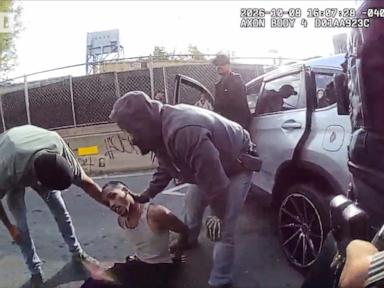
When federal immigration agents shoot a civilian during an enforcement operation in New York, the resulting legal battle over the victim's immediate physical freedom operates on a completely separate track from the investigation into the use of force. Most public analysis conflates criminal culpability with civil detention authority, leading to fundamental misunderstandings of why a federal district judge denies a petition for immediate release. The mechanism governing this outcome is not a judicial endorsement of the shooting, nor is it a determination of the detainee's ultimate right to remain in the United States. It is a strict application of statutory jurisdiction, administrative exhaustion, and the bifurcation of civil immigration law from criminal constitutional tort claims.
The Structural Bifurcation of Federal Legal Tracks
To understand why a federal judge keeps a wounded detainee in custody, one must separate the event into two distinct legal universes that share the same physical reality but rarely intersect in a preliminary hearing. Discover more on a related topic: this related article.
The first universe is Administrative Immigration Detention, governed by Title 8 of the United States Code (specifically the Immigration and Nationality Act, or INA). Under this framework, the Department of Homeland Security (DHS) and Immigration and Customs Enforcement (ICE) exercise broad executive authority to detain non-citizens pending removal proceedings. Detention here is legally classified as civil and preventive, not punitive.
The second universe is Constitutional Tort and Criminal Liability, governed by Title 18, Title 28 (the Federal Tort Claims Act), and Bivens actions under the Fourth Amendment. This track evaluates whether the federal agents used excessive force, violated agency protocols, or committed a crime when they discharged their weapons. More analysis by NBC News highlights similar perspectives on this issue.
A petition for a writ of habeas corpus under 28 U.S.C. § 2241—the standard vehicle attorneys use to demand the immediate release of a hospitalized or detained client—challenges the legality of the custody, not the legality of the arrest mechanics. Unless the petitioner can prove that the underlying authority to detain has completely evaporated, the shooting itself does not automatically void the government's statutory right to hold the individual for removal proceedings.
The Three Pillars of Judicial Denial in Custody Challenges
When a federal judge in the Southern or Eastern District of New York denies a request to release a man shot by ICE agents, the ruling typically rests on three rigid procedural and statutory pillars.
1. The Statutory Bar on Judicial Review (8 U.S.C. § 1226(e) and § 1252)
Congress intentionally stripped federal district courts of the jurisdiction to review discretionary detention decisions made by the Attorney General and the Secretary of Homeland Security. Under 8 U.S.C. § 1226(e), no court may set aside any action or decision regarding the detention or release of any non-citizen, or the grant, revocation, or denial of bond or parole.
A district judge cannot simply order ICE to release a detainee because the circumstances of the arrest were violent or sympathetic. To bypass this statutory wall, the detainee's counsel must raise a pure question of law or a constitutional challenge to the detention framework itself—such as proving that the detention has become unconstitutionally prolonged under Zadvydas v. Davis, or that the government is violating its own mandatory regulations. An allegation of excessive force during apprehension rarely meets the threshold required to invalidate the ongoing statutory basis for civil custody.
2. The Doctrine of Administrative Exhaustion
Federal courts operate under a strict hierarchy of remedies. Before a federal district judge can intervene in an immigration custody dispute, the detainee must exhaust all available administrative remedies within the executive branch. For an individual in ICE custody, this means requesting a custody redetermination (a bond hearing) before an Immigration Judge (IJ) within the Executive Office for Immigration Review (EOIR), and subsequently appealing any adverse decision to the Board of Immigration Appeals (BIA).
If a detainee is hospitalized following a shooting and their legal team files an emergency habeas petition directly in federal district court without first completing the EOIR bond process—or if the detainee is subject to mandatory detention under 8 U.S.C. § 1226(c) due to prior criminal convictions—the federal judge lacks the procedural footing to grant release. The court will rule that the petition is premature, routing the matter back to the administrative immigration courts regardless of the severity of the physical injuries sustained during the encounter.
3. The Distinction Between Medical Parole and Judicial Release
Critics often argue that keeping a gunshot victim under armed federal guard in a hospital bed serves no flight-risk mitigation purpose and constitutes cruel and unusual punishment. In the federal system, however, the authority to grant humanitarian or medical parole rests exclusively with ICE Enforcement and Removal Operations (ERO) under 8 U.S.C. § 1182(d)(5)(A).
Federal judges consistently hold that they cannot substitute their judgment for that of the executive agency regarding whether a detainee's medical condition warrants release. As long as the detainee is receiving adequate medical care while in custody—typically at a secure ward in a major New York hospital—the constitutional threshold under the Fifth Amendment's Due Process Clause (which prohibits deliberate indifference to serious medical needs) is technically satisfied. The physical presence of armed guards outside a hospital room, while optically severe, does not legally constitute a due process violation sufficient to trigger a judicial release order.
The Investigative Quarantine Effect
A critical, frequently overlooked variable in these cases is the immediate freeze imposed by parallel federal investigations. When an ICE agent discharges a firearm in New York, multiple oversight mechanisms trigger simultaneously:
- The ICE Office of Professional Responsibility (OPR) initiates an internal administrative review.
- The DHS Office of Inspector General (OIG) evaluates potential criminal or systemic misconduct.
- The FBI and the U.S. Attorney's Office (SDNY or EDNY) assess whether federal civil rights laws (18 U.S.C. § 242) were violated.
- The New York Police Department (NYPD) Force Investigation Division or local District Attorney may assert concurrent jurisdiction depending on the exact location and nature of the incident.
This multi-agency convergence creates an Investigative Quarantine. During the initial weeks following a shooting, prosecutors and agency counsel are acutely protective of witness testimony, body-worn camera footage, and ballistic evidence. If the detainee is also facing potential federal criminal charges—such as assaulting, resisting, or impeding a federal officer under 18 U.S.C. § 111—the custody equation shifts entirely from civil immigration detention to criminal pre-trial detention under the Bail Reform Act (18 U.S.C. § 3142).
Under the Bail Reform Act, if the government alleges that the man shot by agents provoked the encounter by using a vehicle as a weapon or brandishing an object, a federal magistrate or district judge must evaluate two primary factors: risk of flight and danger to the community. In the immediate aftermath of a shooting, before discovery is complete and while the government's narrative remains largely unchallenged by forensic cross-examination, federal judges overwhelmingly err on the side of maintaining the status quo of custody.
Quantifying the Friction: Civil Habeas vs. Criminal Bail
To evaluate the probability of release in these scenarios, legal practitioners map the detainee's status across two matrices: the Statutory Custody Classification and the Evidentiary Posture.
If the individual is held solely on an administrative immigration warrant (Form I-200) without criminal charges, the friction against release is purely jurisdictional. The district judge is barred by Title 8 from acting as an appellate bond court. The detainee's legal team must prove that the arrest itself was so egregious a violation of the Fourth or Fifth Amendments that the resulting immigration proceedings must be terminated entirely—a remarkably high bar established under INS v. Lopez-Mendoza, which generally holds that the exclusionary rule does not apply in civil immigration proceedings unless the constitutional violation is "egregious" and fundamentally unfair.
Conversely, if the U.S. Attorney's Office files a criminal complaint charging the wounded man with assaulting a federal officer, the jurisdiction shifts cleanly to the federal district court, but the substantive standard becomes much harder to clear. The defense must overcome the government's proffer of dangerousness. Because federal prosecutors control the initial flow of evidence—specifically the statements of the involved agents—the defense cannot effectively impeach the government's narrative at an initial detention hearing. The judge is legally bound to weigh the nature and circumstances of the offense charged, which, by definition, involves a violent confrontation with federal law enforcement.
Operational Limitations of Emergency Litigation
Attorneys representing victims of federal enforcement shootings frequently file high-profile emergency motions for release in the immediate aftermath of the event. While this generates necessary public scrutiny and preserves the record, it carries significant operational limitations as a legal strategy:
- Premature Evidentiary Locking: Filing a habeas petition or bail motion within days of a shooting forces the court to rule on an incomplete factual record. When a judge denies release based on the government's initial representations, that denial establishes a baseline narrative in the docket that is difficult to dislodge later.
- Jurisdictional Dead-Ends: Demanding immediate release from an Article III district judge when the detainee is subject to mandatory immigration detention under 8 U.S.C. § 1226(c) invites a swift, procedural dismissal. The court cannot grant relief that Congress has explicitly forbidden it to provide, regardless of the moral weight of the petitioner's injuries.
- The Medical Care Paradox: Arguing that a detainee must be released to receive specialized trauma care often backfires when the detainee is already housed in a top-tier New York metropolitan hospital under federal guard. The government easily demonstrates that the detainee is receiving the exact same standard of care as a private citizen, neutralizing the Eighth/Fifth Amendment medical necessity argument.
The Strategic Play for Post-Shooting Custody Litigation
For legal teams navigating the aftermath of a federal enforcement shooting, the objective must shift from seeking immediate, unconditional judicial release to executing a multi-front administrative and evidentiary siege.
First, bypass the jurisdictional trap of a broad habeas corpus petition by targeting the custody classification directly within the administrative apparatus. Submit a formal, heavily documented request for humanitarian and medical parole directly to the ICE Field Office Director, backed by independent medical affidavits detailing the long-term rehabilitative requirements that cannot be met in a correctional medical unit (such as a federal medical center or a county jail under an Intergovernmental Service Agreement). Simultaneously, demand an expedited Joseph hearing before an Immigration Judge if the government asserts mandatory detention, forcing DHS to prove at the threshold that the detainee actually falls within the statutory categories of 8 U.S.C. § 1226(c).
Second, weaponize the parallel investigations to force evidentiary parity. Immediately serve preservation letters and Touhy requests on DHS, ICE, and the U.S. Attorney's Office for all body-worn camera footage, tactical radio transmissions, and use-of-force reports. If the government refuses to produce this evidence while simultaneously arguing that the detainee is a danger to the community, pivot the federal court strategy from a demand for release to a demand for conditional bail pending discovery—arguing that the Fifth Amendment Due Process Clause prohibits the government from detaining an individual on the basis of unverified, withheld law enforcement allegations. By forcing the court to choose between compelling the immediate release of the shooting footage or granting conditional release to the injured detainee, counsel strips the government of its asymmetric informational advantage and converts the custody battle into a mechanism for uncovering the truth of the shooting itself.


