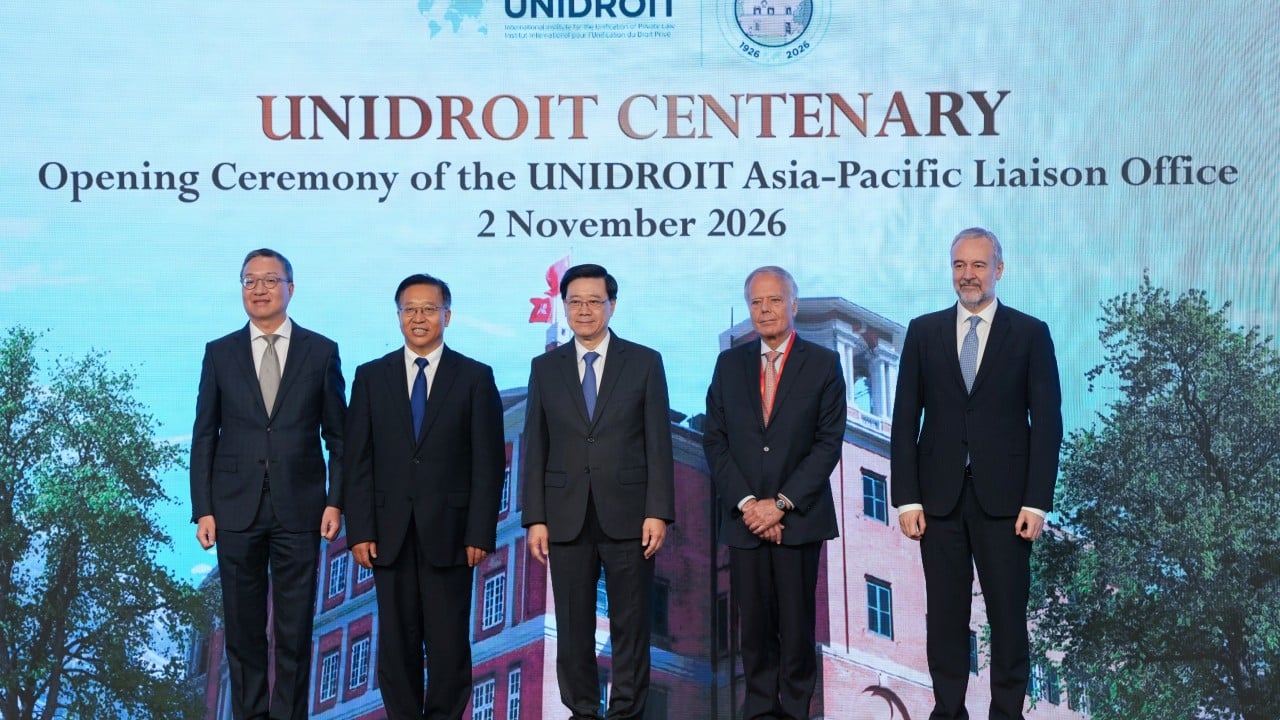
The November 2026 opening of the International Institute for the Unification of Private Law (UNIDROIT) Liaison Office in Hong Kong represents an institutional effort to reduce cross-border legal transaction costs across the Asia-Pacific region. While official statements from Hong Kong Chief Executive John Lee frame the event as a political validation of the city’s status as an international legal hub, the operational reality is rooted in institutional economics. By placing its first overseas liaison office outside Rome inside a common law jurisdiction tethered to mainland China’s civil law market, UNIDROIT is creating a localized mechanism for standardizing commercial contracts, secured transactions, and digital asset rules across incompatible legal systems.
The Economic Friction of Legal Fragmentation
Cross-border trade in the Asia-Pacific suffers from severe jurisdictional fragmentation. A single supply chain transaction originating in Shenzhen, financed in Hong Kong, shipped through Singapore, and delivered to Jakarta crosses multiple distinct legal traditions—specifically, socialist civil law, English common law, and Dutch-influenced civil law.
In institutional economics, as formulated by Ronald Coase and Oliver Williamson, every variation in underlying contract law increases transaction costs. Parties must expend capital on multi-jurisdictional legal due diligence, negotiate bespoke choice-of-law clauses, and price in the risk of non-enforcement. When disputes arise, parties face procedural delays because domestic courts apply conflicting rules regarding title transfer, force majeure, and collateral perfection.
UNIDROIT exists to compress these transaction costs through uniform private law instruments—such as the UNIDROIT Principles of International Commercial Contracts (UPICC) and the Cape Town Convention on mobile equipment. Until November 2026, however, the organization operated exclusively from its headquarters in Rome. For Asian practitioners, this geographical concentration created an adoption bottleneck:
- Temporal and Geographic Latency: Regulatory consultations, working group sessions, and technical clarifications required routing through European time zones and institutional channels.
- Eurocentric Drafting Bias: Uniform rules drafted primarily through European consensus often failed to account for specific Asian commercial practices, such as informal corporate guarantees, state-owned enterprise (SOE) sovereign immunity nuances, and regional digital trade documentation.
- Enforcement Asymmetry: Even when Asian firms adopted UNIDROIT principles in private contracts, local judges and arbitrators lacked institutional training on how to interpret those rules alongside domestic statutory codes.
Establishing a permanent liaison office in Hong Kong directly targets this friction by shifting rule-dissemination and consultative feedback loops into the Asian time zone.
The Three Pillars of Hong Kongs Institutional Positioning
Political rhetoric surrounding Hong Kong’s legal sector frequently relies on broad assertions of resilience. Stripping away official talking points reveals three structural mechanisms that explain why UNIDROIT selected the Special Administrative Region over competing Asian financial centers, and how the office interacts with existing infrastructure.
1. The Common Law Interface Mechanism
Hong Kong remains the only bilingual common law jurisdiction within the People's Republic of China. Under the "One Country, Two Systems" framework, commercial disputes adjudicated in Hong Kong rely on precedent, judicial independence in commercial matters, and English-language pleadings, while mainland China operates under a codified civil law system.
UNIDROIT’s core competency lies in bridging civil and common law traditions; its instruments are specifically engineered to translate concepts across both systems without requiring states to rewrite their entire domestic legal codes. Locating a liaison office in Hong Kong places UNIDROIT at the exact statutory fault line where mainland civil law capital meets international common law contracting. Rather than acting as an adjudicative tribunal—the office holds zero judicial or arbitral authority—the liaison team operates as a technical clearinghouse. It translates UNIDROIT’s soft-law instruments into actionable contract clauses for mainland enterprises expanding outward under Belt and Road initiatives.
2. Institutional Clustering and Network Effects
A standalone liaison office produces minimal economic output unless integrated into a broader dispute resolution ecosystem. Hong Kong’s strategic approach relies on physical and operational clustering. As noted during the launch at Hong Kong Legal Week 2026, the UNIDROIT office is designed to plug directly into a pre-existing institutional stack:
- Adjudication and Arbitration: The Hong Kong International Arbitration Centre (HKIAC) and the Asia-Pacific Regional Office of the Hague Conference on Private International Law (HCCH) already handle high-value cross-border commercial disputes.
- Intergovernmental Mediation: The headquarters of the International Organization for Mediation (IOM), established in Wan Chai, focuses on state-to-state and investor-state mediation.
- Capacity Building: The Hong Kong International Legal Talents Training Academy provides the pedagogical infrastructure required to train regional lawyers and judges in applying international conventions.
In network economics, the value of a legal hub scales exponentially with the number of rule-making and rule-enforcing bodies co-located within the same jurisdiction. When a contract is drafted using UNIDROIT principles, mediated through the IOM, or arbitrated at the HKIAC, legal practitioners benefit from unified procedural standards and shared intellectual capital.
3. Policy Alignment with Beijing’s 15th Five-Year Plan
The timing of the November 2026 launch aligns directly with the rollout of China’s 15th Five-Year Plan, which explicitly designates Hong Kong as an international legal and dispute resolution services center. For Beijing, reliance on New York or London law for Chinese outbound investment presents an unacceptable geopolitical vulnerability, exposing state-linked assets to Western sanctions and extraterritorial court orders.
By embedding UNIDROIT within Hong Kong, Chinese policymakers gain access to internationally recognized, neutral commercial law standards that do not originate in Washington or London. If a Chinese state-owned enterprise and a Southeast Asian infrastructure developer agree to govern their contract under the UNIDROIT Principles with arbitration seated in Hong Kong, both parties achieve neutrality. The foreign counterparty avoids submitting to mainland Chinese courts, while the Chinese entity avoids Western judicial overreach.
Competitive Dynamics Hong Kong Versus Singapore
To evaluate the true market impact of the UNIDROIT office, analysts must measure it against Singapore, Hong Kong’s primary competitor for Asian legal services. Over the past decade, Singapore aggressively captured market share through the Singapore International Arbitration Centre (SIAC), the Singapore International Commercial Court (SICC), and the Singapore Convention on Mediation.
The rivalry between the two jurisdictions represents a classic study in regulatory competition and jurisdictional arbitrage. Corporate general counsel select a governing law and dispute resolution seat based on three variables: predictability of outcome, enforceability of awards, and speed of resolution.
Singapore built its competitive advantage on institutional speed and aggressive state-backed marketing of its judicial stability. Hong Kong, conversely, suffered reputational headwinds between 2019 and 2023 due to domestic political turbulence and the implementation of national security legislation, which prompted several international law firms to reallocate partner headcount to Singapore.
Hong Kong’s counter-strategy does not attempt to out-compete Singapore on identical metrics. Instead, Hong Kong is differentiating itself through two structural advantages that Singapore cannot replicate:
- Asymmetric Mainland Access: Under the 2019 Arrangement Concerning Mutual Assistance in Court-ordered Interim Measures in Aid of Arbitral Proceedings, parties to arbitrations seated in Hong Kong and administered by qualified institutions (such as HKIAC) can apply directly to mainland Chinese courts to freeze assets or preserve evidence. Neither Singapore nor London possesses this procedural privilege. Adding UNIDROIT’s contract standardization capabilities upstream strengthens the entire pipeline from contract drafting to mainland asset preservation.
- Multilateral Treaty Density: By securing the regional offices of the HCCH, the Asian-African Legal Consultative Organization (AALCO), the IOM, and now UNIDROIT, Hong Kong is positioning itself as the Asia-Pacific headquarters for public and private international law rulemaking, distinct from Singapore’s focus on commercial litigation execution.
Operational Limitations and Structural Risks
Treating the UNIDROIT launch as an automatic guarantee of legal supremacy ignores severe operational constraints. Three specific limitations restrict the immediate impact of the new office.
Non-Binding Authority and Soft-Law Friction
The Hong Kong office is strictly a liaison and outreach post. It possesses zero enforcement power, cannot issue binding legal opinions, and does not adjudicate disputes. Furthermore, many of UNIDROIT’s flagship instruments—such as the UPICC—are "soft law." They apply only when commercial parties explicitly opt into them within their contracts, or when arbitrators invoke them to fill statutory gaps. In conservative corporate legal departments across Asia, default templates still overwhelmingly specify English law, New York law, or Singapore law. Changing entrenched boilerplate contracting habits requires years of sustained education and judicial precedent demonstrating that UNIDROIT-governed contracts yield predictable outcomes.
The Perception Gap in Western Capital Markets
While UNIDROIT’s presence validates Hong Kong’s technical capabilities among legal academics and multilateral diplomats, institutional investors in North America and Europe remain sensitive to geopolitical risk. Western general counsel evaluating choice-of-law clauses rarely separate Hong Kong’s commercial courts from broader US-China geopolitical tensions. For transactions involving Western private equity funds or US-listed multinationals, the presence of a UNIDROIT liaison office will not override internal compliance mandates that prohibit selecting Chinese-administered jurisdictions as dispute seats. Consequently, the immediate addressable market for Hong Kong’s UNIDROIT-linked legal services is heavily skewed toward intra-Asian trade, Belt and Road infrastructure, and Global South commercial flows rather than transatlantic capital.
Resource Constraints and Undefined Metrics
At the November 2026 launch, officials declined to disclose the liaison office's operating budget, permanent staffing levels, or specific key performance indicators. A lightly staffed liaison office restricted to hosting seminars and academic roundtables will generate negligible commercial volume. To alter contracting behavior across the region, the office must actively participate in drafting regional model clauses for high-growth sectors—specifically cross-border digital trade, tokenized real-world assets, and carbon credit markets—where existing domestic laws are fragmented or non-existent.
Strategic Execution for Corporate Counsel and Legal Practitioners
For multinational corporations, regional financial institutions, and law firms operating across the Asia-Pacific, the establishment of UNIDROIT in Hong Kong creates an immediate opportunity to optimize cross-border contract architecture. Legal teams should execute three specific adjustments to capture value from this institutional shift:
- Audit Intra-Asian Contract Templates: Review standard procurement, joint venture, and supply chain agreements involving counterparties in mainland China, ASEAN, and the Middle East. Where counterparties reject English or New York governing law due to cost or political friction, replace ad-hoc domestic law compromises with the UNIDROIT Principles of International Commercial Contracts paired with an HKIAC arbitration clause. This structure neutralizes home-court bias while preserving access to mainland Chinese interim asset-freezing measures.
- Deploy UNIDROIT Digital Asset Frameworks: For fintech and trade-finance operations structuring tokenized receivables or electronic bills of lading across Asian ports, utilize the UNIDROIT Principles on Digital Assets and Private Law as the foundational contractual standard. Because domestic statutory frameworks for digital property remain inconsistent across Asian jurisdictions, embedding UNIDROIT’s standardized definitions directly into smart-contract terms and master agreements mitigates the risk of judicial reclassification during insolvency proceedings.
- Establish Direct Technical Channels for Secured Transactions: Financial institutions extending cross-border equipment or aviation financing into emerging Asian markets should engage directly with the Hong Kong liaison office to align local security filings with the Cape Town Convention protocols, reducing the risk premium applied to collateral enforcement in civil law jurisdictions.