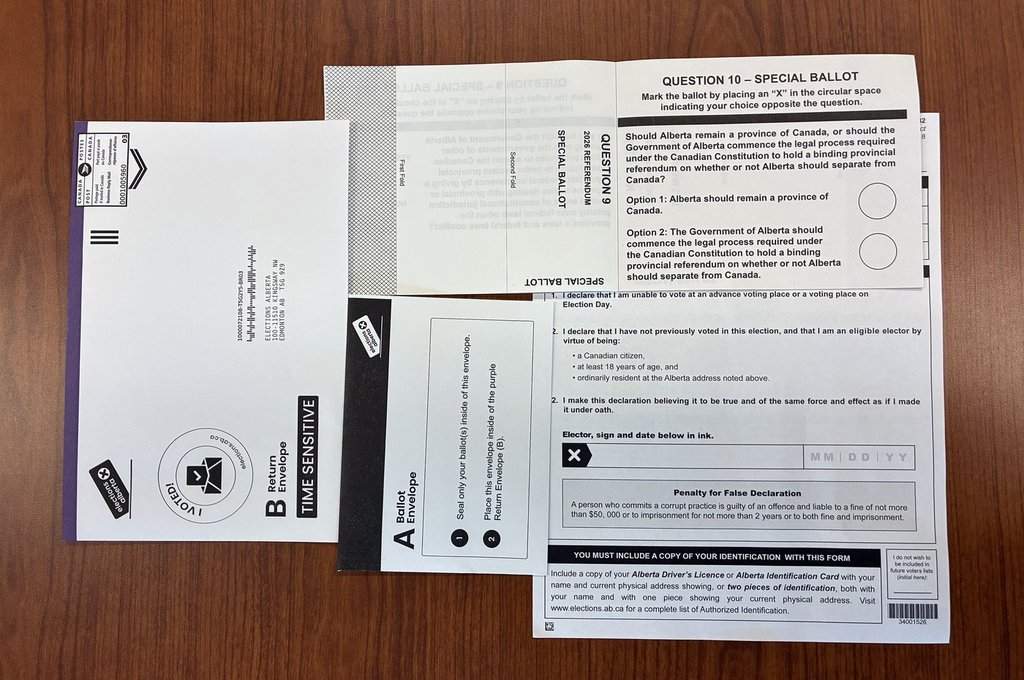
Non-Albertans cannot legally cast mail-in ballots in an Alberta provincial referendum. Under Alberta’s statutory framework—specifically the Election Act and the Referendum Act—eligibility to vote by special ballot is strictly tethered to provincial residency, Canadian citizenship, and age, enforced through a multi-stage identity and address verification pipeline designed to reject out-of-jurisdiction submissions.
Claims suggesting that non-residents can flood an Alberta referendum via mail-in ballots conflate administrative accessibility with substantive eligibility. Expanding the mechanisms through which a ballot can be delivered does not alter the legal criteria required to receive, validate, and count that ballot. To understand why cross-border ballot dilution fails under Alberta’s electoral architecture, one must examine the statutory gating mechanisms, the chain-of-custody protocols for special ballots, and the specific edge cases that generate public confusion.
The Three Statutory Pillars of Voter Eligibility
In any democratic jurisdiction, electoral integrity rests on a binary classification system: an individual either meets the statutory threshold to enter the franchise or is excluded. Alberta law establishes three cumulative conditions for referendum participation. Failure to satisfy any single condition disqualifies the individual, regardless of whether they attempt to vote in person or via mail.
- Citizenship: The applicant must be a Canadian citizen. Permanent residents, temporary foreign workers, and international students—despite paying provincial taxes or maintaining physical residence—are excluded from the provincial franchise.
- Age: The applicant must be at least 18 years of age on referendum day.
- Ordinary Residence: The applicant must be ordinarily resident in Alberta.
The third pillar—ordinary residence—is the primary legal firewall against non-Albertan participation. Under the Election Act, "ordinary residence" is not a vague assertion of affinity or property ownership; it is a defined legal status. A person’s ordinary residence is the place where they live and to which, whenever absent, they intend to return. An individual can have only one ordinary residence at any given time.
Owning recreational property in Canmore while living in Vancouver does not confer Alberta residency. Paying corporate or property taxes to an Alberta municipality does not confer voting rights. Working temporarily on a rotational basis in Fort McMurray while maintaining a primary home and family in Newfoundland does not establish ordinary residence in Alberta. The law explicitly decouples economic participation from political franchise.
Deconstructing the Special Ballot Mechanism
In Alberta, what is colloquially termed a "mail-in ballot" is legally designated as a special ballot. Confusion surrounding non-resident voting frequently stems from a misunderstanding of how special ballots are requested, issued, and tabulated. Unlike mass mail-out models used in certain American jurisdictions—where ballots are automatically dispatched to every address on a voter roll—Alberta operates an opt-in, request-driven system.
Stage 1: Application and Identity Verification
An eligible elector cannot simply download a ballot, fill it out, and mail it to Elections Alberta. The process begins with a formal application for a special ballot package. To complete this application, the elector must provide verifiable personal data, including their full legal name, date of birth, residential address in Alberta, and a mailing address where the package should be sent.
Crucially, the applicant must provide proof of identity and Alberta residency. If the applicant is already on the Permanent Register of Electors with verified identification data (such as an Alberta driver’s license number or Alberta Identification Card number), the system cross-references these credentials against provincial databases. If the applicant is not on the register, or if their details do not match, they must submit copies of government-issued identification establishing both identity and an Alberta physical address.
Stage 2: The Out-of-Province Exception vs. Non-Residency
The existence of a "mailing address" field separate from the "residential address" field is the primary source of misinformation regarding non-Albertans voting. Critics often observe that Elections Alberta mails ballots to addresses in British Columbia, Ontario, or foreign countries, and erroneously conclude that non-Albertans are voting.
This observation confuses temporary physical absence with legal non-residency. The special ballot system exists precisely to enfranchise eligible Albertans who are temporarily away from their ordinary residence during the voting period. This includes:
- Post-secondary students attending universities outside the province who intend to return to Alberta.
- Snowbirds or retirees wintering in the southern United States.
- Military personnel deployed outside the province.
- Consultants, tradespeople, or executives working on temporary out-of-province assignments.
In every one of these scenarios, the voter must declare and prove an ordinary residence within Alberta. The ballot is mailed to an external address, but the vote is legally anchored to an Alberta electoral division. A resident of Toronto with no ordinary residence in Alberta cannot pass the Stage 1 verification gate because they lack an Alberta residential address and the corresponding government-issued documentation to substantiate it.
Stage 3: The Outer Envelope Authentication Protocol
When Elections Alberta approves an application, it dispatches a special ballot kit containing a blank ballot, a secrecy envelope, and a certificate envelope (outer envelope).
Upon marking the ballot, the elector places it inside the unmarked secrecy envelope, which is then sealed inside the certificate envelope. On the exterior of this certificate envelope, the voter must sign a formal declaration affirming their eligibility—specifically attesting that they are a Canadian citizen, at least 18 years old, and ordinarily resident in Alberta, and that they have not already voted in the referendum. Falsifying this declaration constitutes a corrupt practice under the Election Act, carrying severe financial penalties and potential imprisonment.
When the package returns to Elections Alberta, election officials do not immediately open the secrecy envelope. First, they audit the certificate envelope. Officials verify that the signature is present, match the certificate against the approved special ballot register to ensure the voter has not cast an in-person ballot, and confirm that the package arrived prior to the statutory deadline (the close of polls on referendum day). If the certificate envelope is incomplete, unsigned, or fails verification, the entire package is set aside and rejected without the secrecy envelope ever being opened.
The Structural Constraints of Referendum Law
A provincial referendum in Alberta is governed by the Referendum Act, which incorporates the administrative machinery of the Election Act by reference. This statutory linkage means that a referendum cannot operate under looser eligibility rules than a general provincial election unless the Legislative Assembly passes specific amending legislation altering the franchise.
Furthermore, the Citizen Initiative Act—which allows Albertans to petition for a referendum on a specific policy or constitutional question—reinforces these boundaries. Even at the petition stage, before a referendum is ever called, signatures are only valid if collected from eligible electors ordinarily resident in Alberta. Elections Alberta conducts rigorous verification audits of petition signatures, invalidating entries from non-residents, duplicates, or individuals with unverifiable addresses.
The architecture of Alberta’s electoral administration relies on centralized database cross-referencing. Elections Alberta maintains data-sharing agreements with Alberta Registries (which issues driver's licenses and ID cards) and Elections Canada. When an individual moves out of Alberta and surrenders their Alberta driver's license for a British Columbia or Ontario license, or files a federal tax return declaring a new province of residence, those updates propagate through the inter-jurisdictional data networks, flagging the individual for removal from Alberta’s Permanent Register of Electors.
Edge Cases and System Vulnerabilities
No administrative system operates with zero friction or absolute perfection, and acknowledging structural limitations is necessary for an accurate risk assessment. While non-Albertans are legally barred from voting, two narrow edge cases exist where administrative lag creates temporary ambiguity:
- The Transition Window: When an Albertan permanently relocates to another province shortly before a referendum, there is a latency period between their physical move and the updating of government databases. Legally, the moment they establish a new ordinary residence outside Alberta, they lose their eligibility to vote in an Alberta referendum. Practically, if they have not yet updated their driver’s license or tax residency, their name may remain on the Alberta register. Attempting to vote under these conditions, however, requires signing a false declaration on the special ballot certificate envelope—an illegal act subject to post-election audit and prosecution.
- The "Intention to Return" Ambiguity: Determining ordinary residence for individuals with transient lifestyles—such as digital nomads or long-term contract workers—relies partially on subjective intent. If a person maintains an Alberta driver's license, files taxes as an Alberta resident, and retains a physical address (such as a family home) to which they intend to return, the law generally recognizes them as ordinarily resident, even if they spend the majority of the year outside provincial borders.
These edge cases represent micro-level administrative friction, not a systemic loophole allowing non-Albertans to organize and influence a referendum outcome. To alter the outcome of a province-wide referendum in a jurisdiction with nearly three million registered electors, an external actor would need to execute tens of thousands of fraudulent applications, each requiring forged or stolen Alberta government identification credentials, distinct physical Alberta addresses, and forged signatures—all routed through a centralized verification office where every special ballot is manually audited before counting.
Strategic Framework for Evaluating Electoral Claims
When assessing viral claims regarding mail-in voting vulnerabilities in Canadian provincial jurisdictions, analysts and observers should apply a three-step verification protocol rather than reacting to surface-level procedural descriptions:
- Distinguish Delivery from Franchise: Separate the method of transmission (mail, courier, in-person) from the criteria for eligibility (citizenship, age, ordinary residence). Expanding transmission channels does not expand the franchise.
- Trace the Verification Bottleneck: Identify the exact point where human or automated officials validate identity. In Alberta, that bottleneck is the special ballot application and the certificate envelope audit, both of which require verifiable ties to an Alberta physical address.
- Quantify the Scale Requirement: Evaluate the logistical feasibility of the alleged vulnerability. A vulnerability that requires individual identity theft and document forgery per ballot cannot scale to influence a macro-level plebiscite without triggering immediate anomaly detection at the central tabulation facility.
To maintain public confidence during future provincial referendums, Elections Alberta should proactively publish real-time metrics detailing the number of special ballot applications received, the rejection rate at the identity-verification stage, and the geographic distribution of out-of-province mailing addresses tied to verified Alberta residences. Transparency in rejection metrics provides the empirical proof necessary to neutralize misinformation before it undermines the perceived legitimacy of the final tally.