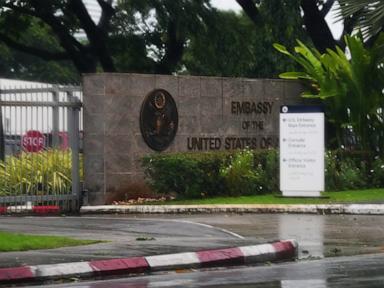
The trial of Pavinee Supasirivisan in Yangon reveals a deliberate sequencing of sovereign power by Myanmar's military junta. Accused of the May 11, 2026, murder of her ex-husband—an unnamed United States diplomat—Supasirivisan is not currently standing trial for homicide. Instead, the Kamayut Township Court is executing a distinct legal maneuver: prosecuting her first under the country's immigration code, which prescribes penalties for any foreign national who commits a crime within domestic borders.
By prioritizing a secondary immigration violation over a primary capital offense, the State Administration Council (SAC)—Myanmar’s ruling military junta—is establishing an explicit jurisdictional anchor. This strategic sequencing serves a dual structural purpose. It asserts absolute sovereign control over a politically volatile case involving a major global power, and it creates a legal buffer that delays the highly sensitive capital murder trial. This analysis dissects the specific mechanisms driving this multi-tiered prosecution, the geopolitical constraints of the participating states, and the structural limitations governing transnational criminal enforcement in a conflict-ravaged state.
The Structural Mechanics of Judicial Sequencing
The decision to prosecute the immigration violation before the murder charge follows an administrative logic designed to secure immediate, incontestable leverage over the foreign defendant. In transnational criminal law, host nations often face complex extraditing pressures, diplomatic immunity claims, or external oversight requests. Myanmar's legal apparatus neutralizes these variables by dividing the state's response into two distinct phases.
Phase One: The Sovereign Anchor
The immigration code applied to Supasirivisan functions as an automatic statutory trigger. Under this framework, the commission of any domestic felony by a foreign national retroactively invalidates their standard entry status, transforming their presence into an immigration offense. The statutory penalty for this specific infraction ranges from six months to five years in prison.
By securing a conviction on this charge first, the state achieves an immediate operational outcome. It establishes a lawful, low-friction basis for long-term detention that requires minimal evidentiary proof compared to a murder trial. The prosecution needs only to establish that a crime occurred and that the defendant is a foreign national linked to the event, effectively bypassing the rigorous forensic thresholds demanded by a homicide defense.
Phase Two: The Capital Trial Buffer
Once a conviction is secured under the immigration code, the state holds the defendant within its penal system under a domestic mandate. This structural delay yields distinct strategic advantages for a military junta operating under intense international scrutiny:
- Evidentiary Consolidation: The police and state prosecutors gain an extended timeline to build their forensic case regarding the homicide at the Sakura Residence & Hotel, unaffected by speedy-trial pressures.
- Information Control: Because journalists are barred from court proceedings and state officials operate under strict non-disclosure mandates, the extended timeline allows the state to manage the flow of information without public or international cross-examination.
- Diplomatic Insulation: The immediate processing of an immigration charge frames the issue as a routine matter of border security and administrative law, making it more difficult for foreign governments to intervene on humanitarian or procedural grounds.
The murder charge, which carries a sentencing spectrum from ten years to the death penalty, remains suspended in perpetuity until Phase One concludes. This separation allows the junta to control the velocity of the legal proceedings based on prevailing geopolitical conditions.
Geopolitical Constraints and State Imperatives
The three nations intersected by this case—Myanmar, the United States, and Thailand—operate under rigid structural constraints that dictate their diplomatic postures. Each actor is bound by a specific imperative that limits its operational flexibility.
       [United States]
       (Imperative: Protection of Diplomatic Integrity)
              │
              ▼
[Myanmar Military Junta (SAC)] ◄────── [Thailand Ministry of Foreign Affairs]
(Imperative: Assertion of Sovereignty)   (Imperative: Consolar Obligation / Minimization)
Myanmar: The Sovereignty Assertion Function
Since the 2021 coup, the SAC has been engaged in a brutal civil war, facing systemic international isolation and economic sanctions. For the junta, the homicide of a Western diplomat within a secure, high-profile enclave like the Sakura Residence—located a mere 1.5 kilometers from the U.S. Embassy—is a direct threat to its claim of domestic stability.
The state's primary function in this trial is to demonstrate absolute judicial authority over foreign entities. By refusing to defer to external investigators, barring outside observers from the Kamayut Township Court, and insisting on the absolute priority of its domestic immigration code, the SAC signals to both domestic resistance movements and foreign adversaries that its administrative institutions remain fully operational and unyielding.
The United States: Diplomatic Security and Informational Redirection
The U.S. State Department faces a profound institutional challenge: protecting the integrity of its global diplomatic corps while navigating a host nation whose government it does not formally recognize as legitimate. The victim’s status as an accredited diplomat—rather than a localized embassy staff member—means the incident impinges directly on national security protocols.
The American strategy relies on a strict policy of informational redirection. By confirming the death while explicitly withholding the diplomat’s identity and refusing to clarify whether official observers are present in the courtroom, the State Department minimizes public escalation. This tight control prevents the case from being weaponized by the junta for domestic propaganda, while preserving private, back-channel options for legal monitoring and potential extraction.
Thailand: The Minimalist Consular Obligation
The Thai Ministry of Foreign Affairs is caught between domestic legal obligations to its citizens abroad and the necessity of maintaining cross-border stability with Myanmar. Thailand’s response has been strictly limited to basic consular assistance.
The ministry has pointedly refused to provide specific details regarding legal representation or defense funding. By maintaining this minimalist posture, Bangkok avoids a diplomatic entanglement with the SAC over a capital case involving a U.S. official, treating the matter as an isolated criminal dispute rather than a bilateral flashpoint.
Structural Fault Lines in Conflict-Zone Jurisprudence
The prosecution of a foreign national within a military dictatorship experiencing widespread civil conflict highlights critical structural vulnerabilities in international legal frameworks. The traditional mechanisms of transnational justice assume a baseline of institutional transparency and bilateral cooperation—both of which are entirely absent in contemporary Myanmar.
The first vulnerability lies in the total collapse of institutional verifiability. The trial relies on testimony from state-controlled immigration and population department officials, delivered in closed courtrooms with anonymous legal representation. Because independent verification of evidence, witness statements, or forensic data from the Sakura Residence is impossible, the resulting judicial outcomes cannot be evaluated against international standards of due process.
The second limitation involves the breakdown of the standard bilateral legal assistance treaties that typically govern cross-border homicides. In a normalized environment, Thai and American investigators would collaborate with local authorities to trace the historical relationship between Supasirivisan and the deceased, analyzing cross-border financial, communication, and travel logs. In this instance, the geopolitical fragmentation of the SAC isolates the local police force, creating a fragmented investigation where critical contextual data from Thailand or the U.S. cannot be systematically integrated into the trial matrix.
Strategic Forecast and Judicial Trajectory
Given the structural design of Myanmar's legal strategy, the proceeding is highly unlikely to yield a swift resolution. The Kamayut Township Court will almost certainly secure a swift conviction on the initial immigration infraction, utilizing the testimony of the state's immigration officers to lock in a maximum five-year sentence. This move guarantees that Supasirivisan remains entirely under the physical jurisdiction of the SAC, insulated from external legal maneuvers or repatriation demands.
The capital murder trial will be deployed as a strategic variable. The junta will modulate the speed and severity of the homicide prosecution to match its immediate diplomatic needs with Washington. If the SAC requires a reduction in diplomatic pressure or a quiet concession on sanction enforcement, the legal proceedings can be prolonged indefinitely, or the eventual sentence can be commuted from the death penalty to long-term imprisonment. If relation dynamics deteriorate, the state can accelerate the prosecution toward a maximum verdict to demonstrate its complete indifference to Western leverage.
The final strategic reality is that the legal outcome of this trial will not be determined by the forensic evidence found at the crime scene, but by the precise geopolitical utility the defendant represents to the state holding her.


