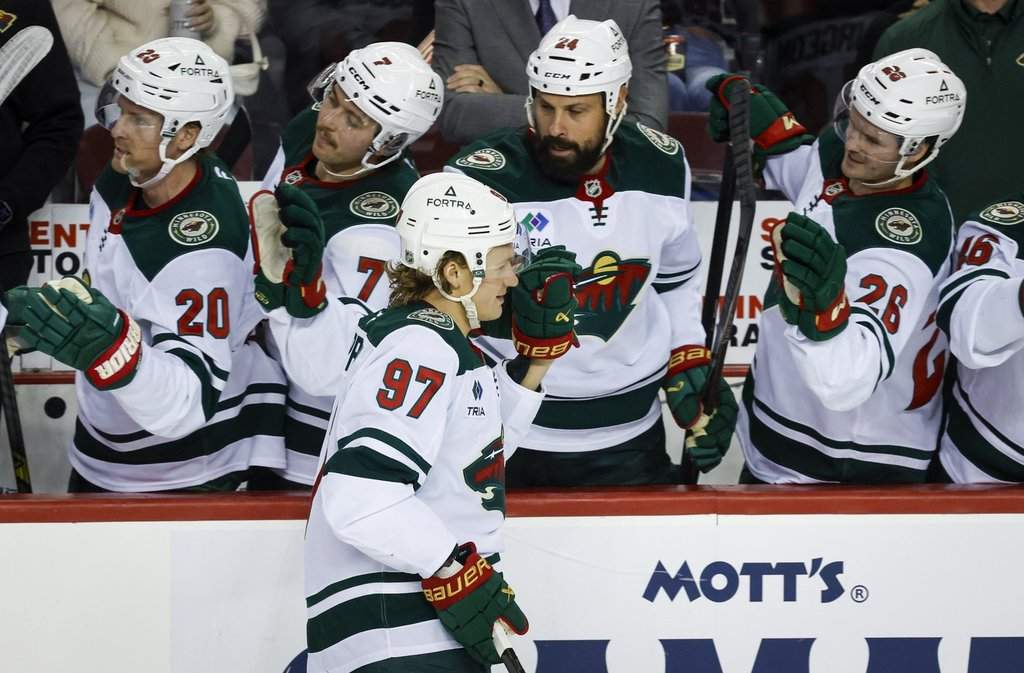
Minnesota dismantled Calgary 4-1 because elite offensive talent paired with mobile puck-moving defense breaks down rigid, low-event systems. Kirill Kaprizov and Quinn Hughes controlled the pace, exploited neutral-zone gaps, and turned simple transitions into high-danger scoring chances before the Flames could set their defensive shell. Most box-score recaps treat this result as another routine regular-season win. They miss the larger structural reality happening on the ice. When a franchise pairs a dynamic, dual-threat winger with a defenseman who manipulates forecheckers at will, traditional defensive schemes simply run out of answers.
Watch the tape again. You will not see lucky bounces or soft goaltending deciding the outcome. You will see geometric manipulation. Modern hockey has moved past the era where heavy corner battles and chip-and-chase tactics dictate eighty-two games. Speed through the middle of the ice, combined with deceptive lateral movement at the blue line, forces defending units to collapse inward. Once those five skaters shrink into a tight box around their own crease, the perimeter opens up completely. That is where Kaprizov and Hughes operate best.
The Anatomy of Modern Puck Possession
For decades, general managers built rosters from the net out using size as the primary metric. Big defensemen cleared the front of the crease while heavy centers leaned on opponents along the boards. That blueprint still holds value in tight playoff series, yet it struggles badly against teams built around controlled zone entries.
When Hughes retrieves a dump-in behind his own goal line, the entire geometry of the rink shifts. Most defenders look up, see two forecheckers bearing down, and rim the puck blindly up the glass. That play surrenders possession roughly sixty percent of the time. Hughes does the exact opposite. He uses subtle shoulder fakes, micro-adjustments with his edges, and rapid changes of pace to draw the first forechecker out of position. The moment that opponent commits his weight to one side, Hughes steps into the vacated lane.
Suddenly, a five-on-five standoff turns into an odd-man rush before the puck even crosses the red line. Calgary spent much of the night chasing shadows because their forecheck never actually touched the puck carrier. You cannot hit what you cannot corner.
Kaprizov thrives on the chaos created by those clean exits. Unlike pure snipers who wait stationary in the faceoff circle for a cross-ice feed, Kaprizov attacks space relentlessly. He curls low through the neutral zone, builds speed underneath the play, and forces opposing defensemen to respect both his shot and his passing lanes. If the defender steps up to take away the wrist shot, Kaprizov slips a backhand saucer pass into the slot. If the defender backs off to protect the middle, Kaprizov uses the screen to pick the top corner.
Why Traditional Forechecks Fail Against Elite Skaters
Coaches love to preach structure. A well-drilled 1-2-2 neutral-zone trap looks great on a whiteboard during morning skate. On paper, every lane is clogged, every passing option is sealed, and the opposing offense is forced to dump the puck into the corner where your bigger players can retrieve it.
Reality rarely cooperates with the whiteboard.
A structured trap relies entirely on timing and spacing between the three forwards and two defensemen. When an elite skater carries the puck with speed, he forces the nearest defender to make a split-second decision. Hold the blue line and risk getting burned wide, or gap up and risk a quick give-and-go pass into the middle. Against average NHL talent, the trap works because the puck carrier slows down at the red line to look for options. Against players with elite edgework and vision, the puck never stops moving.
Calgary tried to clog the middle of the ice, hoping to frustrate Minnesota into low-percentage perimeter shots. Instead, the Wild used quick lateral east-west passes at the offensive blue line to pull the Flames' penalty killers and even-strength defenders out of their lanes. Once a defensive structure stretches horizontally, vertical seams open straight to the net.
Breaking Down the Structural Mismatch
Look closely at how both teams approached the middle forty minutes of the game. While the scoreline reads 4-1, the underlying territorial battle tells a much starker story about roster construction in the current salary cap environment.
| Tactical Dimension | Minnesota Approach | Calgary Approach | On-Ice Consequence |
|---|---|---|---|
| Zone Exits | Short-area passes and skate-outs through the middle | Hard rim plays around the boards and glass clears | Wild maintained possession; Flames iced the puck or turned it over |
| Blue Line Offense | Continuous rotation, lateral walking, and quick low-to-high feeds | Static point shots aimed at deflections and rebounds | Wild generated cross-seam chances; Flames hit shin pads |
| Neutral Zone | High-speed support with staggered wingers | Conservative trap waiting for mistakes | Wild bypassed pressure cleanly; Flames chased the play |
| Net-Front Presence | Layered traffic arriving late into soft ice | Stationary screening fighting heavy defensemen | Wild capitalized on second-chance looks; Flames struggled for clean tips |
Notice the fundamental philosophical divide sitting right there in the second row. Calgary relied heavily on point-shot volume, a strategy that dominated the league ten years ago. The theory is simple enough: throw pucks toward the net from the blue line, create traffic, and hope for a deflection or a messy rebound.
The problem with that approach today is twofold. First, modern goaltenders are taller, faster, and positioned more aggressively than ever before. If a goalie sees a shot leave the stick blade from sixty feet away, he will stop it ninety-five percent of the time. Second, defenders block shots at an unprecedented rate. Firing slap shots into crowded lanes usually results in broken sticks, bruised ankles, and immediate counterattacks going the other way.
Minnesota rejected that outdated formula entirely. Instead of firing low-percentage shots from the perimeter, Hughes and Kaprizov treated the offensive blue line as a launchpad for movement. Hughes walked the line with his head up, freezing the top of Calgary's defensive box before sliding the puck down to the half-wall. Kaprizov immediately rotated high, swapping places with the defenseman to scramble coverage assignments.
Consider a hypothetical example to see why this rotation breaks defensive coverage. Imagine a defending winger assigned to cover the point man. When the defenseman and the star forward swap positions at full speed, the defending winger faces a terrible choice. Does he follow the defenseman down into the corner, leaving a premier goal scorer uncovered at the top of the circle? Or does he stay high and pass the assignment off to his center, risking a half-second of confusion during the switch? At NHL speeds, half a second of confusion is an eternity.
The Salary Cap Reality Behind the Scoreboard
Every general manager in the Western Conference watches games like this with a mixture of envy and anxiety. You cannot simply draft your way out of a talent deficit overnight, nor can you buy elite transition play on the open market without crippling your cap sheet.
True game-breaking talent commands top dollar, and rightly so. When teams allocate massive portions of their salary cap to two or three foundational superstars, the margin for error across the rest of the roster shrinks dramatically. Critics constantly argue that paying premium prices for high-end offensive stars leaves too little money for depth scoring and third-pair defensemen.
They have the math backward.
Depth players are replaceable. Every summer, dozens of reliable bottom-six forwards and stay-at-home defenders sign league-minimum contracts in July and August. A smart pro scouting department can find penalty killers and energy wingers on the waiver wire or in the American Hockey League. What you cannot find on the bargain rack is a winger who commands double-teams every time he touches the puck, or a defenseman who tilts the ice for twenty-five minutes a night.
Calgary's roster reflects the classic trap of middle-class mediocrity. By spreading cap space evenly across solid, hardworking, two-way players without an overwhelming surplus of top-end offensive magic, a team becomes competitive enough to stay in games yet rarely dangerous enough to take them over. Hard work keeps the score close through the first period. High-end skill separates the teams by the third.
Where the Analytics Agree and Where They Fall Short
Modern hockey analytics departments track everything from expected goals to zone-entry denial rates. By almost every underlying metric, a 4-1 victory driven by dominant possession through the middle of the ice validates what data analysts have argued for years. Expected goals for correlate strongly with passes across the royal road—the imaginary line splitting the offensive zone down the middle from the top of the circles through the crease.
Yet numbers alone miss the psychological weight that players like Kaprizov and Hughes exert on an opponent.
When a defenseman knows that one missed poke-check at the offensive blue line will send Kaprizov flying down the wing on a two-on-one, that defenseman stops pinching. He backs off three feet. He surrenders the blue line willingly rather than risking humiliation on the highlight reel. That three-foot cushion does not show up cleanly on a standard Corsi chart, yet it changes the entire geometry of the game.
Similarly, when forecheckers spend two periods skating hard into the corners only to watch Hughes spin away from contact and fire a forty-foot tape-to-tape outlet pass, fatigue sets in mentally before it hits physically. Forechecking requires absolute commitment. You have to sprint full speed into heavy traffic, absorb a check, and trust that your teammates will seal the boards behind you. Once players realize their effort yields zero turnovers, their strides shorten. They glide instead of pumping their legs. They wave their sticks instead of finishing their checks.
The Myth of Playoff Style Hockey
Whenever a skill-driven team dismantles a heavier, more conservative opponent in the regular season, the same tired counter-argument inevitably surfaces among traditionalists. Skeptics point out that time and space disappear in April and May. Referees swallow their whistles, hooking and holding go uncalled, and heavy teams supposedly grind skilled rosters into dust over a seven-game series.
There is a grain of truth buried inside that cliché, though it is wildly overstated.
Yes, playoff hockey features tighter checking and less room along the boards. No, that does not render dynamic skating and elite puck movement obsolete. In fact, when space shrinks in the postseason, individual skill becomes even more decisive. If a team cannot generate offense off the rush because the neutral zone is congested, it must rely on defenders who can walk the blue line and forwards who can make plays in phone-booth spaces.
A team built strictly around grinding and point shots hits a brick wall in the playoffs when opposing defenders block thirty shots a night and goaltenders lock into a rhythm. You cannot simply out-will an elite goaltender with unscreened slap shots from fifty feet out. You have to make him move laterally. You have to force his defensemen into mistakes through deception and speed.
The Vulnerability Hidden Inside Minnesota's Blueprint
Acknowledging the brilliance of Minnesota's top-end execution does not mean ignoring the structural risks baked into their style of play. Aggressive transition hockey walks a razor-thin line between dominance and self-inflicted wounds.
When defensemen activate aggressively into the rush and forwards stretch the neutral zone looking for quick outlets, turnovers inside your own blue line become catastrophic. If a cross-ice pass gets picked off at the offensive blue line while both defenders are pinching down the walls, the opposing team gets an uncontested breakaway. Against opportunistic finishers, a single sloppy period of puck management can turn a commanding lead into a track meet.
Furthermore, over-reliance on two or three primary engines carries an obvious physical toll across an eighty-two-game grind. Opponents know exactly who drives the bus. Every night, Kaprizov absorbs heavy cross-checks in front of the net, and Hughes takes hard bumps every time he retrieves a puck behind his own goal line. Sustaining that level of creative output requires careful load management, smart line matching on the road, and secondary scorers who can capitalize when opponents sell out completely to stop the top unit.
Calgary failed to punish those vulnerabilities because they lacked the counter-punching speed to exploit Minnesota's aggressive pinches. When the Flames did force a turnover, their transition out of the defensive zone moved too slowly to catch the Wild out of position. By the time Calgary crossed the red line, Minnesota's backcheckers had already reloaded above the puck.
What Front Offices Must Learn From Nights Like This
The gap between true contenders and teams fighting merely to stay relevant rarely comes down to effort. Every player in the National Hockey League skates hard, blocks shots, and follows the coaching staff's game plan. Effort is the baseline entry fee just to wear the jersey.
Separation happens in the margins of skill, processing speed, and roster architecture.
Calgary's path forward requires a cold, unsentimental assessment of its core identity. Patching holes with veteran role players and hoping for above-average goaltending will produce plenty of respectable Tuesday night efforts and very few deep spring runs. Without high-end puck movers who can break a forecheck single-handedly, a team remains permanently stuck playing defense in its own end.
Minnesota demonstrated exactly what happens when a franchise empowers its premier talent to dictate terms rather than forcing them into a rigid, risk-averse box. Kaprizov and Hughes did not just beat Calgary on the scoreboard; they exposed the fundamental flaw in trying to contain modern offensive speed with yesterday's defensive blueprint. Until the Flames acquire the dynamic skill required to force opponents onto their heels, nights ending in 4-1 losses will remain the predictable cost of doing business.