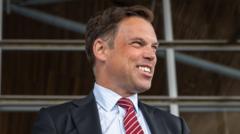
Welsh Labour has learned absolutely nothing from its historic electoral obliteration.
By pulling its leadership contest forward to match the Westminster timetable, the party establishment is congratulating itself on a slick bit of administrative alignment. They want you to believe that rushing Ken Skates into the permanent leadership unopposed is an act of supreme efficiency. They think syncing up with Andy Burnham’s inevitable ascension in London radiates strength.
It does not. It smells of unadulterated panic.
This expedited coronation is a structural disaster masquerading as a logistical triumph. After being brutally relegated to third place behind Plaid Cymru and Reform UK, Welsh Labour’s immediate institutional response is to suffocate internal debate, skip the self-reflection, and rubber-stamp the interim guy because nobody else wants the keys to a burning building.
Rushing this election to hide behind the coattails of a Westminster leadership battle is not leadership. It is an admission of branch-office subservience.
The Illusion of Efficiency
The mainstream political commentary surrounding this pulled-forward contest focuses entirely on synchronization. The narrative is comforting: get the leadership questions settled on both sides of the M4 simultaneously, clear the deck, and begin the fightback.
This is a profound misunderstanding of how political brands rebuild.
When a political machine loses power for the first time since 1999, it does not need an expedited calendar. It needs an ideological autopsy. By compressing the nomination window and wrapping up the contest alongside the UK party schedule, the Welsh Labour Executive Committee has guaranteed that no alternative vision for Wales will be articulated.
I have watched political operations pull this exact lever before. When an institution faces a catastrophic loss, the instinctive reflex of the managerial class is to close ranks, minimize public conflict, and project an image of stability. But stability is the enemy of recovery when your current state is a smoking crater.
Consider the arithmetic of the situation. The party was crushed down to a mere nine seats in the Senedd. Eluned Morgan did not just lose the First Ministership; she lost her own seat entirely. In any healthy democratic organization, an existential shock of that magnitude triggers a fierce, uncomfortable debate about policy, identity, and direction. Instead, Welsh Labour is delivering a one-man race where the interim leader transitions to the permanent leader without facing a single question from a competitor.
The Branch Office Dependency Trap
The decision to accelerate the timetable specifically to line up with London tells you everything about the psychological state of Cardiff Castle. For a quarter of a century, Welsh Labour’s entire brand value relied on the concept of "clear red water"—the idea that Cardiff was distinct, autonomous, and structurally insulated from the whims of the UK central party.
That illusion is completely shattered.
By hitching their wagon to the UK Labour leadership contest following Sir Keir Starmer’s resignation, the Welsh party is signaling that it cannot function independently of the Westminster news cycle. If Andy Burnham takes Downing Street, the media will treat Skates not as a national leader with an independent mandate, but as a regional administrator implementing policies designed in Whitehall.
Imagine a scenario where a business loses 70% of its market share to agile, aggressive local competitors. Would the regional division fix its product by blindly adopting the corporate template of the parent company that is currently going through its own chaotic executive restructuring? Absolutely not. You differentiate. You localize. You dig into the specific grievances of the consumer base you alienated.
Welsh Labour is doing the exact opposite. They are outsourcing their political identity to a UK-wide media storm.
Dismantling the Unopposed Savior Myth
Let us look closely at the candidate himself. Ken Skates is the definition of the continuous establishment. He has been in the Senedd since 2011. He has held senior portfolios under Carwyn Jones, Mark Drakeford, Vaughan Gething, and Eluned Morgan. He is deeply woven into the fabric of the very policy decisions that led to the party's historic third-place humiliation.
To suggest that an insider who managed transport, economy, and infrastructure during the years of compounding voter resentment represents "fresh energy" is an insult to the intelligence of the electorate.
People Also Ask: Isn't a unified party under an experienced leader the best way to oppose a Plaid-Reform coalition?
The premise of this question is fundamentally flawed. Unity around a failed strategy is not an asset; it is a suicide pact. The voters of Wales did not abandon Labour because the party lacked unity. They abandoned Labour because twenty-seven years of continuous rule resulted in deteriorating public services, economic stagnation, and a perceived disconnect between the Cardiff Bay bubble and post-industrial communities.
An unopposed election means Skates never has to defend his track record on transport or the economy to his own membership. He never has to explain why the party's core voters fled to Reform UK in the valleys and to Plaid Cymru in the west. He is gifted the crown by default because the party is too terrified of its own internal divisions to allow a real contest.
The Dark Reality of the New Senedd Order
The structural reality confronting the next Welsh Labour leader is bleak. The party is no longer the natural party of government; it is an opposition faction with nine seats, staring up at a dominant Plaid Cymru and a highly disruptive Reform UK presence.
Operating as an effective opposition requires an entirely different skill set than managing a complacent majority. It requires ideological agility, rhetorical aggression, and a willingness to abandon sacred cows.
- Plaid Cymru now owns the narrative of national ambition and public sector reform.
- Reform UK has successfully weaponized working-class alienation against the Cardiff political class.
- Welsh Labour is left defending a legacy that the voters explicitly rejected two months ago.
An accelerated leadership campaign guarantees that the party's new Senedd team will continue using the same outdated vocabulary. They are already releasing statements about holding the new administration to account using "extensive experience". Experience in what? Experience in losing power for the first time in modern Welsh history?
Stop Reorganizing the Deckchairs
If Welsh Labour wants to survive as a relevant political force, it must halt this desperate rush toward artificial stability. The party needs to stop looking at the M4 corridor for validation.
The immediate imperative is not to elect a leader who can give polite interviews about how well he knows Andy Burnham. The imperative is to build an entirely new policy platform from the ground up.
First, the party must explicitly acknowledge the failure of its late-stage devolution management. This means an honest, brutal assessment of why public services underperformed relative to the rest of the UK, without defaulting to the lazy excuse of Westminster underfunding. When you drop to third place, you lose the right to blame outside forces for your incompetence.
Second, the party must allow its remaining members and regional representatives to openly challenge the executive committee's decisions. Forcing a coronation via an abbreviated timetable suppresses the very grassroots energy needed to rebuild the ground game in lost constituencies.
The current trajectory ensures that Ken Skates will take the leader's office with a weak, untested mandate, achieved via administrative engineering rather than political persuasion. He will be a leader chosen by default, steering a party that prefers the comfort of a coronation to the harsh reality of reform. Welsh Labour is treating this accelerated election as a shortcut to recovery, but in politics, shortcuts almost always lead straight back to the opposition benches.


