The conflict between Donald Trump and the Kennedy family over a proposed triumphal arch near the National Mall is not a petty disagreement over architectural taste. It is a legal and symbolic war over who gets to carve their legacy into the sacred geometry of Washington, D.C. Members of the Kennedy family, backed by preservationists and urban planners, have mobilized against the Trump-backed monument because its proposed footprint and scale directly encroach upon the visual and ceremonial corridor linking the Lincoln Memorial to Arlington National Cemetery—the exact axis anchored by John F. Kennedy’s eternal flame.
For decades, the commemorative core of the American capital has operated under strict federal guardrails designed to prevent any single president or political movement from dominating the skyline. Trump’s push for a towering classical arch to mark the nation’s semiquincentennial upends those rules. By bypassing traditional review timelines and relying on private fundraising tied to allied foundations, the project threatens to alter the sightlines of Arlington House and the John F. Kennedy Gravesite permanently. Meanwhile, you can find other stories here: What the Naresh Bhatt Murder Verdict Really Means for Virginia Cases.
The Battle for the Ceremonial Axis
Washington is not built at random. Every major monument sits on a deliberate sightline engineered by Pierre L’Enfant in 1791 and codified by the McMillan Plan of 1901. When you stand on the steps of the Lincoln Memorial and look west across the Potomac River via the Arlington Memorial Bridge, your eyes follow a straight line directly up the hillside to Arlington House and the gravesite of the 35th president.
That corridor represents national reconciliation and sacrifice. The bridge itself was conceived after the Civil War to physically and symbolically unite North and South. In November 1963, Jacqueline Kennedy chose the slope directly below Arlington House for her husband’s burial precisely because of its alignment with the Lincoln Memorial. She wanted his grave to sit in quiet dialogue with the broader sweep of American history, framed by open sky and green hillside rather than competing masonry. To see the complete picture, check out the recent article by TIME.
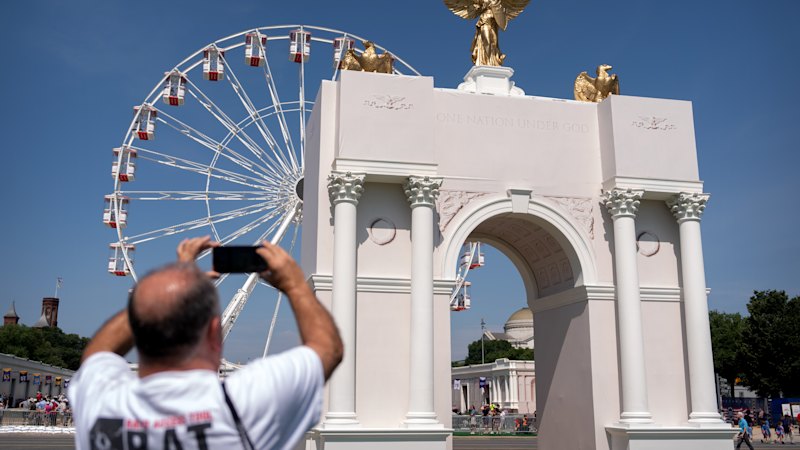
Trump’s proposed triumphal arch—modeled openly on European victory monuments like the Arc de Triomphe in Paris—introduces a massive vertical barrier into that carefully balanced horizontal plane. Architectural renderings circulated among federal review boards show a structure rising more than a hundred feet high, positioned near the Memorial Circle approach on the Virginia side of the Potomac or at the western terminus of Constitution Avenue. Either placement interrupts the unobstructed visual sweep between Lincoln and Kennedy.
The Kennedy family’s opposition centers on this spatial intrusion. To them, placing an imposing imperial-style arch along the approach to Arlington is an act of architectural hijacking. A triumphal arch is built to celebrate military conquest and executive power. Arlington National Cemetery exists to honor the cost of war, not the vanity of victory.
How Federal Monument Rules Actually Work
To understand why this fight has escalated so quickly, you have to look at the Commemorative Works Act of 1986. Congress passed the law because Washington was running out of space, and lawmakers wanted to stop a free-for-all of statues and memorials cluttering the National Mall.
Under normal circumstances, building a new monument in the capital’s monumental core is an agonizing, multi-year slog. A project must clear several distinct hurdles:
- Congressional Authorization: Congress must pass a specific law authorizing the memorial and designating whether it belongs in Area I (the central monumental core) or Area II (the surrounding buffer zones).
- The Reserve Ban: In 2003, Congress amended the law to declare the central cross-axis of the National Mall—stretching from the Capitol to the Lincoln Memorial and from the White House to the Jefferson Memorial—a completed work of civic art. No new memorials are permitted inside this Reserve.
- The 25-Year Rule: A monument commemorating an individual or specific event generally cannot be authorized until at least 25 years after the person’s death or the event’s conclusion, ensuring historical perspective over partisan heat.
- Design Review: Both the Commission of Fine Arts (CFA) and the National Capital Planning Commission (NCPC) must approve the site selection, scale, and architectural drawings through public hearings.
Supporters of Trump’s arch have attempted to sidestep these roadblocks by framing the structure not as a personal monument, but as a tribute to the 250th anniversary of American independence—the semiquincentennial—or as a general memorial to American military veterans. Categorizing it as a broad patriotic marker allows backers to argue for expedited congressional approval while leaning on executive appointments to reshape the review commissions.
During his first term, Trump replaced several members of the Commission of Fine Arts with traditionalist architects who favor classical revival styles over modernist designs. When Joe Biden took office in 2021, he removed those appointees and restored his own slate. With Trump back in control of executive appointments, the composition of both the CFA and the NCPC has shifted once again, turning obscure federal design boards into partisan battlegrounds.
The Architecture of Political Power
Classical architecture in Washington carries heavy ideological baggage. In December 2020, Trump issued an executive order titled "Promoting Beautiful Federal Civic Architecture," which mandated that classical styles—Greek and Roman revival—be the preferred design language for federal courthouses and buildings in the capital. Biden revoked the order in 2021, only for the ideological fight over architectural style to resurface with even greater intensity around the triumphal arch.
Critics of the arch point out a fundamental historical irony. The Founding Fathers chose neoclassical architecture for the young republic to evoke Athenian democracy and the Roman Republic—systems built on checks, balances, and the rejection of kings. Triumphal arches, however, belong to the Roman Empire. Emperors like Titus, Septimius Severus, and Constantine built them to parade captive enemies and looted treasures through Rome after foreign campaigns.
Napoleon Bonaparte revived the form in 1806 with the Arc de Triomphe in Paris to glorify his Grande Armée. Throughout the 19th and 20th centuries, autocrats and imperial powers adopted the triumphal arch as standard propaganda hardware.
The United States has largely avoided permanent triumphal arches in its capital for this exact reason. While temporary plaster arches were erected in New York and Washington to welcome troops home from the Spanish-American War and World War I, Congress consistently refused to make them permanent fixtures on the Mall. American civic tradition favored open public spaces, reflective pools, and temples of democratic deliberation over gates of imperial conquest.
By championing a permanent triumphal arch, Trump is breaking with two centuries of American architectural restraint. Supporters argue that the nation deserves bold, unapologetic monuments celebrating American greatness rather than somber memorials focused on grief and sacrifice. Yet to historians and the Kennedy family, importing an imperial Roman symbol into the corridor leading to Arlington Cemetery fundamentally alters the moral grammar of the capital.
Why the Kennedys Have Standing in This Fight
Public commentary often dismisses Kennedy family interventions in Washington politics as dynastic entitlement. In this case, their involvement is rooted in concrete institutional history.
Jacqueline Kennedy did not merely pick a burial plot in 1963. Working alongside architect John Carl Warnecke, she spent years overseeing the design of the John F. Kennedy Eternal Flame, ensuring that the granite terrace, the low stone walls, and the surrounding landscape remained subordinate to the natural hillside and the axis pointing toward the Lincoln Memorial. She insisted that nothing be built that would obstruct the view from the White House across the Potomac to the grave.
Members of the Kennedy family—including Caroline Kennedy, Jack Schlossberg, and various cousins active in historic preservation—view themselves as custodians of that specific landscape arrangement. Their opposition is amplified by organizations like the National Trust for Historic Preservation and the Committee of 100 on the Federal City, Washington’s oldest planning watchdog group.
These groups recognize that the Kennedys bring something preservationists rarely possess: immediate national media attention. When the Committee of 100 files a technical objection regarding viewshed impact assessments under Section 106 of the National Historic Preservation Act, few outside D.C. zoning circles notice. When the Kennedy family publicly warns that a Trump monument will desecrate the approach to Arlington National Cemetery, the story becomes front-page news across the country.
The Money and Mechanics Behind the Monument
Unlike the Vietnam Veterans Memorial or the National Museum of African American History and Culture, which relied on broad grassroots fundraising and strict congressional oversight, the campaign for the triumphal arch operates through a tightly coordinated network of allied nonprofits and major political donors.
Under the Commemorative Works Act, private foundations must raise the full cost of construction—plus an additional 10 percent maintenance endowment—before a single shovel hits the dirt on federal land. While this rule protects taxpayers from footing the bill for vanity projects, it also gives wealthy donors outsized influence over what gets built. If a handful of billionaires are willing to write eight-figure checks to fund a colossal stone arch, the financial barrier vanishes overnight.
This dynamic exposes a structural vulnerability in how Washington memorializes history. Federal review agencies are equipped to evaluate soil stability, traffic flow, and ADA compliance. They are far less equipped to stop a project backed by aggressive executive branch pressure, a compliant congressional majority, and a war chest of private money.
What Happens When Preservation Laws Collide With Executive Will
The legal battle over the arch will ultimately hinge on environmental and historic preservation statutes rather than aesthetic preferences. Before any construction can begin near the Potomac River or Arlington National Cemetery, federal agencies must complete two mandatory reviews:
- The National Environmental Policy Act (NEPA): Requires a comprehensive Environmental Impact Statement analyzing how a massive stone structure affects traffic congestion around Memorial Circle, drainage along the Potomac riverbank, and local parklands.
- Section 106 of the National Historic Preservation Act: Mandates formal consultation with historic preservation officers whenever a federal undertaking affects properties listed on the National Register of Historic Places. Both the Lincoln Memorial and Arlington National Cemetery carry the highest possible historic designations.
These reviews cannot legally block a project on their own, as they are procedural rather than substantive. However, they require transparency, public comment periods, and documented mitigation plans. If federal agencies rush the paperwork or ignore adverse visual impacts on Arlington Cemetery, the Kennedy family and preservation groups gain immediate standing to sue in federal court under the Administrative Procedure Act.
A federal judge examining whether the National Park Service acted "arbitrarily and capriciously" in approving a 100-foot arch directly in front of Arlington’s main entrance would have ample precedent to issue an injunction. Litigation over Washington monuments routinely stretches across multiple years, easily outlasting a single presidential term or a congressional session.
The Deeper Stakes for American Memory
Every generation argues over what Washington should look like. In 1981, veterans fiercely opposed Maya Lin’s minimalist black granite wall for the Vietnam Veterans Memorial, deriding it as a "black gash of shame" before it became one of the most revered spaces in the country. In the 1920s, critics complained that the Lincoln Memorial looked too much like a pagan Greek temple.
The difference today is not merely a clash between traditional and modern design. It is a dispute over whether the National Mall remains a shared civic sanctuary governed by consensus, or becomes a trophy case for political dominance.
If the triumphal arch is built along the Arlington axis, it will set a precedent that future presidents of both parties will inevitably exploit. Once the protective barrier around Washington’s ceremonial core is breached for one leader’s signature monument, there is no principled argument left to stop the next administration from demanding its own marble colossus across the street.
The Kennedy family understands that concrete and granite outlive news cycles, court battles, and political coalitions. Once stone is anchored into the bedrock beside the Potomac, no future Congress will ever tear it down.