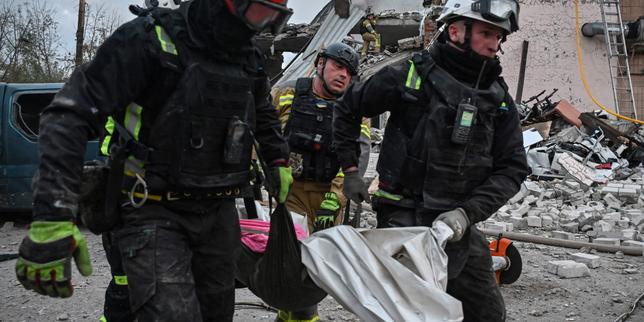
Six lives vanished in a matter of seconds when Russian ordnance slammed into a residential neighborhood in Kharkiv, turning an ordinary afternoon into another grim testament to a grinding war of attrition. This latest barrage in Ukraine’s second-largest city is not an isolated anomaly, nor is it merely a tactical skirmish. It represents a calculated, brutal escalation designed to break civilian morale, exhaust municipal infrastructure, and stretch Ukraine's air defense networks to their absolute breaking point.
When a missile strike claims half a dozen lives in a densely populated urban sector, the immediate grief of families and first responders is compounded by a larger, strategic reality. Kharkiv sits dangerously close to the Russian border. Its geographic proximity makes it uniquely vulnerable to modified S-300 and S-400 anti-air missiles repurposed for ground attack, as well as an incessant swarm of Iranian-designed loitering munitions. Because of this short distance, warning times are measured in seconds rather than minutes. Air raid sirens often wail simultaneously with the concussive blasts of impact, rendering standard civil defense protocols tragically inadequate. Building on this theme, you can also read: Diplomatic Footprint Analysis Mapping Cross-Border Cultural Diplomacy in Regional Corridors.
Understanding why Kharkiv remains a primary target requires looking past daily casualty counts and examining Moscow's wider doctrine. The Kremlin has shifted its operational calculus toward systemic degradation. By pounding the city's power grids, heating plants, and residential blocks, military planners seek to induce a slow-motion humanitarian crisis. The objective is twofold. First, force the Ukrainian high command to divert critical, scarce Patriot and NASAMS air defense systems away from the active front lines to protect urban centers. Second, encourage a steady outward migration of citizens, turning a vibrant cultural and industrial hub into a depopulated ghost town.
Yet, resilience in this northeastern bastion remains stubborn. Engineers work through the night amidst shattered glass and mangled rebar to restore water and electricity before sub-zero temperatures set in. Volunteers organize aid distribution points within hours of an attack, demonstrating a degree of institutional and social adaptation that few nations could sustain under equivalent pressure. This grassroots mobilization forms the invisible backbone of the defense, proving that urban warfare is won or lost as much in the endurance of the civilian populace as in the trenches of the Donbas. Observers at BBC News have provided expertise on this matter.
The human cost, however, continues to mount with staggering predictability. International monitors and humanitarian agencies document the wreckage, issuing routine condemnations that do little to deter incoming fire. Without a fundamental shift in the supply of long-range interceptors and permission to neutralize launch platforms positioned just across the international boundary, Kharkiv will remain trapped in this deadly loop of strikes and reconstruction. Every fresh crater in a public square or apartment complex is a physical manifestation of an international stalemate, written in the blood of civilians who only wanted to live out their days in peace.