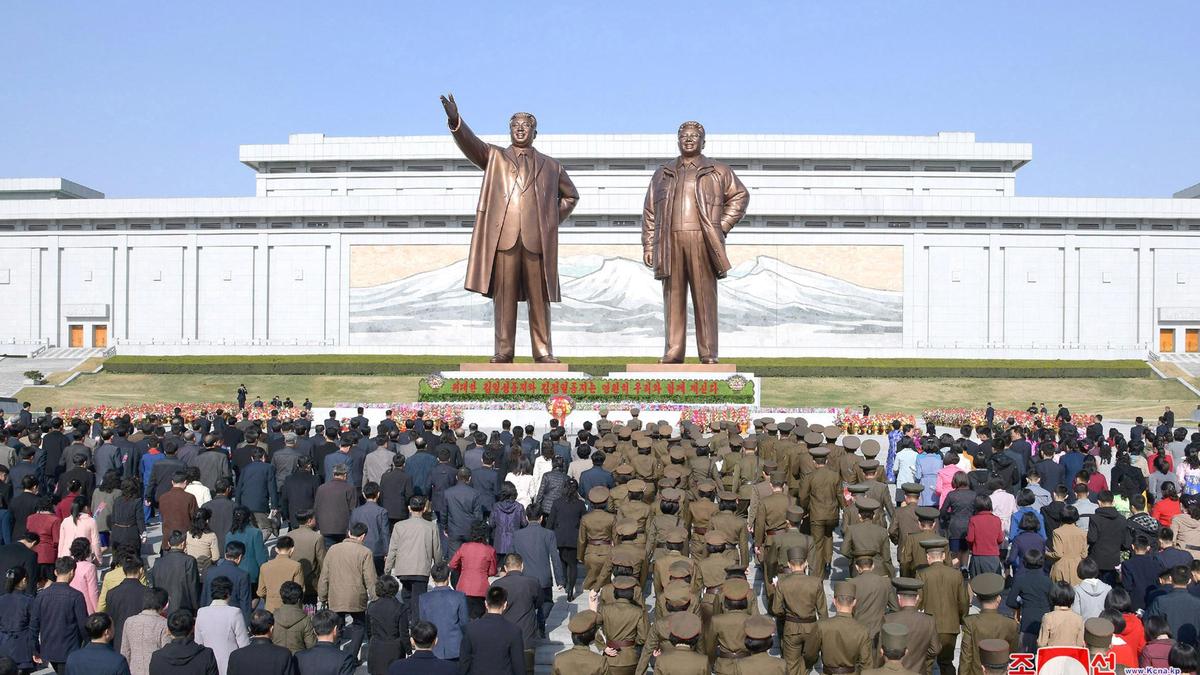
Pyongyang has finally stopped pretending. By stripping all language regarding "peaceful unification" and "kindred blood" from its constitution, Kim Jong Un has effectively declared that the South is no longer a long-lost sibling to be reclaimed, but a foreign enemy to be conquered. This is not a mere bureaucratic update. It is a fundamental shift in state ideology that prepares the North Korean population for a permanent state of war with a separate, hostile entity.
For seven decades, the "One Korea" policy served as the bedrock of North Korean identity. It was the justification for the Kim family’s existence. They were the supposed liberators of a divided people. Now, that fiction is dead. The revision codifies South Korea as the North’s "primary foe" and "invariable principal enemy." By removing the goal of reunification, Kim removes the need for diplomatic engagement based on shared heritage. He is clearing the legal and psychological path for the use of nuclear weapons against a neighbor that he now defines as a foreign aggressor.
The Death of the Sunshine Legacy
The constitutional rewrite marks the formal end of an era that began with the 1972 Joint Statement and peaked during the "Sunshine Policy" of the early 2000s. For years, both nations operated under the legal fiction that they were two governments within one nation, temporarily divided by outside forces. This allowed for special economic zones like Kaesong and family reunions that pulled at the heartstrings of the world.
Kim’s new doctrine incinerates that bridge. By defining the South as a separate state, he eliminates the constitutional contradiction of attacking "his own people." If the South is a foreign occupier, the moral hurdles for a full-scale strike vanish. This shift is a cold-blooded calculation. Kim has watched the cultural influence of the South—K-dramas, music, and wealth—seep through his borders. He realized that as long as the South was "the same nation," the North’s impoverished citizens would naturally look toward Seoul as a better version of themselves.
To survive, Kim had to make the South "the other." He had to ensure that a North Korean soldier looks across the DMZ and sees a stranger, not a cousin.
Sovereignty as a Shield for Nuclear Ambition
The timing of this constitutional purge is linked directly to the North’s rapid nuclear advancement. In the past, North Korea’s nuclear program was often framed as a bargaining chip for reunification on Pyongyang’s terms or for securing a peace treaty with the United States. That facade has been dropped.
When Kim Jong Un calls for the "complete occupation" of the South in the event of war, he is signaling that the North no longer seeks a negotiated settlement. The new constitution provides the legal framework for the "integration" of Southern territory into the North through force. This removes the ambiguity that previously hindered North Korean military doctrine.
The geopolitical math is simple. Kim sees a fractured West. He sees a Russia desperate for his artillery shells and a China that will not allow his regime to collapse. He has concluded that he no longer needs the promise of unification to maintain internal discipline. Instead, he needs a perpetual external threat that cannot be reasoned with. By constitutionalizing the South as a foreign enemy, he justifies the continued diversion of every available calorie and cent into the North’s missile program.
The Geographic Purge
This is not just about words on a page. The North has been physically erasing the history of the two Koreas. The "Monument to the Three Charters for National Reunification," a massive arch in Pyongyang showing two women holding a map of a unified Korea, has been demolished. It was an eyesore to Kim's new reality.
Railroads and roads that once connected the two halves have been systematically severed and mined. These were symbols of a future that Kim has decided is too dangerous for his grip on power. The physical destruction matches the legal destruction. If there is no road to Seoul, there is no temptation to flee, and no path for "contamination" to enter.
The Role of Russia and the New Cold War
One cannot analyze this constitutional shift without looking at Moscow. The deepening military pact between Kim Jong Un and Vladimir Putin has given the North a level of confidence it hasn't felt since the 1950s. Russia’s need for munitions has turned North Korea from a global pariah into a critical strategic partner for a nuclear superpower.
This alliance provides Kim with a safety net. If he no longer needs to pretend to want peace with the South to please China or solicit aid, he can be his most authentic, aggressive self. The constitutional change reflects this newfound insulation. He is betting that the "New Cold War" will last long enough for him to cement the North as a permanent, independent nuclear power that owes nothing to the concept of Korean brotherhood.
Weaponizing Culture Through Legislation
The constitutional revision acts as the ultimate "anti-reactionary thought" law. Over the last three years, Pyongyang has intensified its crackdown on Southern media, even introducing the death penalty for those distributing K-pop or K-dramas.
If the South is "one nation," the influence of its culture is a family matter. If the South is a "hostile foreign state," its culture is psychological warfare. By changing the constitution, Kim makes any interest in Southern life an act of treason against the state. It allows the security apparatus to move from "re-education" to "elimination."
The internal logic is airtight. To maintain a totalitarian grip, Kim must ensure his people believe that the South is not just different, but an existential threat. The wealth of Seoul is no longer something to be envied; it is the decadent poison of a foreign puppet state.
The Strategic Trap for Seoul and Washington
The constitutional change puts South Korean President Yoon Suk Yeol in a difficult position. Seoul’s policy has long been predicated on the hope of eventual peaceful unification. If the North officially rejects that goal, the South’s "Ministry of Unification" becomes a relic. It forces the South to choose between its own constitutional mandate—which still claims the entire peninsula—and the reality of a neighbor that wants nothing to do with them except for their total surrender.
Washington is equally hamstrung. For decades, US policy was built on "denuclearization" and "stability" on the peninsula. Kim is telling the world that those goals are dead. He is not interested in talking about his nukes because his nukes are now the primary tool for dealing with the "hostile foreign state" to his south.
We are entering a phase where the risk of miscalculation is at its highest since 1953. When two nations no longer speak the same language of heritage, the only language left is that of the military. Kim has burned the dictionary.
The Demographic Time Bomb
Kim is also fighting a battle against time. The generation of North Koreans who remember a unified country or have direct family ties to the South is dying out. The youth of North Korea have grown up in a closed loop of information. They do not feel the "yearning for unification" that their grandparents did.
Kim is leaning into this demographic shift. He is creating a new North Korean nationalism that is divorced from the South. This "North Korea First" ideology is designed to be more durable than the old "One Korea" dream. It is easier to motivate a population to hate a foreign enemy than it is to explain why they must remain separated from their own kin.
This is a permanent divorce. Kim Jong Un has served the papers, and he has made it clear that he will keep the house, the weapons, and the children. Anyone looking for a "thaw" in relations is ignoring the cold, hard facts of the North's new supreme law. Pyongyang is no longer playing the game of brothers. It is playing the game of nations, and it has decided that the only way to win is to ensure the other side ceases to exist as a separate entity.
The move is a total rejection of the global order’s hopes for the peninsula. It signals a leader who is done with the theater of diplomacy. Kim Jong Un has finalized his fortress. He has built the walls not just out of concrete and wire, but out of the very law of the land, ensuring that the dream of a unified Korea remains exactly that: a dream that he has now made a crime to pursue.