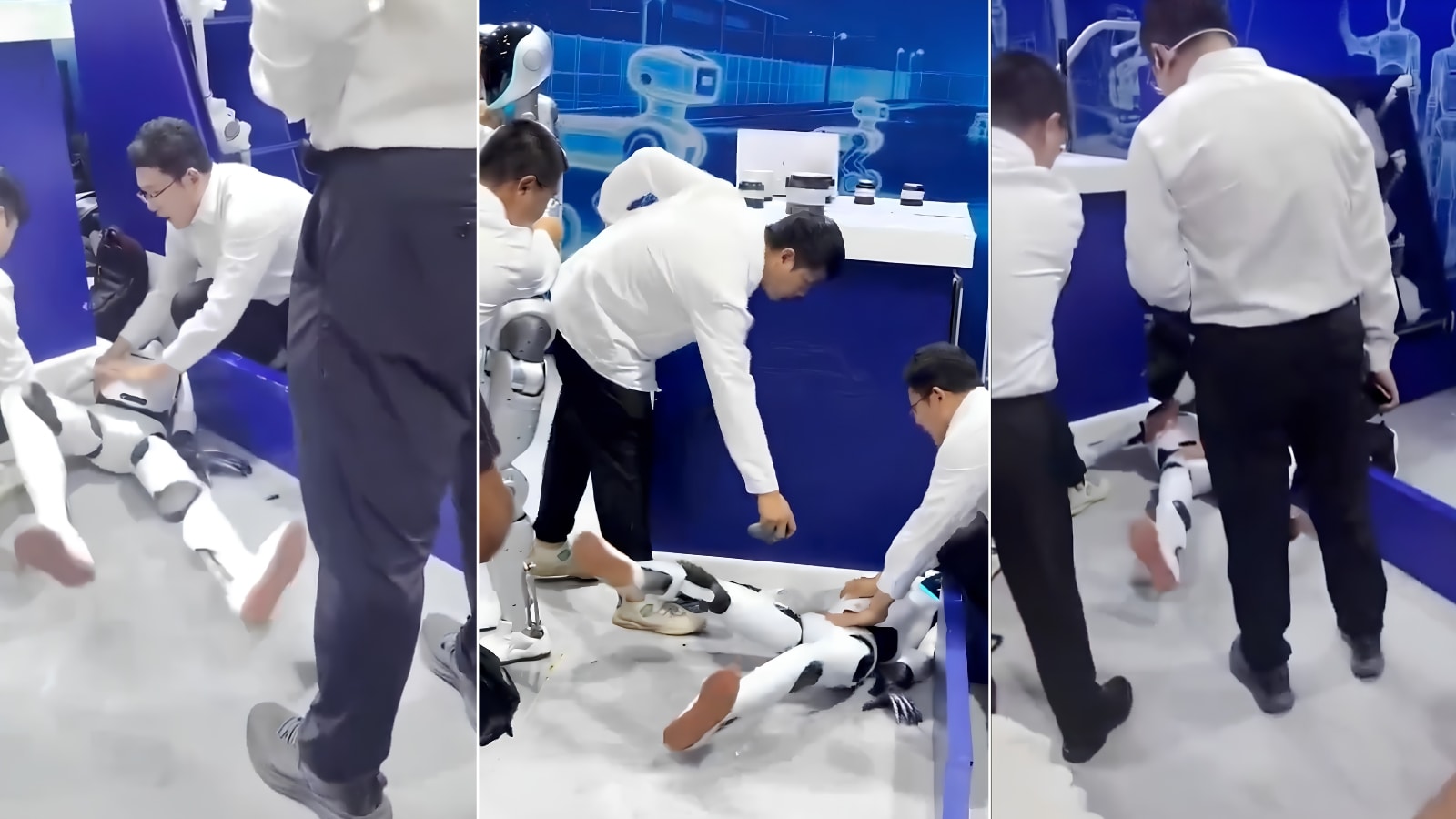
The recent malfunction of a humanoid robot at the 2026 World Robot Conference—characterized by erratic, seizure-like oscillations on the event floor—is not a statistical anomaly but a predictable consequence of current control-system architectures. When a robotic agent enters a state of uncontrolled kinetic output, the diagnostic reality typically involves a breakdown in one of three primary subsystems: the proprioceptive feedback loop, the actuator signal integrity, or the emergency override protocol.
The Proprioceptive Feedback Loop
Humanoid stability relies on a constant, high-frequency stream of data from inertial measurement units (IMU) and joint-position sensors. When these systems disagree, the robot enters a state of "control conflict." If an internal sensor detects an orientation shift that the control software perceives as an error, the machine will attempt to apply corrective torque to compensate for a deviation that may not exist.
This creates a positive feedback loop: the robot detects a tilt, adjusts its motors to correct it, shifts its center of mass, and then detects a new, more severe tilt, leading to the thrashing motion observed. In the Beijing incident, the apparent inability of operators to immediately force a power-down suggests that the low-level logic governing the machine's "safe state" was overridden or unreachable due to the severity of the processor interrupt, leaving the machine trapped in a hardware-level execution loop.
Actuator Signal Integrity and Latency
The transition from a polished trade-show demonstration to a mechanical collapse is often rooted in signal degradation. Humanoid platforms are complex networks of distributed controllers. Each joint requires nanosecond-level synchronization. If the internal communication bus—often burdened by the high-bandwidth requirements of modern AI-driven motion planning—experiences latency or packet loss, the motors receive desynchronized instructions.
Without valid synchronization, the motors engage in opposing torques. The resulting vibration is what lay observers interpret as a "seizure." Mechanically, this manifests as extreme stress on gearboxes and joint linkages. If the emergency stop system relies on software interrupts rather than a hardware-level electrical disconnect, a locked-up processor cannot process the "stop" signal, turning the operator’s console into a bystander interface.
The Operational Cost Function
The deployment of humanoid platforms at public conferences involves a specific set of risks that organizations must reconcile. The industry currently optimizes for "perceived intelligence" and "fluid motion" to attract capital and talent. However, this optimization occurs at the expense of "fail-passive" safety.
A truly robust system requires a tiered hierarchy of control:
- Application Layer: Handles high-level intent, gait, and environmental interaction.
- Kinematic Layer: Translates intent into specific joint torques while enforcing safety constraints.
- Hard-Wired Safety Layer: An autonomous, independent electrical circuit that ignores all software input and cuts power to the actuators in the event of anomalous vibration or user command.
When the third layer is missing or poorly integrated, the machine remains vulnerable to any bug in the application layer. The struggle to restrain the malfunctioning robot at the Beijing conference underscores the absence of a "dead man's switch"—a physical, hardware-interrupt mechanism that removes the robot's motive force instantly.
Strategic Implications for Robotics Development
Current market entrants, particularly those scaling rapidly to meet the demand for "general-purpose" humanoids, face a fundamental bottleneck: the reliance on software-based safety in hardware-intensive environments.
The industry must shift its focus from "demonstration-ready" to "fail-safe" benchmarks. Development teams should prioritize the implementation of independent, physical safety interlocks that operate outside the central processing unit. Until then, public demonstrations are inherently high-risk, as the systems are being asked to balance on a razor's edge of complex, non-linear mathematics without an adequate safety net.
Manufacturers should transition to a modular safety architecture. By isolating the emergency power-cutoff circuit from the primary logic board, firms can ensure that even if the AI or motion-control systems suffer a critical failure—or "seizure"—the physical hardware remains tethered to a safe state. This is not a matter of better code; it is a matter of redundant, hardware-centric power management. The next generation of industrial-grade humanoids will be judged not by their agility, but by the reliability of their stillness.