The core-collapse supernova observed in the year 1054 (SN 1054) released an estimated $10^{44}$ joules of kinetic energy, transforming a massive stellar progenitor into a high-energy laboratory that continues to redefine modern plasma physics. For twenty-three days, the event was visible in broad daylight, a manifestation of peak absolute magnitude driven by radioactive decay and shock heating. Today, nearly a millennium later, data from the Hubble Space Telescope demonstrates that the system—now classified as the Crab Nebula (Messier 1)—is not merely coasting on inertial momentum but is actively accelerating due to a continuous injection of energy from a central pulsar.
Understanding this system requires moving past superficial descriptions of "glowing space clouds" and instead analyzing the specific fluid dynamics, magnetohydrodynamics (MHD), and relativistic acceleration vectors that govern the debris field. The expansion of the Crab Nebula offers a quantifiable case study in how energy transitions across states, from mechanical rotation to relativistic particle winds, and finally into visible structural deformation across parsec-scale distances.
The Three Structural Pillars of the Remnant Matrix
The evolution of the Crab Nebula cannot be modeled as a uniform sphere of expanding gas. The system operates as a stratified, three-part engine driven by distinct physical mechanisms.
The Relativistic Pulsar Engine
At the absolute coordinate center of the remnant sits the Crab Pulsar (PSR B0531+21), a neutron star spinning at approximately 30.2 times per second. This object compresses roughly 1.4 solar masses into a sphere with a radius of only 10 to 12 kilometers. The rapid rotation of its intense magnetic field ($10^{12}$ Gauss) generates an unmitigated voltage drop that accelerates electrons and positrons to ultra-relativistic speeds. This continuous output, known as a pulsar wind, serves as the primary power source for the entire nebula, injecting $4 \times 10^{31}$ watts of energy into the surrounding medium.
The Synchrotron Nebula
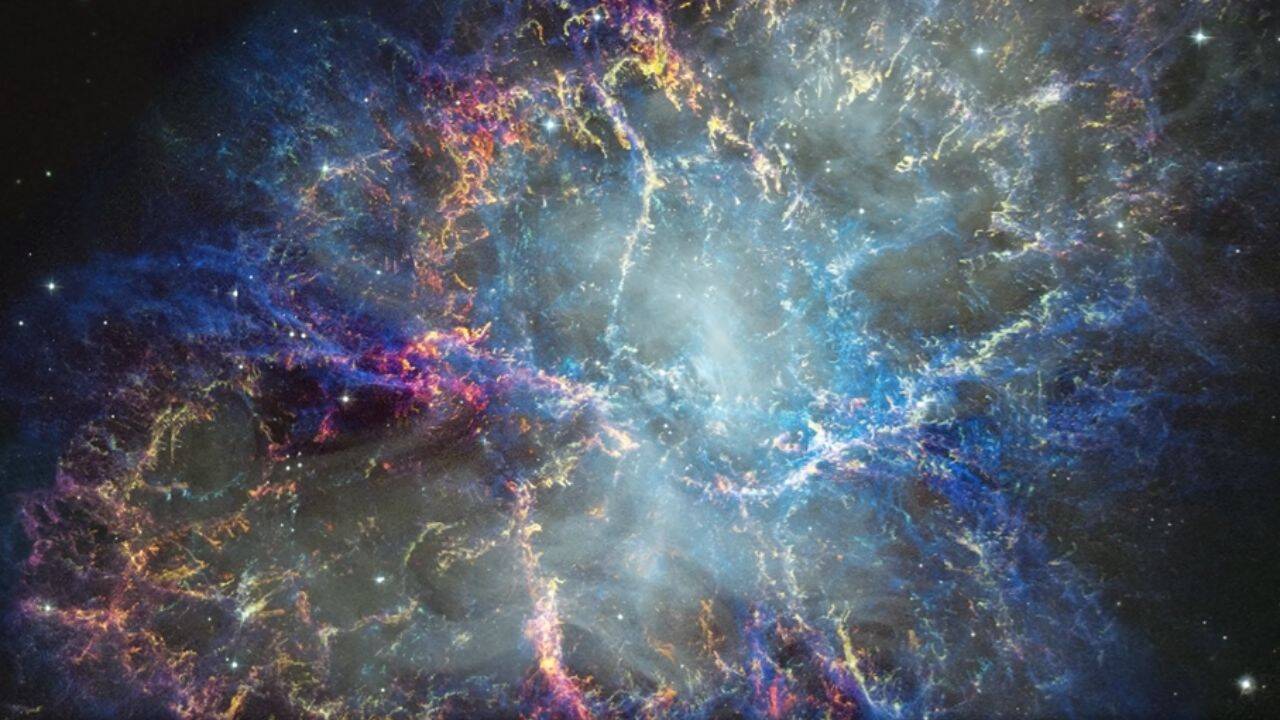
Surrounding the pulsar engine is a non-thermal emission zone that spans several light-years. As the relativistic pulsar wind collides with the slower-moving stellar ejecta, a termination shock forms. This boundary accelerates particles further, forcing them to spiral along magnetic field lines. This process generates synchrotron radiation that spans the electromagnetic spectrum, from low-frequency radio waves to high-energy gamma rays. The glowing interior visible in Hubble imaging is not thermal gas reflecting starlight; it is a manifestation of continuous magnetic confinement and particle acceleration.
The Filamentary Outer Shell
Encasing the synchrotron nebula is a complex web of dense, cool gas filaments composed primarily of ionized hydrogen, helium, carbon, oxygen, and iron. These filaments represent the outer layers of the original progenitor star, blasted outward during the initial detonation. The filaments act as a containment vessel, absorbing the high-energy photons emitted by the interior synchrotron nebula. This interaction ionizes the gas, causing it to emit specific spectral lines that allow astronomers to map the chemical composition and velocity vectors of the expanding shell.
Quantifying the Day-Visibility Phenomenon
Historical records from East Asian and Middle Eastern astronomers establish that SN 1054 reached a peak apparent magnitude of approximately -6. For comparison, Venus reaches a maximum brightness of roughly -4.9. To understand how a stellar explosion 6,500 light-years away achieved such luminosity, the event must be analyzed through the mechanics of shock-breakout chemistry and radioactive synthesis.
Peak Apparent Magnitude: -6.0 (Visible in daylight for 23 days)
Distance to Source: 6,500 light-years (2 kiloparsecs)
Progenitor Mass Estimate: 9 to 11 Solar Masses
The initial flash of a core-collapse supernova is driven by a shock wave breaking through the surface of the progenitor star. This shock wave heats the outer stellar envelope to millions of Kelvin, triggering a brief but intense burst of ultraviolet and X-ray radiation. However, the prolonged luminosity that sustained daylight visibility for over three weeks requires an internal energy source: the radioactive decay chain of Nickel-56 to Cobalt-56, and ultimately to stable Iron-56.
The mass of Nickel-56 synthesized during the core collapse determines the peak brightness of the light curve. In the case of SN 1054, models indicate the explosion synthesized roughly 0.05 to 0.1 solar masses of Nickel-56. The energy released by the gamma-ray emissions of this radioactive decay was trapped within the expanding, optically thick envelope, warming the gas and forcing it to glow with an intensity that overcame the atmospheric scattering of Earth’s daytime sky.
Hubble Space Telescope Astrometry and Kinetic Tracking
Modern analysis of the Crab Nebula relies heavily on the high-resolution imaging capabilities of the Hubble Space Telescope's Wide Field Camera 3 (WFC3) and Advanced Camera for Surveys (ACS). By comparing images taken across a baseline of several decades, researchers can measure the proper motion of individual filaments and shock fronts with unprecedented accuracy.
This structural tracking relies on three core observational variables:
- Proper Motion Angular Velocity ($\mu$): The apparent angular movement of filaments against background stars, measured in arcseconds per year. In the outer fringes of the nebula, this value averages roughly 0.2 arcseconds per year.
- Doppler Shift Spectrosopy ($v_r$): The line-of-sight radial velocity determined by measuring the redshift or blueshift of emission lines like H-alpha ($H\alpha$) and ionized sulfur ([S II]). This yields physical speeds ranging from 1,000 to 1,500 kilometers per second.
- Distance Factor ($d$): Integrating the angular expansion rate with the true radial velocity via trigonometric parallax calculations yields a highly refined distance of approximately 2 kiloparsecs.
When Hubble pairs these measurements with historical data, a stark physical discrepancy emerges between the geometric age of the nebula and its chronological age.
The Kinetic Discrepancy Framework
If the expansion velocity of the Crab Nebula had remained entirely constant since the initial explosion in 1054, tracing the velocity vectors backward in time should point to a convergence date exactly matching the historical observation. However, linear backward extrapolation yields a convergence date around the year 1140—nearly nine decades later than the actual event.
Historical Age (1054 to Present): ~972 Years
Geometric Expansion Age (Linear Extrapolation): ~886 Years
Calculated Acceleration Vector: ~0.0011 cm/s²
This structural delta proves that the expansion of the nebula has accelerated over time. The physical mechanism driving this acceleration is the pulsar wind nebula (PWN) phenomenon. The immense magnetic pressure and relativistic particle injection from the central pulsar act as a piston, pushing outward against the inner boundary of the filamentary shell.
This interaction is governed by Rayleigh-Taylor instabilities. The light, high-energy fluid of the synchrotron nebula is pushing against a heavier, denser fluid (the filamentary shell). As the pulsar wind drives into the denser ejecta, it forms elongated, finger-like structures that pierce the shell. This instability accelerates the filaments outward, explaining both the observed velocity increase and the highly fragmented, web-like morphology captured in Hubble imaging.
Magnetohydrodynamic Bottlenecks and Energy Conversion
The transition of rotational energy from the pulsar into the kinetic energy of the nebula is limited by magnetohydrodynamic constraints. This efficiency bottleneck is often analyzed using the "sigma parameter" ($\sigma$), which defines the ratio of magnetic energy flux to particle kinetic energy flux in the pulsar wind.
$$\sigma = \frac{B^2}{4\pi \gamma \rho c^2}$$
Where:
- $B$ represents the magnetic field strength
- $\gamma$ represents the Lorentz factor of the plasma wind
- $\rho$ represents the mass density of the plasma
- $c$ represents the speed of light
Near the surface of the pulsar, the wind is highly magnetized ($\sigma \gg 1$), meaning almost all the energy is stored within the magnetic fields. However, to account for the observed expansion of the synchrotron nebula, this magnetic energy must convert efficiently into particle kinetic energy ($\sigma \ll 1$) before or during its collision with the termination shock.
The precise structural mechanism behind this conversion remains an active area of investigation. Theories suggest that magnetic field lines of opposing polarity strip and reconnect as the wind travels outward, a process known as relativistic magnetic reconnection. This dissipation converts magnetic energy into thermal and kinetic energy, accelerating the electron-positron plasma to the high Lorentz factors required to generate the synchrotron emission mapped by Hubble.
Strategic Modeling and Predictive Frameworks
The empirical data gathered from the long-term observation of the Crab Nebula provides an invaluable template for analyzing other supernova remnants and high-energy plasma environments across the cosmos. To build accurate predictive models of these systems, researchers must prioritize multi-wavelength structural integration. Relying solely on optical data introduces significant blind spots, as the cold dust and highly magnetized relativistic tracking zones reveal different components of the same kinetic system.
Future research initiatives must focus heavily on three-dimensional magnetohydrodynamic simulations that account for the anisotropic energy output of the central pulsar. The pulsar does not emit energy equally in all directions; it projects highly directional jets along its rotational axis and a dense equatorial wind. Incorporating these directional vectors into kinetic expansion models will allow scientists to map the precise structural evolution of the nebula over the next millennium, transforming raw astronomical imagery into an absolute mathematical blueprint of stellar decay.