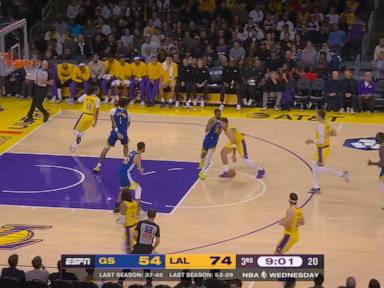
The Los Angeles Lakers defeated the Golden State Warriors 127-105 on opening night of the 2026-27 NBA season on October 21, 2026, at Crypto.com Arena, riding a 28-point night from Luka Dončić and an astonishing 26-point, 12-for-12 shooting debut from center Walker Kessler. Yet anyone treating that 22-point blowout as proof of an instant Western Conference crown is reading the box score without reading the injury report or the calendar. Golden State arrived in Los Angeles missing key pieces—including Jimmy Butler, Kristaps Porziņģis, and Moses Moody—while a 35-point peak lead for the Lakers evaporated into a 37-25 fourth-quarter push by Golden State's reserves. Nine days later, when the two rivals met again on October 30 at Chase Center in NBA Cup play, Golden State flipped the script with a 112-95 victory, exposing just how volatile early-season matchups between the Lakers and Warriors really are.
In sports media, opening night is a machine designed to manufacture certainty out of chaos. A highlight clip runs for ninety seconds, a talking head declares a shift in power, and a column gets filed before the arena parking garage even clears. Having covered league front offices, coaching staffs, and roster turnovers for more than twenty years, I have watched enough October routs turn into January slumps—and enough October clunkers turn into spring contenders—to treat the first week of the season as a diagnostic scan rather than a verdict.
Opening Night Spectacle vs. Roster Reality
Walk into any sports bar in Southern California or the Bay Area on the first night of the season and you will hear the same shorthand. Los Angeles looked bigger, faster, and sharper. Golden State looked thin and outmatched inside.
Both impressions were true on October 21. They were also incomplete.
A game in late October is a snapshot of availability, conditioning, and schematic familiarity, not a sealed document of season-long superiority. When the Lakers beat the Warriors 127-105, Los Angeles shot 56.8% from the field (46-of-81) and 39.3% from three-point range (11-of-28), while holding Golden State to 22.2% from beyond the arc (8-of-36). That kind of shooting gap almost always produces a comfortable margin.
Look beneath the surface, though, and the blowout loses some of its luster. After a tight 34-33 first quarter, Los Angeles built massive separation in the middle periods, outscoring Golden State 32-19 in the second and 36-16 in the third. Once the lead ballooned to 35 points, urgency dipped, rotations stretched, and the Warriors took the fourth quarter 37-25.
Roster context matters even more. Golden State entered that opener without Jimmy Butler and Moses Moody, both sidelined while recovering from knee injuries, alongside Kristaps Porziņģis out with a health issue. Stephen Curry still scored 23 points on 7-of-15 shooting and went 7-for-7 at the free-throw line in just 21 minutes before the game's outcome was decided. When a team's primary offensive engine plays barely more than a half because the margin is out of reach, drawing grand conclusions about the opponent's defense requires caution.
An October blowout proves what a roster can do on a fresh night with favorable matchups. It rarely proves how that roster holds up over eighty-two games, back-to-backs, or playoff adjustments.
How Walker Kessler and Luka Dončić Reshaped the Matchup
If there was a genuine structural takeaway from the opening-night win over the Warriors, it centered on how Los Angeles paired perimeter creation with vertical rim pressure.
Luka Dončić finished with 28 points, 8 rebounds, and 7 assists, orchestrating the offense with the deliberate pace and court manipulation that have defined his career. Alongside him, Austin Reaves chipped in 23 points, 4 rebounds, and 6 assists, giving Los Angeles a secondary ball-handler capable of punishing switches when defenses blitzed Dončić.
The real eye-opener, though, was Walker Kessler. Making his regular-season debut for Los Angeles, Kessler poured in 26 points and grabbed 9 rebounds while converting all 12 of his field-goal attempts. Against a Golden State frontcourt lacking traditional seven-foot size, Kessler's ability to roll hard to the basket, finish lobs, and command second-chance possessions punished every rotation a step late.
Here is how the core contributors stacked up in that October 21 opener:
| Player | Team | Points | Rebounds | Assists | Key Takeaway |
|---|---|---|---|---|---|
| Luka Dončić | Lakers | 28 | 8 | 7 | Primary playmaker driving efficient half-court creation |
| Walker Kessler | Lakers | 26 | 9 | 1 | 12-for-12 shooting punished interior size mismatch |
| Austin Reaves | Lakers | 23 | 4 | 6 | Steady secondary scoring and transition spacing |
| Stephen Curry | Warriors | 23 | 2 | 1 | Efficient in 21 minutes before blowout dictated bench time |
| Brandon Williams | Warriors | 14 | 4 | 3 | Provided second-unit scoring spark and free throws |
| Yaxel Lendeborg | Warriors | 12 | 3 | 2 | Solid starter scoring output amid tough team shooting night |
| Gui Santos | Warriors | 12 | 5 | 0 | Active forward minutes in an undersized frontcourt |
That table highlights a critical dynamic for Los Angeles. Kessler will not shoot 100% from the floor every night—even the most efficient roll men regress toward normal finishing rates over a full schedule. Yet the process behind his touches is repeatable. When a defense has to respect Dončić as a three-level scorer and kick-out passer, the weak-side help tag on a diving center becomes a high-risk gamble.
Still, one game does not erase every flaw. Ball security remains a recurring test for any high-usage heliocentric offense. In the opening-night win, Los Angeles committed 15 turnovers, matching Golden State's 15 turnovers. Nine days later in San Francisco, turnovers and perimeter variance swung the result sharply the other way.
The Counter-Argument Nobody Wants to Hear About Early Blowouts
Conventional sports coverage loves a neat arc: big win on opening night equals momentum, chemistry, and swagger. Veteran coaches and front-office executives usually view it with more skepticism.
First, early-season defensive communication is rarely sharp across the league. Complex switching schemes, weak-side rotations, and closeout discipline take weeks of live reps to crystallize. A team that shoots nearly 57% from the field on October 21 may face completely different defensive coverages once scouting reports accumulate and opponents sharpen their timing.
Second, rivalries between the Lakers and Warriors carry a distortion factor that skews emotional reads. Because both franchises sit at the center of NBA media gravity, every possession feels magnified. A thunderous dunk or a step-back three gets replayed dozens of times, making a standard regular-season victory look like a statement of historic weight.
Consider a hypothetical example from front-office evaluation: suppose a team wins its opener by 22 points behind 60% shooting on contested midrange jumpers and a career-best efficiency night from a role big man. A headline writer sees dominance. An analytics department sees unsustainably high shot-making paired with middling turnover differential and looks for what happens when three-pointers stop falling at a 40% clip.
That reality check arrived quickly in the 2026-27 season. When the Lakers traveled to Chase Center on October 30 for their NBA Cup group-stage meeting, Golden State knocked down 22 three-pointers on 46 attempts (47.8%) and forced 20 Lakers turnovers—including eight from Austin Reaves—on the way to a 112-95 win. Dončić still dropped 37 points and Kessler posted a 10-point, 13-rebound, 5-block line, yet Los Angeles shot just 28.2% from three and lost by 17.
What the Rematch Exposed About Both Franchises
The contrast between October 21 and October 30 is the real story behind the opening-night headline. Rather than settling a hierarchy, the first two regular-season meetings showed two teams searching for consistency under very different constraints.
For Golden State, the October 30 response demonstrated that when Curry finds rhythm—finishing with 31 points and 8 made threes—and secondary contributors like Brandin Podziemski (21 points, 6 assists) and De'Anthony Melton (16 points, 4 threes) space the floor, the Warriors can still overwhelm opponents with pace, ball movement (31 assists), and three-point volume. Draymond Green's 9 assists and 3 steals in that game underscored how Golden State's defensive disruption and connective passing still swing possessions when the roster is locked in.
For Los Angeles, the October 30 loss underscored how fragile margin for error can be when perimeter shooting goes cold and turnovers mount. Even with Kessler anchoring the paint and Dončić carrying a heavy scoring load, sloppy execution against aggressive defensive pressure quickly turns a manageable road game into an uphill climb.
To be fair to Los Angeles, the Lakers also showed resilience in the weeks that followed, stringing together strong scoring nights and multi-win stretches through early and mid-November. Neither franchise's identity is fixed in amber after two October games. Both are navigating injuries, rotation adjustments, and the grinding realities of a long Western Conference slate.
How to Read Lakers vs. Warriors Going Forward
Fans and bettors who want to separate signal from noise when watching the Lakers and Warriors—including their upcoming January 21, 2027 meeting in San Francisco and March 14, 2027 clash in Los Angeles—should track four concrete indicators instead of chasing opening-night narratives:
- Live-ball turnovers under pressure: Watch how cleanly Los Angeles handles traps and baseline pressure when primary creators are forced out of rhythm.
- Three-point volume versus rim protection: Golden State thrives when it stretches defenses with high-volume perimeter shooting and forces bigs into space; Los Angeles counters best when Kessler and its frontcourt control the paint and defensive glass.
- Bench scoring and foul trouble: Early foul trouble on key bigs or perimeter defenders changes defensive coverage immediately, often deciding which second unit wins the non-star minutes.
- Health and rotation continuity: Lineups featuring core starters who have logged consecutive weeks together execute far more crisply than patchwork injury-era groupings.
A 127-105 opening-night win makes for a lively broadcast clip, and Dončić paired with Kessler gives Los Angeles a dangerous formula when everything clicks. Judge the rivalry over the full arc of the season, not the first week's highlight reel.