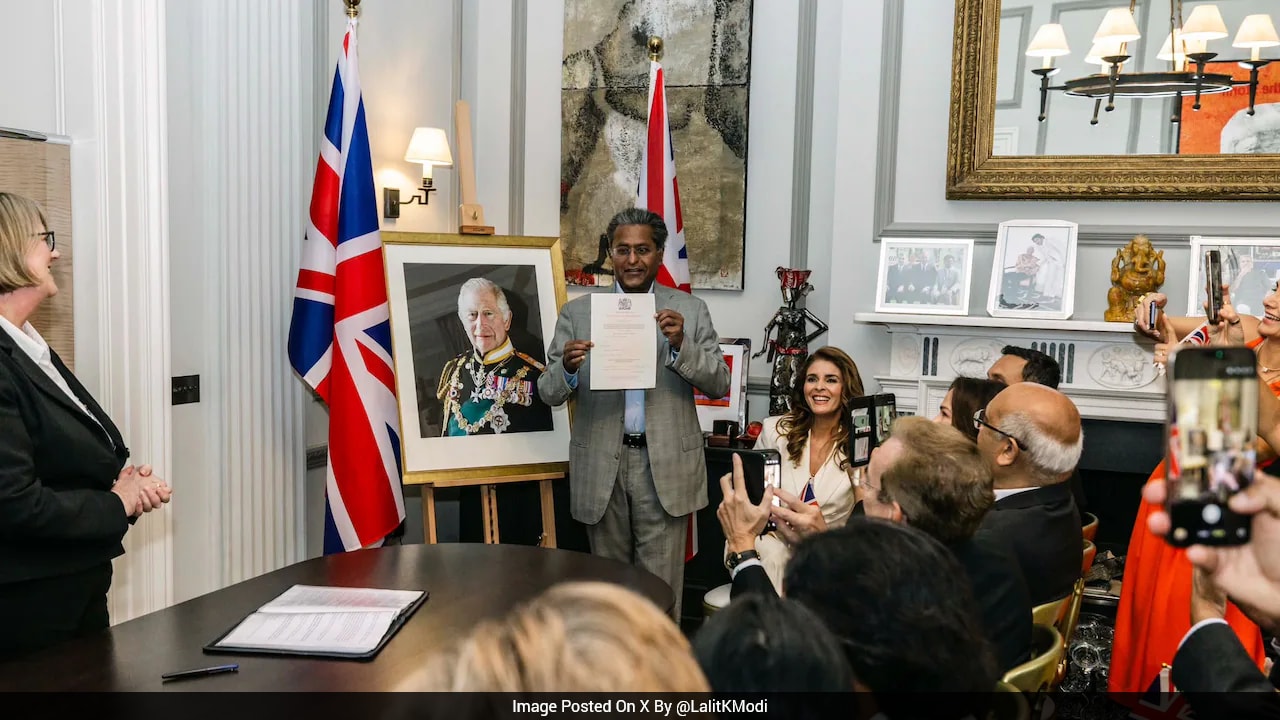
Everybody is looking at the wrong piece of paper.
When Lalit Modi took to social media with a triumphant "God Save The King" to flaunt his British citizenship, the mainstream press did exactly what they always do. They gasped. They clutched their pearls. They framed a routine bureaucratic update as a dramatic "checkmate" against New Delhi—a billionaire fugitive slipping through the fingers of Indian enforcement agencies with a royal smirk.
That narrative is lazy, legally illiterate, and completely detached from how international extradition actually functions.
The media wants you to believe a British passport is an invisible cloak against Indian law. It isn't. By formalizing his status as a British citizen, the former Indian Premier League (IPL) commissioner didn't build a fortress around himself. He just stripped away his biggest diplomatic leverage and handed the United Kingdom's judicial system direct, unvarnished jurisdiction over his neck.
The Lazy Consensus About Fugitive Passports
Read any standard news report on Lalit Modi’s announcement and you will find the exact same formulaic panic. The story goes like this: Modi fled India in 2010 amid allegations of financial irregularities, bid-rigging, and money laundering under the Foreign Exchange Management Act (FEMA) and the Prevention of Money Laundering Act (PMLA). For over a decade, he lived in London on indefinite leave to remain, fighting off India's revoked passport status and Interpol Red Corner Notice attempts. Now, by naturalizing as a British subject, he has supposedly locked the doors from the inside.
This is pure theater designed for outrage clicks.
In reality, the legal mechanics of extradition between India and the United Kingdom do not care about the color of your passport cover. They care about dual criminality, prima facie evidence, and Article 3 of the European Convention on Human Rights (ECHR).
I have watched high-net-worth individuals burn tens of millions of dollars on white-shoe London legal teams believing that naturalization or citizenship-by-investment schemes would immunize them from sovereign prosecution. Every single time, they confuse residency friction with legal immunity. A passport changes where you stand in the airport queue; it does not rewrite the 1992 India-UK Extradition Treaty.
What The 1992 Extradition Treaty Actually Says
If you want to understand why Modi’s "God Save The King" post is less of a victory lap and more of a public relations smokescreen, stop reading tabloid summaries and look at the statutory architecture governing London and New Delhi.
Under the UK Extradition Act 2003, India is designated as a Category 2 territory. Unlike several European civil-law nations—such as France or Germany—which maintain strict constitutional bars against extraditing their own nationals, the United Kingdom holds no blanket prohibition against handing over British citizens to foreign powers.
Let that sink in. Being a British citizen does not protect you from extradition from Britain.
Ask any white-collar defense lawyer working out of Lincoln's Inn Fields. The UK Home Office and the Westminster Magistrates' Court extradite British nationals every year—to the United States, to European states, and yes, to Commonwealth partners—provided the requesting state clears the evidentiary bar.
The Real Reason Modi Is Still In London
So why hasn't Lalit Modi been put on a flight back to Mumbai? The answer has nothing to do with his newly minted British citizenship and everything to do with India’s own prosecutorial track record in Westminster.
To extradite someone from the UK to India, New Delhi must satisfy three brutal hurdles:
- Dual Criminality: The alleged offense must constitute a crime punishable by at least 12 months in prison under both Indian and English law. Administrative violations under FEMA—which largely deal with civil foreign exchange contraventions rather than outright criminal fraud—routinely collapse under English judicial scrutiny because the UK abolished exchange controls in 1979. You cannot extradite a man from London for breaking a currency rule that hasn't existed in Britain for nearly half a century.
- The Prima Facie Case: Unlike extradition requests from the US, where Washington merely needs to show "reasonable suspicion," India must present a prima facie case that would justify a trial under English criminal standards. Indian agencies have historically submitted sprawling, 10,000-page charge sheets translated poorly from Hindi or Marathi, drowning British District Judges in unindexed paper rather than tight, admissible evidence.
- Human Rights & Prison Conditions: Under Section 87 of the Extradition Act 2003, British courts must block extradition if it violates the subject's human rights—specifically Article 3 (prohibition of torture or inhuman/degrading treatment) and Article 6 (right to a fair trial). Defense lawyers routinely turn Indian extradition hearings into trials of India’s overcrowded prisons and glacial court dockets.
Modi didn't survive fourteen years in London because he was waiting for a British passport. He survived because the Enforcement Directorate (ED) and the Central Bureau of Investigation (CBI) struggled to translate complex cricket broadcasting and facilitation fee disputes into clean, indisputable English criminal fraud.
Why Naturalization Actually Weakens His Hand
Here is the counter-intuitive reality that the "God Save The King" headlines completely missed: transitioning from a stateless/revoked-passport Indian resident to a naturalized British citizen introduces severe, underappreciated vulnerabilities for someone in Modi's position.
When Modi was an Indian citizen fighting passport revocation in London, his legal team could frame every move by New Delhi as political persecution against an Indian national caught in a domestic factional war. He operated in a gray zone—a man without valid travel documents, stuck in Belgravia, reliant on discretionary UK immigration leave.
By naturalizing as a British citizen, three fundamental shifts occur:
1. The Death Of The "Stateless Victim" Narrative
For years, Modi’s defense hinged on the argument that India had stripped him of his fundamental right to travel by revoking his passport in 2011, effectively trapping him while refusing to guarantee his safety upon return. That sympathy card is dead. He is now a full citizen of a G7 nation. He cannot claim diplomatic abandonment or arbitrary statelessness before a British tribunal.
2. Direct Exposure To UK Financial Crime Enforcement
As a British citizen domiciled in the UK, Modi falls squarely under the domestic oversight of the UK’s National Crime Agency (NCA), the Serious Fraud Office (SFO), and His Majesty's Revenue and Customs (HMRC). Previously, British authorities viewed his dispute as an external Indian regulatory headache—something to be managed through immigration tribunals. Now, any financial movement, trust structure, or offshore dividend flowing to a British citizen in central London is domestic tax and compliance territory. With the UK's Economic Crime and Corporate Transparency Act tightening beneficial ownership rules, holding a British passport puts your global balance sheet under a brighter, far less forgiving spotlight.
3. The "Vanuatu" Precedent And Citizenship Revocation
Remember what happened just recently when Modi attempted to acquire citizenship in Vanuatu, only for the Pacific island nation's Prime Minister to order the cancellation of his passport after India intervened? That episode exposed how fragile secondary passports really are when geopolitical pressure mounts. While the UK is obviously not Vanuatu, British citizenship obtained through naturalization is not absolute. Under Section 40 of the British Nationality Act 1981, the UK Home Secretary retains the statutory power to deprive a naturalized citizen of their citizenship if it was obtained by fraud, false representation, or concealment of a material fact—or if deprivation is deemed "conducive to the public good."
Imagine a scenario where Indian investigators unearth a previously undisclosed criminal conviction or a material omission in Modi's decade-long UK residency filings and hand that dossier directly to the Home Office. Naturalization doesn't lock the door; it creates an entirely new set of compliance tripwires that didn't exist when he held indefinite leave to remain.
Answering The Questions Nobody Wants To Ask Honestly
When news like this breaks, search engines flood with the same predictable questions from readers trying to decode the theater. Most commentary dances around the answers to avoid offending either New Delhi or London. Let’s strip away the polite hedging.
Does a British passport stop Interpol from arresting Lalit Modi?
No. Interpol does not care about your nationality; it cares about whether a member state has submitted a valid, compliant request that meets Article 2 and Article 3 of Interpol's Constitution (which bans notices of a political, military, religious, or racial character). Interpol previously rejected India’s Red Corner Notice request against Modi not because of his UK residency, but because India had not yet filed a formal charge sheet at the time of the application, and Interpol’s Commission for the Control of Files (CCF) scrutinizes whether commercial disputes are being dressed up as criminal offenses. A British passport changes zero variables in Lyon, France.
Can India still seize Lalit Modi's assets?
Yes, and they don't need him in a Mumbai courtroom to do it. Under India's Fugitive Economic Offenders Act (FEOA) of 2018—legislation specifically engineered to counter high-profile departures like Vijay Mallya, Nirav Modi, and Lalit Modi—Indian courts can declare an individual a "fugitive economic offender" and confiscate all domestic and benami properties, shares, and bank accounts without waiting for a criminal conviction. The nationality of the fugitive is completely irrelevant to asset forfeiture inside India.
Why didn't the UK block his citizenship while India wanted him?
Because the UK Home Office operates on strict statutory criteria, not diplomatic favors. If an applicant meets the continuous residency requirements, passes the "Life in the UK" test, demonstrates English proficiency, and clears the "Good Character" requirement—which checks for actual criminal convictions, unspent sentences, or proven involvement in war crimes and terrorism, not unproven allegations or pending foreign civil notices—the Home Office has no legal basis to deny naturalization. Refusing citizenship based on unverified foreign allegations would immediately trigger a Judicial Review in the High Court that the UK government would lose.
The Real Lesson From The Vijay Mallya And Nirav Modi Playbook
Look at the broader pattern of high-profile Indian financial cases in London, and the illusion of the "British safe haven" collapses entirely.
Consider Nirav Modi. Held in Wandsworth Prison since 2019, he exhausted every conceivable appellate avenue in the UK High Court and Supreme Court. British judges systematically dismantled his human rights objections, accepted India's sovereign assurances regarding prison conditions at Arthur Road Jail in Mumbai, and cleared his extradition.
Consider Vijay Mallya. He lost his extradition battle in the Westminster Magistrates' Court, lost his appeal in the High Court, and was denied leave to appeal to the UK Supreme Court. The only reason Mallya has not been boarded onto a flight to Delhi is a confidential, parallel legal track—widely understood to involve asylum or protected status claims—that operates entirely outside standard passport rules.
Neither man needed a British passport to drag out proceedings for years, and a British passport wouldn't have saved either of them once the UK courts ruled that India had established a prima facie case of fraud.
The lesson for anyone watching cross-border enforcement is brutally simple: British courts protect process, not people.
If a requesting nation brings sloppy paperwork, political rhetoric, or civil tax disputes disguised as criminal fraud, Westminster will throw the case out regardless of whether the target holds an Indian passport, a British passport, or a diplomatic pass. Conversely, if a requesting nation brings airtight forensic accounting, clear evidence of deceit, and credible prison assurances, Westminster will sign the extradition order whether the target sings "God Save The King" every morning or not.
The Downside Of Dismissing Modi's Victory Lap Too Quickly
To be entirely candid, pretending that Modi's British citizenship carries zero strategic value would be just as dishonest as claiming it makes him untouchable. There are two tangible advantages he just locked in—and pretending otherwise ignores reality.
First, mobility. For over a decade, Modi was effectively confined to the United Kingdom after India revoked his passport in 2011. Traveling without a sovereign passport requires fragile, single-use travel documents that invite detention at every transit hub. With a UK passport in his pocket, Modi can board a flight to dozens of jurisdictions without immediate visa friction—provided he avoids countries with aggressive, low-threshold extradition treaties with India, such as the UAE.
Second, consular standing. If Modi is detained in a third country on an Indian bilateral warrant, he no longer faces the nightmare scenario of being deported straight to New Delhi as an undocumented Indian national. As a British citizen, he is entitled to UK consular access, and any third-country extradition tribunal must now weigh competing representations from London alongside Delhi.
Those are real, tactical upgrades to his quality of life. They allow him to move through Mayfair, Monaco, and Mykonos with far less administrative drag.
Stop Confusing A Travel Document With A Verdict
What Lalit Modi executed is a masterclass in narrative framing, not legal invincibility. By wrapping a standard naturalization milestone in royalist pageantry, he successfully baited the Indian media into portraying him as an untouchable mastermind who outfoxed an entire sovereign state.
He didn't outfox the law. He merely exploited the massive gap between how fast social media reacts and how slowly international criminal procedure moves.
The Enforcement Directorate doesn't need to worry about Modi’s new passport, and Modi shouldn't mistake the Home Office's stamp for an acquittal. His fate in London remains tethered to the exact same metric it has been tied to since 2010: whether Indian prosecutors can finally assemble a clean, indisputable criminal brief that survives cross-examination by a King's Counsel in Westminster.
Until that dossier lands on a British judge's bench, "God Save The King" is just expensive background music.


