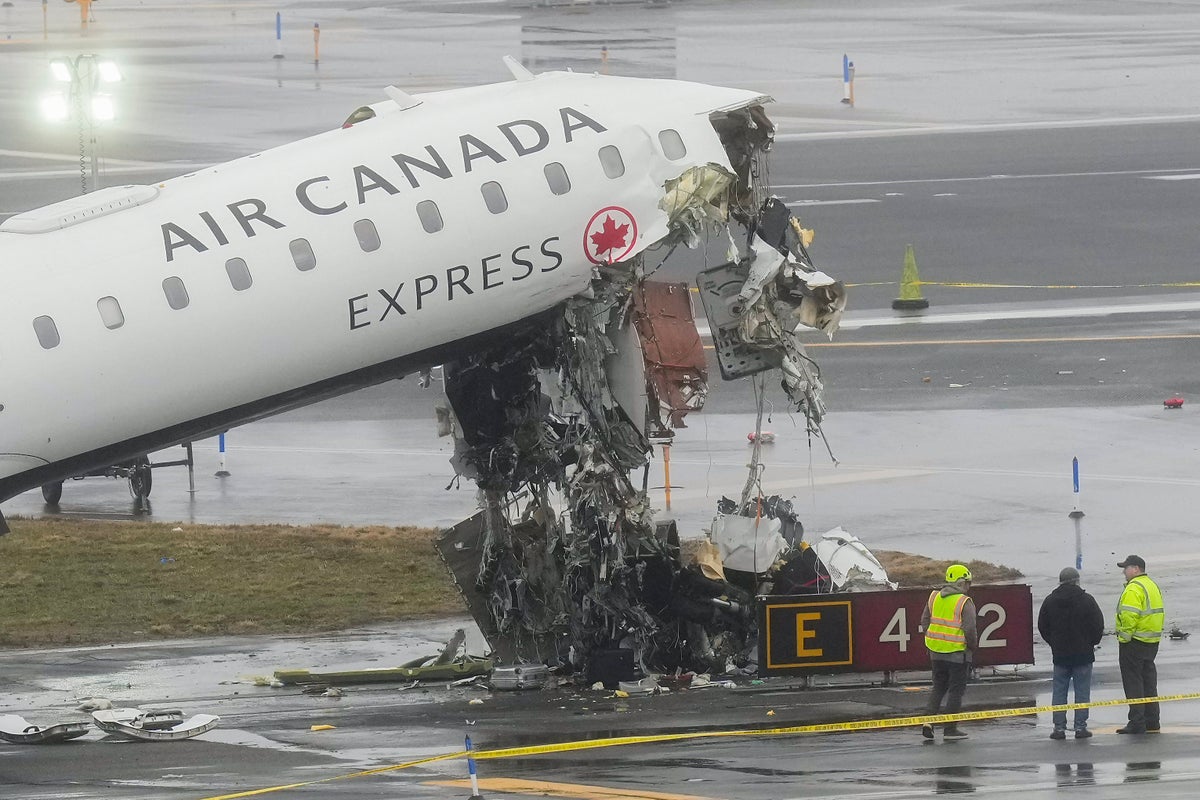
The air inside the Montreal terminal usually carries a specific, rhythmic hum. It is a polyglot symphony, a blurring of French and English that defines the very soul of Quebec. But on that Tuesday, the hum turned into a jagged, suffocating silence.
Michael stood by the gate, clutching a lukewarm coffee he’d forgotten to drink. He wasn’t a CEO. He wasn't a PR consultant or a crisis manager. He was a son waiting for a father who was currently being pulled from a smoking fuselage three hundred miles away. In moments of terror, we strip back the layers of our sophisticated, modern selves. We don’t reach for "synergy" or "robust logistical frameworks." We reach for the mother tongue. We reach for the words that tasted like home before we knew how to spell them. Don't forget to check out our recent post on this related article.
When the crash happened, the world stopped for families like Michael's. In those first, agonizing hours, every syllable uttered by the national carrier, Air Canada, felt like a lifeline. But what happens when the lifeline is tethered to a voice that doesn't speak your language? What happens when the person leading the company tasked with your safety admits, with a shrug of the shoulders, that he hasn't bothered to learn the words your grandmother uses to pray?
The Architecture of an Insult
It wasn't just a linguistic slip. It was a structural failure of empathy. To read more about the background here, Business Insider offers an excellent summary.
The CEO of Air Canada, a man whose name was synonymous with corporate efficiency, walked to a podium after the tragedy. He spoke. He used the practiced, polished English of a man who lives in the stratosphere of private jets and Davos meetings. When asked why he hadn't learned French—a language protected by law and cherished by the heart of his home base—his response wasn't an apology. It was a dismissal.
"I have a lot on my plate," he essentially said, though the words were dressed in more expensive suits.
The blow wasn't that he couldn't conjugate a verb. The blow was that he didn't care to. In the wake of a crash, where bodies were still being identified and the soil was still warm with jet fuel, this "lack of compassion" wasn't a PR gaffe. It was a revelation of the invisible wall between the boardroom and the ground.
Imagine Michael sitting there, the television flickering in the terminal. He hears the man in charge of the airline that just failed his father. He hears that man treat the culture of Quebec like a nuisance, an administrative box that didn't quite get checked. The language we speak isn't just a series of sounds. It is the vessel for our grief. To refuse to speak it in the moment of a community's greatest pain is to tell that community their pain is secondary to your schedule.
The Cost of Cold Facts
A corporation is often described as an entity. Legally, it's a person. But it has no pulse. It only mimics one through the leadership at the top. When that leadership disconnects from the cultural DNA of its customers, the entity begins to rot from the inside out.
The numbers were there. Air Canada is a global giant. It moves millions. It generates billions. But those billions are built on a social contract. We give them our money, and in exchange, they promise to see us as more than just "seat 14B." They promise to respect the tapestry of our lives.
There is a specific kind of arrogance that grows in the high-oxygen environment of executive suites. It’s the belief that the "hard" metrics—on-time departures, fuel hedging, quarterly dividends—are the only things that matter. But the "soft" metrics are the ones that keep people from burning your effigy in the streets of Montreal.
Compassion is a hard metric. It is the weight of a CEO’s words when the world is watching. It is the silent acknowledgment that your business exists only because people trust you with their lives. When that trust is broken by a mechanical failure, the only thing left to mend it is human connection. If you cannot speak the language of the people you have failed, you are not a leader. You are a bookkeeper.
The Fall of the Architect
The pressure didn't come from a single source. It wasn't just a angry tweet or a grumpy editorial in Le Devoir. It was a groundswell of realization. People across Canada—not just in Quebec—looked at the podium and saw a man who had forgotten the fundamental rule of service: You must meet the people where they are.
He stepped down.
The headlines called it a resignation. The street called it a reckoning. The board of directors realized that a CEO who is "too busy" to respect the culture of his headquarters is a CEO who is too busy to understand his own market.
Consider the hypothetical boardroom meeting that must have followed. The lawyers likely focused on the liability of the crash. The accountants focused on the stock price. But somewhere in that room, someone must have realized that the real liability was the silence. The silence of a man who had spent years in a city without ever listening to its heartbeat.
The departure was inevitable. You can survive a bad quarter. You can survive a technological glitch. You can even, with enough transparency and humility, survive the aftermath of a disaster. But you cannot survive the public's realization that you do not see them as human beings.
The Invisible Stakes of Communication
We often think of corporate communication as a series of press releases. We view it as a shield. But in truth, communication is a mirror. It reflects the values of the organization back to the world.
When the CEO spoke only English, he wasn't just choosing a language. He was choosing a side. He was signaling that the elite, English-speaking world of global commerce was his only true constituency. The families in the Saguenay, the shopkeepers in Quebec City, the students in Montreal—they were the "others." They were the consumers, not the community.
Language is the most intimate thing we own. It is how we whisper to our children and how we scream for help. To ignore it is to perform a kind of cultural erasure. In the context of a plane crash, that erasure feels like a second tragedy. It feels like the airline is saying, "We lost your loved ones, and we don't even know how to say 'I'm sorry' in a way you understand."
The Shadow at the Gate
Michael eventually got the call. His father was alive, but the recovery would be long. The physical scars would heal, but the psychological ones were deeper. For Michael, every time he sees the Air Canada logo now, he doesn't think of flights or vacations. He thinks of a man at a podium with a cold, dismissive look in his eyes.
He thinks of the silence.
The CEO is gone now. A new name will be etched onto the door. There will be promises of "renewed commitment to diversity" and "increased cultural sensitivity." There will be mandatory French classes for the executive suite. But the damage is a ghost that will haunt the terminals for years.
It serves as a reminder that the most important part of any business isn't the machine. It isn't the software. It isn't the route map. It is the fragile, invisible thread of empathy that connects one person to another. When that thread snaps, no amount of corporate jargon can tie it back together.
The lesson wasn't about French or English. It was about the difference between a boss and a leader. A boss manages systems. A leader carries the weight of his people's souls. When you forget that, you aren't just losing a job. You are losing the right to be heard.
Late at night, when the Montreal airport is at its quietest, you can still hear the voices. They are speaking in every tongue imaginable. They are laughing, crying, and saying goodbye. They are the heartbeat of the world. If you want to lead them, you have to do more than just fly over them. You have to listen.
The podium is empty now. The silence that follows is the only thing that actually makes sense.