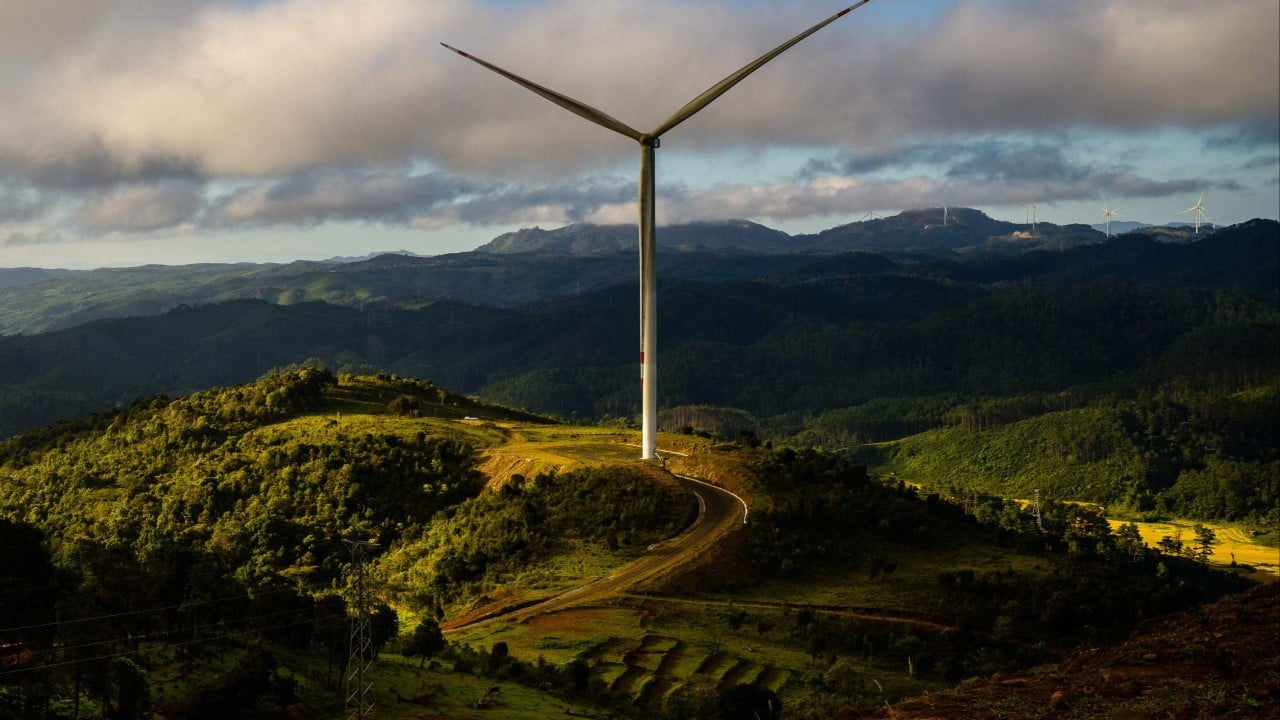
Every energy publication on the planet is currently running the same lazy victory lap. They look at a map of Southeast Asia, see massive turbine blades spinning over the Annamite Range, and applaud Laos for finally diversifying away from hydropower.
They call it a clean energy transition. They call it the birth of the "Battery of Southeast Asia."
They are wrong.
Building massive wind farms in a landlocked, debt-strapped country with a fragile transmission network is not a masterstroke of green engineering. It is an expensive infrastructure trap disguised as climate leadership. While mainstream analysts celebrate gigawatts on paper, the physical and financial reality on the ground tells a much darker story. Laos is not solving its energy crisis with wind. It is importing a grid-stability nightmare it cannot afford to manage.
The Myth of the "Battery of Southeast Asia"
To understand why the current hype around Lao wind energy is dangerously flawed, you first have to dismantle the premise of the country’s entire energy strategy.
For two decades, Vientiane has marketed itself as the "Battery of Southeast Asia." The pitch is simple: build massive power plants, export the electricity to energy-hungry neighbors like Thailand, Vietnam, and Singapore, and use the foreign currency to lift the nation out of poverty.
First, they tried it with mega-dams on the Mekong River. The result? Catastrophic ecological disruption, displaced communities, and a mountain of sovereign debt owed largely to Chinese state-owned banks. Worse, climate change arrived faster than the dam builders anticipated. Severe, recurring droughts turned multi-billion-dollar concrete turbines into expensive river ornaments during the dry season.
So, the consultants pivoted. If the rivers are drying up, look to the sky. Enter wind power—led by flagship projects like the 600-megawatt Monsoon Wind Power project in Sekong and Attapeu provinces.
The lazy consensus assumes that wind and hydro are natural partners. When the dry season hits and water levels drop, the wind blows harder. On a spreadsheet in a Singaporean investment bank, the seasonal curve looks poetic.
In the real world of high-voltage physics, spreadsheets do not keep the lights on.
Why Wind and Hydro Do Not Actually Balance Each Other
Let’s get technical, because this is where the PR brochures fall apart.
Hydropower is dispatchable generation. You open a gate, water hits a turbine, and you get predictable, controllable electricity on demand. It provides rotational inertia—heavy spinning metal masses that keep grid frequency locked at a steady 50 Hertz.
Wind is intermittent, non-synchronous generation. It blows when it wants, stops without warning, and connects to the grid through power electronics (inverters) that offer zero natural inertia.
When you dump hundreds of megawatts of variable wind power onto a weak transmission system, you introduce violent voltage fluctuations and frequency instability. In mature grids like Germany or Texas, operators spend billions on synchronous condensers, grid-scale battery storage, and automated demand-response systems just to stop wind farms from tripping the entire network offline.
Laos does not have those systems.
State utility Électricité du Laos (EDL) is already drowning in billions of dollars of debt—so much so that it had to hand over a majority stake in its high-voltage transmission grid to a Chinese-backed entity, Électricité du Laos Transmission Company (EDLT), just to keep the lights flickering.
Expecting a cash-strapped utility with aging substations to smoothly absorb erratic wind surges across mountainous terrain is pure fantasy.
The Cross-Border Transmission Mirage
Ask any project developer in Vientiane who is actually buying this wind power, and the answer exposes the real flaw in the business model.
Laos does not need the electricity. Its domestic industrial base is tiny. Almost every single megawatt from these flagship wind farms is earmarked for export, primarily via Power Purchase Agreements (PPAs) with Vietnam Electricity (EVN).
Here is the catch that rarely makes the headlines: you cannot export electrons through wires that do not exist.
Vietnam’s own national grid is notoriously congested. Over the past few years, Vietnam experienced a massive, chaotic boom in domestic solar and wind installations that completely overwhelmed its north-south transmission lines. Thousands of megawatts of clean energy inside Vietnam were forcibly curtailed—meaning wind turbines were shut down during peak winds because the grid simply couldn't carry the load.
Now, Laos is building massive wind farms right on the Vietnamese border, expecting EVN to seamlessly absorb that power and pay top dollar for it in US currency.
Imagine a scenario where a torrential monsoon hits the Annamite Range. The turbines in Laos spin at 100% capacity, generating maximum power. At the exact same moment, Vietnam’s domestic wind farms across the border are also hitting peak output, while heavy rain cools down Hanoi and Ho Chi Minh City, causing air-conditioning demand to plummet.
Where does the Lao electricity go? Nowhere. Either EVN curtails the imports, or the Lao grid chokes on excess power it has nowhere to store and no local factories to consume.
I have watched energy developers across emerging markets burn through hundreds of millions of dollars on "export-ready" generation assets, only to discover that cross-border grid synchronization takes a decade longer than pouring concrete for turbine foundations. Building generation before transmission is like buying a fleet of Ferraris before paving the roads.
Following the Money: Who Actually Wins?
If the grid math is shaky and the buyer’s transmission lines are clogged, why is capital still flooding into Lao wind projects?
Because in international project finance, risk is socialized while returns are privatized.
Look at the financing structures behind Southeast Asian renewable mega-projects. They are backed by multilateral development banks—institutions like the Asian Development Bank (ADB) and the Japan International Cooperation Agency (JICA)—alongside private regional conglomerates from Thailand and Hong Kong.
These deals are insulated by ironclad, "take-or-pay" style off-take agreements, sovereign guarantees, and political risk insurance. The developers and international lenders get guaranteed dollar-denominated returns protected by international arbitration treaties.
Meanwhile, the host nation assumes the long-term structural burden:
- Land degradation: Carving access roads for 80-meter turbine blades through pristine, unexploded-ordnance-contaminated mountain forests triggers severe soil erosion and landslides during monsoon rains.
- Stranded domestic infrastructure: Every dollar of institutional bandwidth spent facilitating foreign-owned export wind farms is a dollar not spent fixing local distribution losses inside Lao villages.
- Currency mismatch: While export projects earn US dollars, EDL collects domestic tariffs in the Lao Kip—a currency that has suffered catastrophic inflation and devaluation, making it nearly impossible for the state utility to buy power from independent producers for domestic use.
Laos is effectively leasing out its mountain ridges as an assembly line for foreign energy companies, capturing a sliver of royalties and tax revenue while taking on massive environmental and logistical headaches.
Dismantling the Common Myths Around Lao Renewables
When investors and policymakers defend this strategy, they rely on three tired talking points. Let’s break them down honestly.
"Isn't wind power cheaper than building new coal or gas plants?"
On a pure Levelized Cost of Electricity (LCOE) basis, yes. The marginal cost of wind is zero once the turbine is built. However, LCOE is the most abused metric in modern energy economics. It measures the cost of generating a megawatt-hour at the turbine base; it completely ignores the system-level cost of delivering that power reliably when the wind stops blowing. When you add the cost of backup firming capacity, grid upgrades, and curtailment losses, wind in a weak grid becomes vastly more expensive than the brochure claims.
"Doesn't this help Laos achieve energy independence?"
No. True energy independence means a country can power its own economy without relying on foreign capital, foreign operators, or foreign buyers. Most Lao wind farms are engineered in Europe, manufactured in China, financed in Bangkok and Manila, and wired directly to Vietnam. If the border interconnects are severed tomorrow, those turbines cannot even power the villages sitting directly beneath them because they aren't integrated into the local distribution network.
"What is the alternative? Should Laos just keep building destructive Mekong dams?"
This is a classic false dichotomy. Rejecting mega-wind farms does not mean returning to mega-dams. The real answer lies in scaling down, not scaling up.
The Contrarian Blueprint: What Laos Should Actually Do
To be fair, the allure of wind power for a landlocked nation with zero domestic fossil fuel reserves is completely understandable. Sitting on high-altitude wind corridors next to booming Asian economies looks like winning the geographic lottery.
But if Vientiane wants genuine wealth and grid resilience rather than another cycle of debt-fueled mega-projects, it needs to kill the export-wind obsession and pivot to three unconventional priorities.
1. Pivot from Mega-Wind to Distributed Floating Solar
Laos already possesses one massive, underutilized piece of infrastructure: thousands of square kilometers of flat reservoir surfaces behind its existing hydropower dams.
Instead of blasting new roads through untouched mountain forests to haul giant wind blades, Laos should deploy floating solar arrays directly onto existing dam reservoirs.
The engineering synergy here is real, not theoretical:
- Zero land acquisition: The reservoirs already exist.
- Existing grid connections: Every major dam already has high-voltage transmission lines wired directly into the national grid.
- Natural cooling: Water beneath the panels keeps solar cells cool, boosting photovoltaic efficiency by up to 10% compared to ground-mounted systems.
- Instant hydro-firmed output: The dam operator can throttle down water turbines during sunny afternoons—saving water in the reservoir—and ramp them back up the second clouds roll in.
It requires a fraction of the logistics, zero mountain deforestation, and solves the seasonal drought problem without introducing violent wind-induced frequency swings.
2. Stop Exporting Raw Electrons and Start Exporting Processed Value
Shipping raw electricity across borders via high-voltage cables is the lowest-margin business in the energy sector. You lose up to 10% of your product simply to electrical resistance along the wire, and you remain entirely at the mercy of a single neighboring buyer's grid constraints.
Instead of exporting megawatts to Vietnam, Laos should attract high-energy industrial off-takers to set up shop inside Laos, directly next to existing power generation hubs.
Green hydrogen production, aluminum smelting, or modular AI data centers cooled by mountain air can consume surplus seasonal power right at the source. You turn stranded, low-value electrons into high-value physical commodities or compute power that can be shipped globally, bypassing regional transmission bottlenecks entirely.
3. Fix the Grid Before Buying Another Megawatt of Generation
Before approving a single new independent power producer, Laos must enforce a strict moratorium on export-only generation until domestic grid losses are brought under control and local substations are modernized.
Adding more generation capacity to a broken distribution network is like pouring high-octane racing fuel into a car with a cracked engine block. Until EDL can reliably deliver power to its own citizens without bleeding cash on technical losses and currency mismatches, every new wind turbine is just window dressing for foreign investors.
The Verdict
The global energy press loves a clean narrative. A small, developing nation harnessing the mountain winds to power Southeast Asia makes for a great headline.
It is also a dangerous distraction.
Until Laos fixes its fractured transmission grid, solves its sovereign debt crisis, and stops building generation assets designed exclusively for congested foreign buyers, its wind energy boom will remain exactly what its hydropower boom became: an expensive monument to foreign capital built on the backs of local infrastructure. Stop applauding the megawatts being built, and start looking at the wires meant to carry them.