The wind in Tomioka does not sound like the wind anywhere else. It carries no laughter, no hum of distant traffic, no clatter of ceramic dishes from the kitchen windows. In the spring of 2011, a silence fell over this coastal stretch of Fukushima Prefecture so heavy it felt structural, like a physical wall built out of sudden absence.
When the earth buckled on March 11, and the sea rose to swallow the coast, the world watched the flashing red lights and the digital countdowns of a nuclear crisis unfolding in real time. We saw the maps shaded with concentric rings of exclusion. We read the staggering statistic: 150,000 people ordered to drop everything and run.
But statistics are cold. They smooth over the jagged edges of human panic. They omit the smell of burning wires, the taste of metallic ash on the tongue, and the sound of a front door slamming shut on a life that would never be reclaimed.
When an entire population flees in a matter of hours, they leave behind more than just houses. They leave a living, breathing ecosystem that has no concept of radiation, evacuation zones, or political borders.
Naoto Matsumura did not look like a hero destined for international headlines. He was a fifth-generation farmer, a man with calloused hands and a deep, unhurried connection to the soil of his ancestors. When the sirens wailed and the invisible cloud began to drift from the crippled Fukushima Daiichi plant, he initially joined the mass exodus. He sought refuge with relatives, then in evacuation centers.
He was turned away. The centers were overflowing, choked with the terrified and the displaced. In the chaos, a realization settled over him, quiet and absolute.
He went back.
The Reverse Migration
To understand what Matsumura walked back into, you have to strip away the clinical language of disaster management. Imagine a neighborhood where every single front door is unlocked. Cars sit idling in driveways until their fuel runs dry. The power grid is dead, plunging the nights into an ancient, terrifying darkness.
But it was not quiet. Not at first.
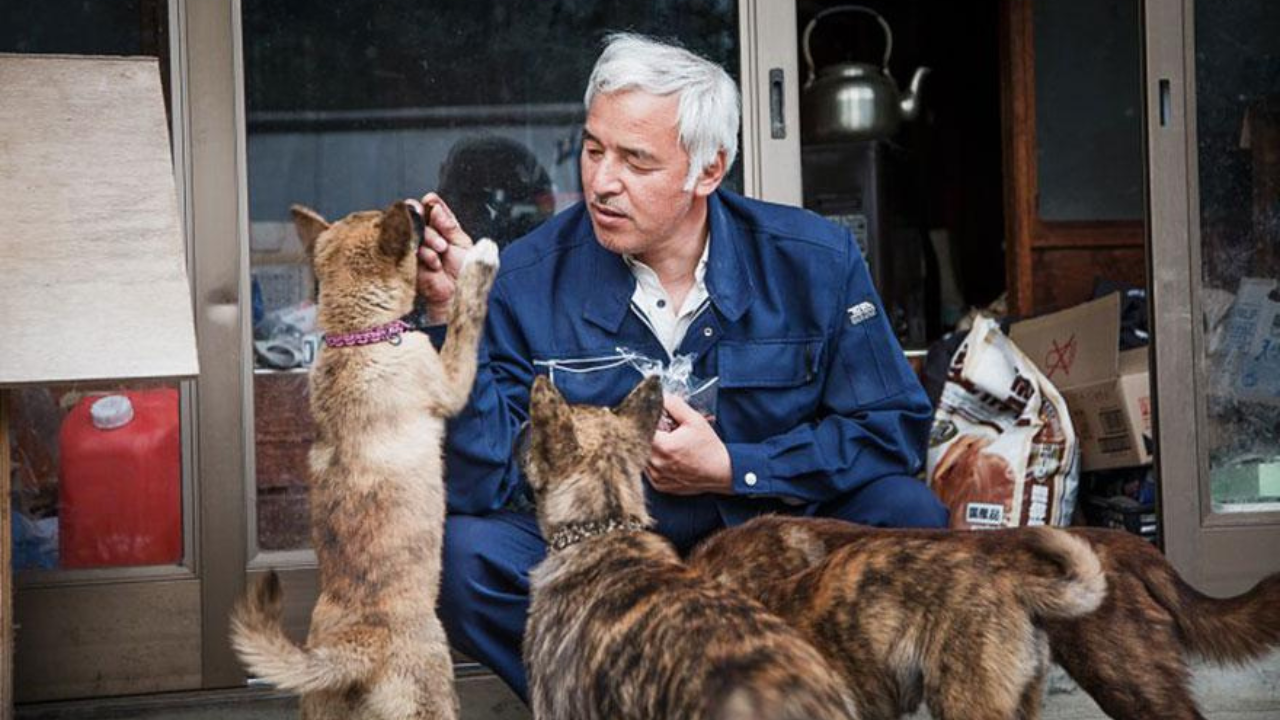
As Matsumura walked through the deserted streets of his hometown, a chorus of agony greeted him. Dogs chained to porches whined until their throats were raw. Cattle, locked securely in their barns to protect them from the initial earthquake, bellowed for water. Cats darted through the shadows, confused by the sudden disappearance of the hands that fed them.
The government saw a zone of containment. Matsumura saw a massive, slow-motion tragedy of neglect.
He had returned primarily to check on his own family’s local livestock, but the cries from the neighboring properties made it impossible to walk away. He began to snap the padlocks off barn doors. He unchained the dogs whose necks were chafed raw from pulling against their leashes.
It was an act of pure, stubborn defiance against a disaster that seemed too vast for any single human to combat.
Consider the sheer logistics of his rebellion. There was no running water. The local supermarkets were empty hulls, their shelves overturned. To keep hundreds of abandoned animals alive, Matsumura had to become a scavenger, a smuggler, and a caretaker all at once. He drove out of the exclusion zone to buy pet food and supplies with his own savings, navigating police checkpoints and the constant, invisible threat of contamination.
The Invisible Enemy
Radiation is a unique kind of terror because it bypasses the human sensory apparatus entirely. You cannot smell it. You cannot see it. You only know it is there because a small plastic device in your pocket clicks with frantic, irregular urgency.
Matsumura lived with that clicking every day. He chose to consume local water and food in the early days because there was simply no alternative if he wanted to stay. When researchers from Tokyo University eventually caught up with him years later, they conducted tests on his body. The results were staggering. He possessed the highest level of internal radiation exposure of any person tested in the country.
They told him he was walking a path toward severe illness.
His response was stripped of melodrama. He noted that he was already in his fifties, and by the time any radiation-induced sickness caught up with him, he would likely be dead of old age anyway. He chose to worry about the lives that needed him immediately, rather than the phantom cells mutating inside his own body.
Through his actions, the farmer exposed a deep, uncomfortable flaw in how we measure safety and success during a crisis. The official response was clinical, focused on boundaries, percentages, and long-term risk models. Matsumura’s response was immediate, visceral, and localized.
He became the guardian of the left-behind. He adopted an ostrich that had been abandoned by an local attraction. He fed pigs that had broken free from their pens and were roaming the radioactive scrubland. He kept hundreds of cattle alive long after the state had issued orders for them to be culled to prevent contaminated meat from entering the market.
To the authorities, these animals were hazardous waste with a heartbeat. To Matsumura, they were the last remaining threads of the home he refused to surrender.
The Weight of Absolute Solitude
It is easy to romanticize the lone protector, to paint him as a cinematic figure standing tall against the sky. The reality of life inside the zone was a grinding, exhausting test of mental endurance.
The nights were the hardest. Without the ambient glow of a functioning town, the darkness inside the exclusion zone was total. Matsumura would sit in his home, lit only by a solar-powered lantern or a candle, listening to the wind rattle the shutters of empty houses down the street.
There is a specific psychological weight to knowing you are the only human being for miles in any direction. Every shadow looks like an intruder; every strange sound amplified by the absolute absence of human white noise.
Yet, he stayed. Year after year.
He stayed when the initial global attention faded. He stayed when the journalists packed up their cameras and moved on to the next international crisis. He stayed because he realized that if he walked away, the silence would win completely.
The Soil and the Shadow
Eventually, the government began the agonizingly slow process of decontamination, scraping away centimeters of topsoil across thousands of acres, packing the radioactive dirt into millions of black plastic bags that lined the highways like modern, grim monuments to human error. Parts of Tomioka were eventually declared safe for return, but a town is not a collection of buildings. It is a social fabric. When that fabric is ripped apart for over a decade, you cannot simply stitch it back together with a declaration of safety.
Only a tiny fraction of the original population ever chose to return permanently. The young had built lives elsewhere; the old had passed away in temporary housing, their hearts broken by a decade of exile.
Matsumura remains a singular fixture in a landscape caught between a traumatic past and an uncertain future. He did not save the world. He did not fix the reactors. He did not convince the authorities to change their core protocols.
What he did was much smaller, and perhaps much more profound. He provided a witness. He ensured that in the darkest hour of a modern catastrophe, compassion was not entirely evacuated from the map.
The black plastic bags still sit in fields across Fukushima, slowly being overtaken by weeds. The reactors are still being decommissioned in a process that will take generations. But in one small corner of the zone, there is the sound of grain falling into a trough, the low bark of a dog that lived to see another sunrise, and the heavy, steady footsteps of a man who refused to let the silence have the last word.