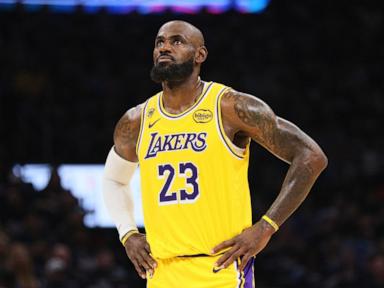
The sports media machine is predictably losing its mind over the narrative that LeBron James leaving the Los Angeles Lakers is a legacy-defining basketball move. The talking heads are projecting championship windows, analyzing salary cap mechanics, and drawing up hypothetical depth charts for whatever contender they think is one 40-year-old away from a ring.
They are looking at the wrong chessboard.
This is not a basketball decision. It never was. To analyze LeBron’s career moves through the narrow lens of regular-season wins and Larry O'Brien trophies is to fundamentally misunderstand the modern intersection of sports entertainment, equity, and corporate branding.
I have spent decades analyzing front-office operations and athlete-brand mechanics. If there is one thing I have learned watching the evolution of the modern superstar, it is that the lazy consensus always defaults to the romanticized narrative of "the pursuit of winning."
The truth is much colder, much more calculated, and infinitely more fascinating. LeBron James isn’t chasing another ring. He is maximizing the final liquidation phase of his active player enterprise value.
The Flawed Premise of the "Championship Chase"
The dominant media narrative insists that LeBron is exiting Los Angeles because the Lakers' roster construction cannot support another deep playoff run. The punditry points to the loaded Western Conference, the team's luxury tax constraints, and the aging core as definitive proof that moving elsewhere is the only logical path to a fifth championship.
Let’s dismantle that premise entirely.
First, any franchise with the immediate cap space or asset flexibility to absorb a maximum contract for an aging superstar is, by definition, structurally flawed. You do not get $50 million in cap room by being a ready-made championship contender. You get it by being young, rebuilding, or poorly managed.
Imagine a scenario where a historic franchise strips its entire depth to accommodate a massive contract, leaving a top-heavy roster vulnerable to the slightest injury bug. We have seen this film before. The assumption that moving to a new market magically cures the realities of the NBA’s collective bargaining agreement is a fantasy. The new second-apron tax rules punish top-heavy teams with brutal severity. If you leave a flawed roster, you are almost certainly landing on another one.
Second, the on-court production of a player entering their 24th month of near-forty status cannot be the engine of a true contender. The physical toll is undeniable. While the box score numbers remain historically anomalous, the defensive regression and late-game fatigue are measurable realities. Citing his raw per-game statistics without factoring in the defensive transition metrics is malpractice.
The Real Capital: From Content Creation to Equity
So, why leave Los Angeles if it isn’t about a guaranteed ring? Because the geographic utility of Southern California has already been fully extracted.
When LeBron signed with the Lakers, the objective was clear: institutionalize SpringHill Company, embed deep into the Hollywood production ecosystem, and secure a foothold in the entertainment capital of the world. That mission is accomplished. The production deals are locked. The network is built.
The next phase of the James enterprise requires an entirely different macroeconomic environment. It requires the leverage of an unvarnished, desperate market willing to grant concessions that the Buss family—whose entire net worth is tied up in the Lakers franchise—simply cannot afford.
The Fractional Ownership Play
The real game is the pursuit of an NBA expansion franchise, specifically the heavily rumored Las Vegas market. The NBA’s current rules strictly prohibit active players from owning stakes in franchises. However, the precedent for deferred compensation, shadow equity, and post-retirement ownership options is being rewritten behind closed doors.
- The Blueprint: Look at how David Beckham negotiated his MLS entry via the LA Galaxy contract, which included a fixed-rate option for an expansion franchise (which became Inter Miami).
- The Reality: A move to a new market isn't about the jersey; it is about the behind-the-scenes covenants with billionaire ownership groups who can facilitate the transition from player to majority governor.
The Lakers are a legacy family business. They do not have the corporate liquidity or the desire to carve out pieces of the franchise or hand over the keys to a parallel business empire. By taking his talents to an ownership group backed by massive private equity or sovereign wealth, James positions himself as the operational face of a future sports conglomerate.
Dismantling the "People Also Ask" Delusions
The public discourse surrounding this move is filled with assumptions that need to be aggressively corrected.
"Will his legacy suffer if he doesn't win another ring elsewhere?"
This question assumes the public evaluates legacy purely on a binary championship scale. It’s an outdated Jordan-era metric. LeBron’s legacy has shifted from being the "Chosen One" to the "Architect." He has already secured the all-time scoring record. He has won championships with three different franchises. His legacy is entirely insulated from on-court failure at this stage. A bad season in a new uniform does not erase two decades of dominance; it merely becomes a footnote to a much larger corporate transition.
"Can a team build a sustainable contender around him today?"
Absolutely not. If a front office believes they can construct a championship-level defense while hiding a high-usage player who must conserve energy for the offensive end, they are living in 2016. Any team acquiring him is doing so for the business surge: guaranteed sellouts, prime-time television inventory, elevated merchandise sales, and immediate brand relevance. It is a corporate bailout disguised as a basketball trade.
The Risk the Contrarian Admits
To be fair, this strategy carries a brutal downside. By prioritizing the corporate and equity play over stable basketball continuity, James risks a deeply unceremonious end to his playing career.
He could easily spend his final seasons playing meaningless basketball for a mediocre team in an inferior market, watching the playoffs from a yacht while young, athletic teams run circles around his squad. The aesthetic of greatness will be compromised. For the basketball purist, watching an icon grind out 32-lineup variations just to secure a ninth seed is agonizing.
But that is the cost of doing business when you are no longer just an athlete.
The sports media will keep tracking private jets, analyzing trade exceptions, and cooking up fake scenarios about building a contender. Let them chase the ghosts. The real move is happening in the boardroom, where the jersey color doesn't matter, and the only metric that counts is the valuation of the next expansion fee.
Stop looking at the box score. Start looking at the capitalization table.