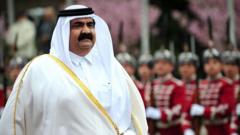
The passing of Qatar's Father Amir, Sheikh Hamad bin Khalifa Al Thani, at age 74 marks the end of an era for the Middle East. The Amiri Diwan announced his death on July 12, 2026, triggering four days of national mourning. Most news outlets will run standard obituaries detailing his dates of birth, rule, and death. They miss the bigger picture. You can't understand modern global diplomacy, media influence, or sports investments without analyzing what this one man built from a tiny desert peninsula.
He took over a quiet Gulf state in 1995 and left it as a diplomatic heavyweight. His actions completely rewrote how small nations project power globally. For a different look, consider: this related article.
The Palace Coup That Changed Everything
In the summer of 1995, Sheikh Hamad executed a bloodless coup while his father, Sheikh Khalifa, was vacationing in Switzerland. It wasn't a standard power grab. It was a calculated move driven by a completely different vision for Qatar's future. At the time, the country had a population of only about 300,000 citizens and sat on vast, mostly unexploited natural gas reserves.
Instead of maintaining the quiet, inward-looking status quo of his father, Sheikh Hamad chose aggressive modernization. He invested billions into liquefied natural gas (LNG) infrastructure. He bet that the world would need cleaner energy, and he won big. Today, Qatar is the world's top LNG exporter. This massive wealth gave him the leverage to build a highly independent foreign policy that often infuriated his neighbors. Similar coverage on this matter has been provided by The New York Times.
He didn't just want money. He wanted absolute security through international relevance.
Building Al Jazeera and Irritating Washington
One of Sheikh Hamad’s first major moves after taking power was funding the launch of the Al Jazeera satellite news network in 1996. It’s hard to overstate how disruptive this was. In a region used to heavily censored, state-run media, Al Jazeera provided raw, aggressive coverage of Middle Eastern politics.
Sheikh Hamad's Power Projection Strategy:
[LNG Wealth] ──> [Global Infrastructure & Media] ──> [Strategic Relevance] ──> [National Security]
It quickly angered other Arab leaders, occasionally leading to severed diplomatic relations. It also riled up the United States. When Al Jazeera aired broadcast messages from al-Qaida leadership after the September 11 attacks, Washington demanded changes. Yet, at the exact same time, Sheikh Hamad allowed the US military to build the massive Al Udeid Air Base on Qatari soil. This became a vital logistical hub for American operations in Iraq and Afghanistan.
This duality defined his rule. He could host the US military while simultaneously funding a media network that criticized Western foreign policy. He built relationships with everyone.
Why His Independent Foreign Policy Angered the Gulf
Sheikh Hamad believed that being friends only with traditional Western allies wasn't enough to protect a small nation positioned between regional giants like Saudi Arabia and Iran. He practiced a form of hyper-diplomacy that brought everyone to Doha.
Under his leadership, Qatar established deep economic ties with Shiite-majority Iran, with whom it shares the massive North Dome gas field. He opened channels with Hamas, hosted leaders of the Muslim Brotherhood, and acted as a mediator in conflicts stretching from Lebanon to Afghanistan.
| Year | Key Diplomatic / Cultural Milestone Under Sheikh Hamad |
|---|---|
| 1996 | Founded Al Jazeera, breaking the state monopoly on Arab media |
| 2004 | Adopted Qatar’s first permanent constitution, granting women voting rights |
| 2006 | Hosted the Doha Asian Games, initiating the nation's massive sports push |
| 2008 | Brokered the Doha Agreement, preventing a full-scale civil war in Lebanon |
| 2010 | Won the controversial bid to host the 2022 FIFA World Cup |
This approach made Qatar indispensable, but it also sowed the seeds for long-term tension. Neighbors like Saudi Arabia and the United Arab Emirates viewed Qatar’s independent ties as a direct threat to regional stability, a friction that eventually bubbled over into the years-long blockade of Qatar years later.
Breaking Regional Tradition by Stepping Down
In 2013, Sheikh Hamad stunned the Arab world by voluntarily abdicating the throne. He handed absolute power to his 33-year-old son, Sheikh Tamim bin Hamad Al Thani.
In a region where rulers almost always stay in power until they die or get overthrown, this voluntary transfer was virtually unheard of. Rumors about his failing health circulated for years—he even required emergency surgery in Switzerland in 2015 after breaking his leg—but the transition was highly strategic. It allowed Qatar to position a young, dynamic leader at the helm right as the region faced the unpredictable fallout of the Arab Spring.
Even in retirement, his presence lingered. When he attended the opening match of the 2022 FIFA World Cup in Doha, the local crowd gave him a thunderous ovation. They knew the tournament wouldn't have happened without his initial financial and political push.
Mapping Out the Real Implications of His Passing
For international observers and investors keeping tabs on the Middle East, this moment requires looking beyond the mourning period. Sheikh Tamim has been firmly in control since 2013, meaning there won't be an immediate shift in Qatari domestic or foreign policy. The structures established by the Father Amir remain rock-solid.
If you are tracking geopolitical risks or energy markets in the region, watch how Qatar navigates its relationships over the coming months. The nation will likely use this period of high-profile international condolences to reinforce its role as a diplomatic mediator in ongoing Middle Eastern conflicts. Keep a close eye on state investment patterns via the Qatar Investment Authority; the focus remains heavily on global infrastructure, high-end real estate, and sports assets, preserving the exact model of international relevance that Sheikh Hamad designed decades ago.